About Me

Ithaca, New York
MWF, now officially 42, loves long walks on the beach and laughing with friends ... oh, wait. By day, I'm a mid-level university administrator reluctant to be more specific on a public forum. Nights and weekends, though, I'm a homebody with strong nerdist leanings. I'm never happier than when I'm chatting around the fire, playing board games, cooking up some pasta, and/or road-tripping with my family and friends. I studied psychology and then labor economics in school, and I work in higher education. From time to time I get smug, obsessive, or just plain boring about some combination of these topics, especially when inequality, parenting, or consumer culture are involved. You have been warned.
Showing posts with label religion. Show all posts

Friday, August 10, 2012

#70: Under the Banner of Heaven

Under the Banner of Heaven: A Story of Violent Faith
by Jon Krakauer
(New York: Doubleday, 2003)
 Summary:
"Jon Krakauer's literary reputation rests on insightful chronicles of lives conducted at the outer limits. In Under the Banner of Heaven, he shifts his focus from extremes of physical adventure to extremes of religious belief within our own borders. At the core of his book is an appalling double murder committed by a pair of Mormon Fundamentalist brothers, Ron and Dan Lafferty, who insist they received a revelation from God commanding them to kill their blameless victims. Beginning with a meticulously researched account of this crime, Krakauer constructs a multilayered, bone-chilling narrative of messianic delusion, savage violence, and unyielding faith. In the process, he uncovers a shadowy offshoot of America's fastest-growing religion, analyzes the abduction of fourteen-year-old Elizabeth Smart (and her forced 'marriage' to her polygamous kidnapper), and raises provocative questions about the nature of religious belief.

"Krakauer takes readers inside isolated communities in the American West, Canada, and Mexico, where some forty thousand Mormon Fundamentalists believe that the mainstream Mormon Church went unforgivably astray when it renounced polygamy. Defying both civil authorities and the Mormon establishment in Salt Lake City, the leaders of these outlaw sects are zealots who answer only to God. Marrying prodigiously and with virtual impunity (the leader of the largest fundamentalist church took seventy-five 'plural wives,' several of whom were wed to him when they were fourteen or fifteen and he was in his eighties), fundamendalist prophets exercise absolute control over the lives of their followers and preach that any day now this world will be swept clean in a hurricane of fire, sparing only their most obedient adherents.

"Weaving the story of the Lafferty brothers and their fantastical brethren with a clear-eyed look at Mormonism's violent past, Krakauer examines the underbelly of the United States' most successful homegrown faith and finds a distinctly American brand of religious extremism. The result is vintage Krakauer, an utterly compelling work of nonfiction that illuminates an otherwise confounding realm of human behavior."

Opening Line:
"Almost everyone in Utah County has heard of the Lafferty boys."


My Take:
I'll give Krakauer credit, and assume that much of what he describes was more shocking when he first published his book 9 years ago, before so many similar news and fiction accounts have been aired. That said, it's a good book and I still like his work, but would have liked him to have focused more on contemporary Mormon Fundamentalism and less on the history of Mormonism. I know his point is that the faith's violent past somehow leads to the fundamentalist horrors that bubble up now and again, but he doesn't sufficiently convince the reader how Mormonism is different in this regard from, oh, Judaism or Christianity -- both of which have plenty of violence in their own histories. Is it just because Mormonism is more hierarchical and values absolute obedience more highly? Or is there something else? A decent read, but again, the history seemed a bit too Wild West for my liking without a clear explanation of how it got us (or Mormon Fundamentalists, anyway) where we (they) are now.
 

Monday, July 9, 2012

#52: When She Woke

When She Woke, by Hillary Jordan (Chapel Hill, NC: Algonquin Books of Chapel Hill, 2011)
 
Summary:
"From the author whose international bestseller, Mudbound, so hauntingly re-created America’s past comes a stunning creation of America in the near future, where faith, love, and sexuality have fallen prey to politics.

"Hannah Payne’s life has been devoted to church and family, but after her arrest, she awakens to a nightmare: she is lying on a table in a bare room, covered only by a paper gown, and cameras are broadcasting her every move to millions at home, for home observing new Chromes criminals whose skin color has been genetically altered to match the class of their crime is a new and sinister form of entertainment. Hannah is a Red; her crime is murder. The victim, says the state of Texas, was her unborn child, and Hannah is determined to protect the identity of the fathera public figure with whom she’s shared a fierce and forbidden love.

"When She Woke is a stunning story about a stigmatized woman struggling to navigate an America of a not-too-distant future, where the line between church and state has been eradicated and convicted felons are released back into the population after being 'chromed.' In seeking a path to safety in an alien and hostile world, Hannah unknowingly embarks on a path of self-discovery that forces her to question the values she has held true and the righteousness of a country that politicizes the personal."

Opening Lines: 
"When she woke, she was red. Not flushed, not sunburned, but the solid, declarative red of a stop sign."

My Take:
Spectacular, contemporary/ dystopian reimagining of The Scarlet Letter.

Wednesday, April 4, 2012

#25: Caleb's Crossing

Caleb's Crossing, by Geraldine Brooks (New York: Viking, 2011)

Summary:
In her new novel, Caleb's Crossing, Geraldine Brooks once again takes a shard of little-known history and brings it vividly to life. In 1665, a young man from Martha's Vineyard becomes the first Native American graduate of Harvard College. From the few facts that survive of this extraordinary life, Brooks creates a luminous tale of passion and belief, magic and adventure.

"The voice of Caleb's Crossing belongs to Bethia Mayfield, growing up in the tiny island settlement of Great Harbor amid a small band of pioneering English Puritans. Possessed of a restless spirit and a curious mind, Bethia slips the bonds of her rigid society to explore the island's glistening beaches and observe its native inhabitants. At twelve, she meets Caleb, the young son of a chieftain, and the two forge a secret bond that draws each into the alien world of the other.

"Bethia's father is Great Harbor's minister, who feels called to convert the Wampanoag to his own strict Calvinism. He awakens the wrath of the medicine men, against whose magic he must test his faith in a high-stakes battle that may cost his life and his very soul. Caleb becomes a prize in this contest between old ways and new, eventually taking his place at Harvard, studying Latin and Greek alongside the sons of the colonial elite. Bethia also finds herself in Cambridge at the behest of her imperious older brother. As she fights for a voice in a society that requires her silence, she also becomes entangled in Caleb's struggle to navigate the intellectual and cultural shoals that divide their two cultures.

"What becomes of these characters -- the triumphs and turmoil they endure in embracing their new destinies -- is the subject of this riveting and intensely observed novel. Like Brooks's beloved narrator Anna in Year of Wonders, Bethia provides an emotionally irresistible guide to the wilds of Martha's Vineyard and to the intimate spaces of the human heart. The narrative travels from the sparkling harbors of Martha's Vineyard to the mean, drafty dormitories of early Harvard and, as ever, Brooks buttresses her richly imagined fiction with the fascinating and meticulously researched detail that has brought her legions of readers and a Pulitzer Prize."

Opening Lines:
"He is coming on the Lord's Day. Though my father has not seen fit to give me the news, I have the whole of it."

My Take:
Enjoyed it, but not as much as I did People of the Book or Year of Wonders. This may be in large part because the pre-Colonial/ Colonial/ Revolutionary periods just aren't my favorites where historical fiction is concerned. Part of it, though, was that I was a bit frustrated at not seeing and learning more of Caleb's life firsthand. On one hand, the book's supposed to be about him (at least, so I was led to believe by the jacket), but on the other, Bethia narrates it, and once their closeness wanes, we see only the scraps of his life here and there that she learns about. The quasi-epilogue of an ending was also less than satisfactory, as I didn't feel we'd seen enough of Bethia's life between the end of the main narrative and her old age (and presumably imminent death). Again, still a solid read that I'd recommend, but (in my opinion, anyway) not quite up to the level of the other Brooks novels I've read.

Tuesday, August 23, 2011

#61: The Pillars of the Earth

The Pillars of the Earth, by Ken Follett (New York: New American Library, 1989).

Summary:
"Set in the turbulent times of twelfth-century England when civil war, famine, religious strife and battles over royal succession tore lives and families apart, The Pillars of the Earth tells the story of the building of a magnificent cathedral.

"Against this richly imagined backdrop, filled with intrigue and treachery, Ken Follett draws the reader irresistibly into a wonderful epic of family drama, violent conflict, and unswerving ambition. From humble stonemason to imperious monarch, the dreams, labours and loves of his characters come vividly to life. The Pillars of the Earth is, without a doubt, a masterpiece -- and has proved to be one of the most popular books of our time." -from the back cover of my paperback copy

"Set during the reign of King Stephen and the Anarchy, The Pillars of the Earth hangs a rich and intricately woven tapestry of intrigue and conspiracy over a solid foundation of historical events to explore topics as diverse as medieval architecture, civil war, secular/ religious conflicts, and shifting political loyalties.

"Principal characters include Tom Builder, a stonemason; Philip, Prior of Kingsbridge; and Archdeadon Waleran Bigod. The historical King Stephen is variously abetted and attacked by characters both real and fictional, including his cousin and rival Empress Maud; Sir Percy Hamleigh and his son William Hamleigh; the prior Earl of Shiring Bartholomew's daughter Aliena and son Richard; and Ellen with her son Jack." -from Wikipedia


Opening Line:
"The small boys came early to the hanging."

My Take:
This was the second of three books I took with me on vacation, and the last one I actually read. (Anna Karenina will just have to wait, which seems to be its fate; it still has a bookmark in it from a White Mountains resort, so this clearly isn't the first trip from which it's come home unread.)

Wow. Another sweeping, engaging saga that I got way more into than I'd expected to. I mean, really -- who expects to get totally absorbed in a story about the building of a cathedral in medieval England? Darn it, though, if Follett doesn't make the characters just complicated enough to both compel you on to find out what happens to them next, and keep you guessing. Prior Philip, head of the Kingsbridge monastery where the cathedral is to be built, was a pleasant surprise, character-wise -- probably the most interesting literary cleric I've come across. (Sorry, Father Ralph de Bricassart.) In the introduction, Follett calls him his only cheerfully celibate character, but he's a long way from being saintly; while he may not mind the whole lack of sex thing, he does tend toward both rigidity (who, me? Punny?) and pride. Tom Builder is likewise a good character (fascinating how the author makes a twelfth-century mason seem accessible to twenty-first-century readers by establishing, in the first chapter, that his first wife, Agnes, is his soul mate, and that he truly cherishes not just her but their children), and deposed earl's daughter cum wool merchant Aliena (it's a long road, but hey, it's a long book), forgive the anachronism, Rocks. Out.

Follett's even gone and created one of the most despicable, love-to-hate-him villains I've seen in a while: William Hamleigh, son of the nobleman who insinuates himself into the earldom after King Stephen takes it away from Aliena's father, Bartholomew. A brutish, violent bully who's secretly terrified of the priests and his hideous mother (apparently the miniseries, which I haven't yet seen, hints at some incest here -- ew!), and can get aroused only when he's beating the woman unlucky enough to be in his company, William's definitely an exception to the nuanced-character comment above, but it's still so much fun to despise him and to wait for his inevitable comeuppance.

Full disclosure: I'm neither a builder nor an architect, and some of these details didn't really interest me much. I was happy enough to read about the revelations that come to Jack when he travels through France and Spain in search of a) his mysterious, dead father's past, and/or b) peace from his tortured, seemingly impossible love for Aliena, and sees how differently these places have approached cathedral architecture. And the build-a-defensive-wall-in-a-hurry scenes, well, those were as much adventures (with a hint of the Redwall series I used to read with Twig when she was younger) as they were about building. But some of the more nitty-gritty, how this part gets done passages read, well, like a homebuilders' manual, and I found myself skimming over them to see what happened next. Fortunately, I managed not to miss any important plot developments this way (I think).

All right, an overdue post meets an overdue bedtime. More soon.

Tuesday, May 10, 2011

#37: The Lonely Polygamist

The Lonely Polygamist, by Brady Udall (New York: W.W. Norton, 2010).

Summary:
"Golden Richards, husband to four wives, father to twenty-eight children, is having the mother of all midlife crises. His construction business is failing; his family has grown into an overpopulated mini-dukedom beset with insurrection and rivalry; and he is done in with grief: due to the accidental death of a daughter and the stillbirth of a son, he has come to doubt the capacity of his own heart. Brady Udall, one of our finest fiction writers, tells a tragicomic story of a deeply faithful man who, crippled by grief and the demands of work and family, becomes entangled in an affair that threatens to destroy his family's future. Udall's characters engage us to the fullest as they grapple with the nature of need, love, and belonging. Beautifully written, keenly observed, and ultimately redemptive, The Lonely Polygamist is an unforgettable story of an American family -- with its inevitable dysfunctionality, heartbreak, and comedy -- pushed to its outer limits."


Opening Line:
"To put it as simply as possible: This is the story of a polygamist who has an affair."

My Take:
The Big Love comparisons are inevitable: Our hero, a decent and surprisingly gentle guy who just happens to have four wives, is down to his last nerve, what with his wives always at him for something and all those darned kids running around underfoot. Even his name evokes Bill Richardson's.

And so far, that's about where the similarities end. I don't know enough about FLDS polygamists to know if this story is an accurate portrayal, but it definitely makes the HBO series seem like the Disney-fied (well, plus the sex) version. Here, the kids are constantly clamoring for a scrap of Dad's attention, ever vigilant lest someone else get a stick of gum they miss out on. Wife #1, Beverly, gets a new couch, and a mutiny almost results when the old one is passed on to Big House for #2 and #3 to enjoy. There's never a bathroom free when you need one, and Beverly is appalled when an 11 year old boy (not her own son) is caught trying on his older sisters' underwear -- not because he finds it exciting, but because he himself has never had any underthings that are brand new and not stretched out. And Golden's construction business? This is no HomePlus where he owns a successful mega-store or 3 and gets to go home for dinner with the fam every night; you see, business has been poor these last few years, and he's been forced to work 250 miles away to make ends meet, living in a Spartan trailer, coming home only on weekends ... and building, of all things, an expansion for a brothel (which his wives don't know about, though everyone else in his circle seems to have figured it out).

(later, 5/16/11) I don't often say this any more, but I'm glad I stuck this one out. The characters and plot lines manage to at once be so over-the-top that they're simultaneously funny and repellent (um, 4 wives and 28 kids?) ... and yet very real, as if the Richardsons' trials are just like everyone else's, but more so. I couldn't decide till fairly late in the game whether I liked Golden's character or not, but I managed to feel a bit sorry for him anyway. And my heart just broke for both Rusty, the aforementioned 11-year-old coveter of his sister's new underwear, and Trish, the pretty but isolated and grief-stricken fourth wife. It takes a while for the story line to really get going, but once it did, I couldn't put the book down. Satisfying conclusion, if just a wee bit too neatly wrapped up. Definitely worth a read.

Sunday, June 13, 2010

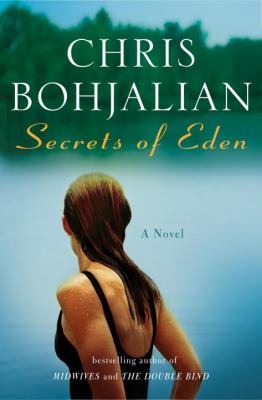
#45 - Secrets of Eden

Yesterday -- only a day overdue! -- I finished Secrets of Eden (New York: Shaye Areheart Books, 2010).

Jacket summary: "'There,' says Alice Hayward to Reverend Stephen Drew, just after her baptism, and just before going home to the husband who will kill her that evening and then shoot himself. Drew, tortured by the cryptic finality of that short utterance, finds his faith in God slipping away and is saved from despair only by a meeting with Heather Laurent, the author of wildly successful, inspirational books about .. angels.

"Heather survived a childhood that culminated in her own parents' murder-suicide, so she identifies deeply with Alice's daughter, Katie, offering herself as a mentor for the girl and a shoulder for Stephen -- who flees the pulpit to be with Heather and see if there is anything to be salvaged from the spiritual wreckage around him.

"But then the state's attorney begins to suspect that Alice's husband may not have killed himself ... and finds out that Alice had secrets only her minister knew."


Opening line: "As a minister I rarely found the entirety of a Sunday service depressing."

My take: Initially, I felt like I was reading the much-revised final version of a story that started out as The Law of Similars. I got over it -- Secrets ultimately proved to be a stronger book -- but it nonetheless had its flaws, and is a long way from being as compelling as Midwives or The Double Bind.

Set in contemporary, bucolic Haverhill, Vermont, Secrets of Eden is narrated in turn by four different characters: Stephen Drew, the (so it seems) unusually bereaved and guilty pastor who baptized Alice only hours before her death; state attorney Catherine Benincasa, whose storybook family life contrasts dramatically with the horrors she sees in her work, and who becomes suspicious of Drew almost immediately; Heather Laurent, rock star author whose hippie-dippie, New Age-y beliefs about angels stem from a pivotal moment in her own tragic childhood; and Katie, the Haywards' now-orphaned 15-year-old daughter and all-around Good Kid, whose future the others can only begin to imagine.

You just know when you start a book like this that there's going to be a twist at the end. There is, of course, and I'm a bit disappointed in myself for not guessing correctly what it would be. We do learn, fairly early on, that whether or not it resembles Eden, there are secrets aplenty in Haverhill. Alice's diary is found, and its easily-deciphered code reveals that Stephen was her lover as well as her pastor. Crime scene analysis (I'll spare you the grisly details, which seemed a bit over the top to me) suggests that while George Hayward may have killed Alice, he probably didn't shoot himself. And Stephen, whose faith was faltering even before Alice's murder, feels called to leave his pulpit and Haverhill ... only to arrive in New York City on Heather's doorstep. Understandably, this starts to look a little suspicious.

Perhaps the book would have been more compelling had the narrators been introduced in a different order. Other reviewers have complained that Stephen is unlikeable, and while I don't disagree, I think the bigger problem is that he's just not very interesting. This is too bad, as the introductory chapter -- in which he ponders his growing irritation with the (in his words) whiny concerns his church members bring forward for prayer each Sunday -- has some promise; suggesting a disillusionment with the ministry that's at once funny and sad. Likewise, Catherine Benincasa, the second narrator, just doesn't seem to fit into the story all that well. Sure, I understand her role as the state's attorney, but we see very little of her actually interacting with Stephen, Katie, or any of the other principals. It's as though Bohjalian dropped her in to provide explanations, forgetting that it's always more interesting to be shown than to be told.

Heather's narrative is more solid, and the character more likeable, than the previous two, but as with Law of Similars, it's hard to understand how she and Stephen become romantically involved. Given that she herself was orphaned by her own parents' murder-suicide, after witnessing years of their abuse, her empathy for Katie makes sense, but I think we'd have had a better story had the author not needed to shoehorn this whirlwind love affair between troubled souls in there.

Katie's section seemed to me the strongest of the four, probably because Bohjalian succeeds in capturing the minutae that make an adolescent character believable: her awkwardness about imposing on her best friend's family, who take her in after her parents die; her bemused observation about teachers giving her a free pass; her complicated views and feelings about her parents' marriage. Unfortunately, the skillful way in which she's rendered doesn't manage to give us a deeper understanding of her parents, or even get to know Heather and Stephen more thoroughly. In the end, it's only mildly interesting to find out what really happened, and only Katie we can bring ourselves to care or wonder about once the book ends.

Wednesday, March 10, 2010

#15 - Brideshead Revisited

All right, true confession time. The (for me) slower-than-usual pace of book bloggage this year probably has something to do with my being gainfully re-employed, true -- but only something. A large part, I fear, is this quixotic goal I ran up the flagpole, once upon early January, about using my speed-reading prowess for good and reading The Classics this year.

Well, gentle friends, it ain't gonna happen. Not as I'd imagined it, anyway. There's still plenty of literature that's, er, stood the test of time, and I do still plan to spend at least some of my time seeking it out in the library's wayback stacks, instead of just being led astray by all the new fiction I have to pass to get there (and yes, these are the bibliophile's equivalent of candy in the checkout line at the supermarket). But sometimes, you read a classic, and you aren't sure what to think: Was it significant in its time and place, but far less so now? Is it just plain the-emperor-has-no-clothes boring? Or do you Just Not Get It? Well, that's about what I thought of Brideshead Revisited: The Sacred and Profane Memories of Captain Charles Ryder, by Evelyn Waugh (Boston, 1999).

Summary: "Captain Charles Ryder, stationed at Brideshead, recalls his boyhood associations with the odd but charming members of an English noble family." That's all. Even the venerable library site couldn't find much more to say about it, I guess.

My slightly longer summary: We open with a fairly anemic frame story, set in the English countryside during WWII, in which the now-adult Captain Ryder is stationed in an army camp he recognizes as being near to or perhaps even on the grounds of Brideshead -- an old friend's family estate, which has since gone to seed. This leads him to remember his first visit to Brideshead years earlier. Back then, he was a college student recently befriended by Sebastian Flyte, a hard-drinking, teddy-bear-carrying, eccentric younger son of an upper-class family that, frankly, had seen better days. Somehow, even though it's not clear Ryder likes Sebastian or the others of their set all that much, he becomes a frequent guest at Brideshead, where he meets the rest of the Marchmain family: reclusive Bridey, the eldest son; earnest if plain youngest daughter Cordelia; and the lovely Julia. The Marchmains are Catholic, which is apparently a big deal for them, even though none save Mrs. Flyte attend Mass regularly, and Mr. Flyte has been living in Italy with a mistress for years.

Somehow, mostly off-camera, Sebastian descends into full-fledged alcoholism, which leads to his expulsion from university and (when they try to keep him from drink, though the rest of the family indulge in moderation) on-and-off estrangement from his family. Ryder carries a torch for the inscrutable Julia, which seems (ahem) interesting in light of her physical resemblance to brother Sebastian. However, she is promised and ultimately married to an aspiring politician, so he contents himself by marrying another classmate's sister, and building a fairly successful career producing architectural paintings of old British manor houses -- usually, because their owners are about to tear them down or sell them, and want some memento to hang on to. An unexpected shipboard reunion, coupled with nasty weather and an epidemic of seasickness, sees Ryder and Julia literally thrown together, consummating their attraction even though Ryder's seasick wife is in the cabin next door. Despite apparently being one another's true love, family pressures and good old-fashioned Catholic guilt make Julia decide at the last minute to remain with her less-than-appealing husband, although Ryder has no such qualms about leaving his own wife, Celia.

So, um, yeah -- I think I just didn't get it. I think this may fall into the "doesn't stand the test of time" camp, or at least, doesn't resonate with someone like me who's neither of that time and place nor particularly familiar with it. The reported closeness of Ryder and Sebastian's friendship (mostly evidenced by Ryder or Sebastian telling us what great friends they are, and by the frequency of Ryder's visits to Brideshead), coupled with Sebastian's flamboyance, initially seemed homoerotic to me, but I ultimately dismissed the thought; nothing ever comes of it, so perhaps this was just how you behaved as an upper-class Brit in the '20s and '30s. What I couldn't overlook, however, was that Sebastian was so darned unlikeable. Sure, I guess if you like that sort of thing, he might be one of those people who's great fun to party with, but I just couldn't get past wondering why on earth Ryder seemed so spellbound by him (or by Julia, for that matter). And Ryder, while not as actively obnoxious, wasn't particularly compelling or interesting, either.

In short, not a favorite of mine, and not something that will inspire me to seek out more of Waugh's work. Rent the DVD, to see if Jeremy Irons and John Gielgud can make it more interesting? Perhaps.


Thursday, November 19, 2009

120 - The Shiksa Syndrome

120 was The Shiksa Syndrome, by Laurie Graff (Broadway Books, 2008).

Dust Jacket: "Manhattan publicist Aimee Albert knows a good spin, but she's the one who winds up reeling when her gorgeous, goyishe boyfriend breaks up with her -- on Christmas! For a stand-up comedian, you'd think he would have better timing. But Aimee's not about to let a man who doesn't even have a real job get her down. She dusts herself off and decides to seek companionship with a member of her own tribe. There's just one problem: all the shiksas are snapping them up!"

Just in case you didn't already judge this book by it's cover, Serious Literature this ain't. (My friend L says I'm a book snob. Guilty as charged.) It is, however, a heck of a lot of fun, despite a few plausibility gaps, and has enough to say about identity and intimacy to save it from the realm of the totally vapid. (It also has chick-flick screenplay written all over it, especially in some of the comic scenes; if you see a trailer in a year or so, remember you heard it here first.)

While the Christmas breakup referenced above is indeed ill-timed, the reasons behind it aren't primarily religious. Simply put, 39-year-old Aimee wants a family; Peter, a struggling standup comic, isn't there yet. Things come to ahead when, after a Christmas dinner in which Aimee's parents' latkes feature prominently, she asks if Peter could give up Christmas to raise a Jewish family with her. His response is not the "No" you might expect, but a more complicated one:
"'Funny you bring this up,' Peter says. ... 'Because I was just thinking today how you never ask me anything about my religion.' ...

"'Okay, I know it's totally unfair,' I say, 'but I guess I always feel that my holidays are ... well, dominant,' I finish, kind of ashamed of how I feel. 'It's probably because everything's here. My family. Synagogue. New York. For me it's all the same things like always. Only it's better because now you're here too. Though --

"'I wonder. Are you ever homesick? ... Do you ever want your stuff back?'

"'Sometimes. I know I'll never move back, but sometimes I really miss Minnesota. The snowstorms. My family. Sunday dinners. All of us going to church. I never told you this, but I sang in the choir as a kid. ... But it never really did it for me. ... When I first got to New York, I tried a few places. Felt like I was missing something. But all that changed when I met you. I really enjoy your family. I can totally get into all your traditions. ...

"'Committing to you feels like having to commit to your world. Not just New York, also about how you're Jewish. ... I mean your Jewish identity. ...

"'But, Aim, I can't. I'm sorry. .... I can't even think about it until I'm in a different place with work. Till I'm earning real money. And I'm ... just not ready ... not yet ....' he says. 'I can't make any of these decisions now. And I won't make any promises. I still want to be with you, but it has to stay like this until ... I feel like I'm just too young -- '

"'Look, I'm so not close to being there. But you are,' he says ... 'You're ready. So maybe it's best. I don't want to be wasting your time. I love you.'"
Mourning the breakup with Peter, and still grieving the 9/11 death of then-beau Sam Feinstein in the World Trade Center, Aimee probably would have withdrawn from the dating scene for a while, were it not for her best friend Krista. Krista, also newly single, decides Jewish men are the ticket, and starts dragging Aimee along as her wingman to Jewish singles mixers. The first time out, Krista's shiksa-goddess looks prove to be a hunk magnet, while Amy's left dancing with dweebs; the one halfway-promising guy she sees won't look twice at her.

That, however, is B.C. -- before coloring. For Aimee's birthday, her brother Jon and his girlfriend surprise her with a makeover that leave her with sleek red hair and green contacts. Coupled with her post-breakup weight loss, the transformation is so complete that Krista (who's now posted a profile on JDate listing her religious affiliation as "willing to convert") walks right by without recognizing her. At the next singles event, Mr. Halfway-Promising from the first mixer, Josh Hirsch, is clearly taken with the new Aimee, who gradually realizes as the night winds down that he's mistaken her for a shiksa. On their first date, a pull-out-all-the-stops dinner at the tres-chic China Grill, he makes it clear that that's a huge plus from his perspective:
"'My last girlfriend would never have anything but a glass of red wine, if she would even drink at all. Jewish girls. ... So she was on the partner track. Total workaholic. And in the end really disappointed I wasn't quite the Jewish professional she hoped me to be. ... She wanted what she wanted, and, I have to tell you, it kind of made me rethink Jewish women."'
Aimee's protest of the stereotype is anemic at best, and before long, she's invented a parallel Gentile life for herself, complete with a faux childhood in Middle America-sounding Scranton. After all, as a P.R. executive, who knows better how to maintain a perfect impression?
"What I can appreciate is the power of brand building. Don't let anyone ever tell you first impressions aren't everything. See, your brand stands for something to your customers. They can relate to who you are because somehow you've created a connection with their soul. And you can control that perception."
Shortly thereafter, she convinces herself that Josh buys her brand because he wants to be fooled. Over the objections of a disapproving Krista, who's begun to fall hard for Josh's friend Matt, she decides not to come clean ... even though she regrets the decision almost immediately.
"Suddenly, I miss being Jewish. Although I'm not quite sure what I'm missing because nothing has been taken from me. Well, perhaps a little of my humor ... some of my disclosure ... parts of my vocabulary ... and a lot of my Jewish know-it-all because now I don't. But I am enjoying Josh and love feeling like a sweet, adorable, pampered girl."
Over the coming months, Aimee's efforts to maintain the charade result in some Three's Company-worthy slapstick/ farce action, including an unplanned run-in with her sister and niece in the New Jersey 'burbs. Moreover, she's not the only one denying her identity; despite growing up in Long Island's Five Towns, Josh and his family's Judaism is so minimalist that they celebrate not a seder, but a simple, tasteful Passover dinner, complete with bread on the table. He's quick to reassure her, however, that they do celebrate Christmas. (Why a dude who neither identifies strongly as a Jewish man nor has any interest in dating Jewish women is trolling Jewish singles mixers is never really explained.)

Not surprisingly, amid these shenanigans, Aimee can't help but rethink her own religious and cultural identity. She's positively crushed at missing not just her family's seder, but Krista's first one, for the Hirsches' Passover Lite dinner. When a longtime friend of Josh's family dies, Aimee accompanies him to sit shivah with the family, and aches to be the requisite tenth adult for their minyan so the mourners can say Kaddish -- especially since it almost doesn't happen without her. (Josh himself, though he was bar mitzvahed and is eligible, declines.) While it was easy to box up her menorah and bat mitzvah album for safekeeping at Krista's, replacing them with Christmas wrap, setting aside so much of her very self proves to be a lot more complicated:
"How far am I willing to let all this go? How much am I giving up so I can get? I keep making myself less in order to get more. In the end I'm afraid it won't be. But what if I'm wrong? Or do I mean right? Once I straighten this all out, could Josh make me happy? For now I'm unsure where we stand on issues I never even thought we would have."
Ironically, much as Dorothy has to go to Oz to find out how much she values her own home, Aimee has to go to church to fully understand her own faith. After meeting with a West Side pastor, she muses:
"Jim says when it comes to reverence, the Torah is to Jews as Jesus is to Christians. I never thought of it like that but find it more than interesting to contemplate. I mean, Jewish people are known to stress learning. The focus on interpretation and discussion, the openness to debate. Or in the words of Tevye, 'On the one hand ... on the other hand ... on the other hand ... '

"I wonder if all that study gave birth to the stereotype of the overly analytical Jew. I've been accused of that myself. If you're one to think the constant back-and-forth over the same thing a little analytical. Maybe more like a little neurotic. But in kindness it is just the ability to see, yet, another hand. There's always more than one way to look at something, and how you do informs your behavior. I only have to look as far as myself to know this is true."
Likewise, it's in church on Easter that she fully comes to appreciate the Jewish approach to prayer:
"'Now tell him your needs and desires,' says the pastor.

"Wow. Christians get straight to it, I think. It feels so unencumbered.

"In Judaism, we praise and honor God before we ask him for stuff. In fact, for me it has always felt as if we really should skirt around the idea of too much personal asking. Better to ask for help and guidance rather than a direct 'Dear God, please let me win that new account.' Rewards will be attained through mitzvahs and good deeds. We step back before we step forward. Honor, but know your place.

"But what do I know? It's all my interpretation. To me, Jim's words feel like permission to go for it. That said, I'm such a mess I don't have the chutzpah to ask God to hook me up with a husband. My best bet at this point is to ask for help and guidance."
Themes of identity and self-determination recur throughout the novel. Early on, it's established that Aimee doesn't drive -- hardly unheard of in Manhattan, but after a series of scheduled road tests pre-empted by tragedy (the last, and most devastating, on 9/11), she's terrified of the possibility, and convinced herself it's just not meant to be. This seems emblematic of her willingness to be a passenger in her own life, letting others determine where she's going and how she gets there. Josh, to his credit, springs a surprise on her that's not the marriage proposal she expected, but a driving lesson, and Aimee responds with "gratitude that he is taking charge."

Gradually, though. Aimee comes to see that it's her undemanding nature Josh has fallen in love with, which isn't really her at all. As she describes the conversation just before the driving lesson:
"'How easygoing you are,' he says, driving over to the side of the empty road. Stopping the car. 'You're so low-maintenance.'

"'Low-maintenance?'"

"He means this as a compliment, but I don't hear it that way. Low or high, it's one of those terms I do not like. What does it really mean? Everyone requires maintenance. So does everything. If the maintenance feels too high, it's probably more a reflection on the other person. He or she feeling that something or someone isn't really worth that level of their energy or attention. ...

"'What do you mean?' I ask Josh, anxious to hear him explain.

"'Like now. I'm always in these relationships where those silences mean the woman wants to know where it's going. Always all this analysis. Man, it gives me a headache. But with you --'

"Me? Oh yes, little ole low-maintenance me.

"See, to be with someone, to be with anyone is to make accommodations. But if you really want to be with that person, you don't feel you are making them. Doesn't Josh see how he accommodates me by simply filling in the blanks? To prove this point to myself, I don't answer. I look at him. Questioningly. And then I smile.

"'You just roll with it. You don't ask for anything. It makes me want to give that much more.'"
With this knowledge comes the unsettling realization that if she's compromising too much for Josh's sake now, she may not have compromised enough in the past. Says Peter, confronting Aimee during a surprise run-in in Scranton (don't ask!):
"'Just get this,' Peter says in a commanding voice I never have heard. 'You are deceiving him that you're his -- oh, what do you always call it? -- oh, yeah ... his Shiksa Goddess. And you think he'll fall so in love with you he won't care you betrayed him? ... You know, Aim, if you tried this hard with me, you could have been my goddess and gotten to still be you in the bargain.'"
As you'd probably expect, Aimee's secret is ultimately revealed, but the outcome isn't quite the one you'd (or at least I'd) expected.

The jacket blurb calls The Shiksa Syndrome "disarmingly poignant," and I'll almost buy it. It would, however, be a far better book if it weren't for a few factual and plausability errors. I can suspend my disbelief for a few silly coincidences (specifically, the chance meetings with Aimee's sister in NJ and with Peter in Scranton). I'll even ignore Gershow's creative license with upstate NY and PA geography, as it's certainly not my first encounter with metro-NYC chauvinism ... but c'mon, people, Syracuse, where Josh and Aimee attend Josh's college reunion, is hardly "[Aimee's] neck of the woods ... not far from Pennsylvania" (it's 90 miles from Syracuse to the Penna. border, and another 40 to Scranton), and is not the scene of quaint country roads like the one where Aimee's driving lesson allegedly takes place. I draw the line, though, at believing hip, professional adults in 21st century Manhattan would be as ignorant of common Yiddish words and originally-Jewish customs as Gershow would have us believe. Kristi can't pronounce "oy vey" or "mishegas"? Josh asks Aimee if she's ever eaten corned beef, or knows what a bar mitzvah is? Puh-leeze. Not only did I (a tasty blend of Irish Catholic and WASP wannabe who grew up not far from Josh on Long Giland) start preschool knowing this stuff; even my maple-eatin', BoSox-cheerin', L.L. Bean-shoppin' New Englander husband learned it at least by junior high. And while we're at it, how did Aimee's makeover render her so changed that her best friend didn't know her on the street at point-blank range, but still recognizable in a moving car half a block away by her niece?

Vent over now. Still a fun read, but not one to be taken too seriously.


Tuesday, October 20, 2009

#107 - Cutting for Stone

Finished Abraham Verghese's Cutting for Stone (Alfred A. Knopf, 2009) last night. Interesting story, but very long and a bit slow-paced at times. Obligatory Times review that inspired me here; longer original review to follow soon.

Monday, September 7, 2009

#82 - The Believers

OK, good -- it's been a while, so I was about due for one of these. The Believers, by Zoe Heller (Harper Collins, 2008), was awesome! I picked this one out based on a New York Times review, which works out better some times than others ... this book was one of the betters. It's a well-written, believable, moving story about a family, yes -- but it's also a novel about what we believe in, and what happens when those beliefs are shaken.

Most of the novel is set in contemporary New York City, although it opens with a brief trip back to London in the early 1960s. Here, Audrey Howard, 19 year old daughter of an utterly dismal working-class family, meets Joel Litvinoff, a fiery leftist American lawyer some 12 years her senior, at a party. On a whim, they take the long train trek to her parents' home the next day, and such begins an odd courtship we're never really privy to.

However, it must have been successful, as 40 years later, the pair are still married (more or less happily, we presume), with three grown children. Consequently, when Joel suffers a sudden stroke in the courtroom, and is left in a coma, five lives are thrown into disarray. Rosa, who's shared her father's socialist and atheist sentiments for most of her life, has recently begun testing the waters of Orthodox Judaism, and struggles to reconcile not just a lifelong skepticism with the comforts of faith, but the many restrictions of that faith with her intellectual heritage. Karla, an overweight social worker who's forever apologizing and trying not to ask too much, is embarking on adopting a child with husband Mike (she feels she owes him that much, even if she's fairly indifferent about the whole thing) when she forges a tentative friendship (or is it?) that leads her to question everything she's settled for over the years. And Lenny, himself adopted at 7 after his birth mother was jailed for Weatherman-type activities, has been pretty disorganized all along, struggling with his drug addiction and the suffocating results of Audrey's one vein of maternal instinct.

Audrey herself, frankly, is awful ... so much so that you don't know whether to laugh or cringe. When a former lover of Joel's shows up on the doorstep after his stroke, wanting her young son to get to know his half-siblings, you find yourself feeling like Audrey had it coming (not my usual reaction in stories where adultery suddenly comes to the surface). To say too much more would spoil much of the pleasure the book offers, but it's both a page-turner and a thinking person's novel. Enjoy.

Wednesday, August 5, 2009

#71 - Eat, Pray, Love

Finally got around to reading Eat, Pray, Love: One Woman's Search for Everything Across Italy, India, and Indonesia, by Elizabeth Gilbert (Viking Penguin, 2006). Truthfully, I was prepared not to like it. The title seemed a little arrogant, which mirrored the opinion of a co-worker who got to it months ago. And hey, you know I'm a little jumpy about classism, so the idea of a Perils-of-Pauline style travelogue by someone who's privileged enough to spend an entire year traveling around the world just didn't appeal. But I'd bought it some time ago (partly on the advice of a dear friend, herself an expat in Bali, who proclaims Gilbert's description of that piece of her journey dead on), and here it is.

As you've probably guessed after all that, I did enjoy the book tremendously, which was a pleasant surprise. For the 3 people out there who haven't heard the buzz, Gilbert had pretty much everything she'd ever wanted by the time she hit her mid-30s -- a successful writing career, a lovely suburban New York home and a Manhattan pied-a-terre, and a husband -- but still wasn't happy. After a bitter divorce and a passionate but troubled rebound affair, she took off in search of the meaning of life -- specifically, spending four months each studying and living pleasure (chiefly food) in Italy, prayer and devotion in a remote Indian ashram, and balance in Bali. Each locale gets its own section, which is further divided into 36 short (2-5 page) chapters or stories. The writing is superb, and made me wish I could transport myself into the midst of any one of her experiences, from being consumed with mosquitos during a twilight meditation to waxing rhapsodic about the best pizza in the world in Naples to trading bawdy jokes that transcend culture with a Balinese folk healer. I sound like a broken record (I rarely meet a book I don't like) but really -- read this one, or just a chapter or 2, if you haven't yet.

Tuesday, March 24, 2009

#27, take 2 - Escape

All right, I'm trying to stop apologizing for having, er, some eclectic tastes in reading matter, so here it is again. After giving up on Atmospheric Disturbances, I read Escape, Carolyn Jessop's autobiographical account of being raised in the Fundamentalist Latter-Day Saints (FLDS) church, coerced into a polygamous marriage with a much-older husband, bearing 8 children, enduring all manner of horrifying emotional and physical abuses, and ultimately, fearing for her own and her childrens' lives and safety, fleeing her husband and the FLDS.

Yes, it's a bit on the sensational side. Even with co-author Laura Palmer, Jessop's understandably too emotionally close to her subject matter for this book to pass as real journalism, in the manner of Jon Krakauer's acclaimed Under the Banner of Heaven, which tackles much the same subject matter. But what does "too sensational" mean, exactly? We've all heard the aphorism: Truth can be stranger than fiction. In my last post, I wrote about unreliable narrators, and in a sense -- when it comes to our own experience, we're all unreliable. For any episode in my life, I'd be glad to write up or retell whatever details I can remember, as honestly as I can, but that doesn't guarantee that someone else won't remember it differently or that there isn't a back story I didn't (or still don't) know that might color one's understanding of the situation. Likewise, I don't have the book at hand right now, but I don't think Escape purports to speak for all FLDS women or all women in polygamous marriages. Even if it does, it's more appropriately read as one person's account: probably accurate, as far as it can be, but neither objective nor complete. If you're conducting a study or writing a paper, use this book as one of your sources, but don't stop here. If you're particularly upset (as in, you'll have nightmares or otherwise be haunted for weeks) by accounts of child or sexual abuse, you may want to pass this one by, as, well, it's in there. OTOH, if you're interested in a less camera-friendly picture of FLDS and/or polygamy than Big Love offers, or you've ever scratched your head wondering how on earth a woman could agree to live like this in the 21st century, this is as good a place as any to begin.