About Me

Ithaca, New York
MWF, now officially 42, loves long walks on the beach and laughing with friends ... oh, wait. By day, I'm a mid-level university administrator reluctant to be more specific on a public forum. Nights and weekends, though, I'm a homebody with strong nerdist leanings. I'm never happier than when I'm chatting around the fire, playing board games, cooking up some pasta, and/or road-tripping with my family and friends. I studied psychology and then labor economics in school, and I work in higher education. From time to time I get smug, obsessive, or just plain boring about some combination of these topics, especially when inequality, parenting, or consumer culture are involved. You have been warned.
Showing posts with label rich people. Show all posts

Monday, January 21, 2013

#100: Between You and Me

Between You and Me, by Emma McLaughlin and Nicola Kraus
(New York: Atria Books, 2012)

Summary:
"Twenty-seven-year-old Logan Wade is trying to build a life for herself far from her unhappy childhood in Oklahoma. Until she gets the call that her famous cousin needs a new assistant -- an offer she can't refuse.

"Logan hasn't seen Kelsey in person since their parents separated them as kids; in the meantime, Kelsey Wade has grown into Fortune Magazine's most powerful celebrity. But their reunion is quickly overshadowed by the toxic dynamic between Kelsey and her parents as Logan discovers that, beneath the glossy facade, the wounds that caused them to be wrenched apart so many years ago have insidiously warped into a showstopping family business.

"As Kelsey tries desperately to break away and grasp at a 'real' life, beyond the influence of her parents and managers, she makes one catastrophic misstep after another, and Logan must question if their childhood has left them both too broken to succeed. Logan risks everything to hold on, but when Kelsey unravels in the most horribly public way, Logan finds that she will ultimately have to choose between rescuing the girl she has always protected ... and saving herself."

Opening Line:
"'Okay, we're coming up on our final hill,' Sandra, my instructor. puffs into her microphone, reaching out from her bike to dim the spin room's lights even further."

My Take:
Poor McLaughlin and Kraus. While I'm sure they're laughing all the way to the bank, I think by now it's safe to say that they're unlikely to ever have another zeitgeist-grabbing megahit anywhere close to what they did with The Nanny Diaries. You and Me was good enough, an entertaining, engaging few days' read -- but not so memorable and compelling that I can picture where I was and what else was going on while I read it (in contrast to Dedication, for example, which wasn't really much better but does conjure up my room in the Colonial Building on Boylston Street). This one does a lot of hinting at some deep, dark back story behind Logan and Kelsey's childhood separation, and at the creepiness of Kelsey's overly close relationship with her parents, but never delivers anything scandalous or surprising enough to merit all the ominous foreshadowing. As a story of Logan, girl next door who stumbles into the bright lights, big city of celebrity and finds it's not all it's cracked up to be, it's OK, but not terribly memorable. 


Thursday, August 16, 2012

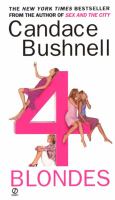
#72: Four Blondes

Four Blondes, by Candace Bushnell
(New York: Signet/ Grove Press, 2002, c2000)
Summary:
"Sex and the City author Candace Bushnell returns to the playgrounds of Manhattan's powerful and beautiful with her sizzling sensation Four Blondes, which gives an insider's look at the romantic intrigues, liaisons, and betrayals among the elite. She chronicles the lives of four beautiful women -- a model, a columnist, a socialite, and a writer -- as they face turning points at which each must choose among her passions.
"Studded with Bushnell's trademark wit and stiletto-heel-sharp insights, Four Blondes serves up the zeitgeist and mores of our era with gossipy, scandalous verve."

Opening Line:
"Janey Wilcox spent every summer for the last ten years in the Hamptons, and she'd never once rented a house or paid for anything, save for an occasional Jitney ticket."

My Take:
Ugh. Everything annoying and shallow and makes-you-want-to-claw-your-eyes-out about Sex and the City (the TV show; never read the book and may not bother after this) with none of the redeeming qualities (friendship, characters with at least some depth, etc.). Not a likeable person in the whole book. Also seemed remarkably dated for the early '00s, as if a story line from the 1980s somehow turned up behind the old washing machine. If I hadn't been up way too early for a flight and too tired and sad to focus on anything else, I wouldn't have bothered to finish it.

Monday, July 23, 2012

#65: An Inconvenient Woman

An Inconvenient Woman, by Dominick Dunne
(New York: Bantam Books, 1991 c1990)
Summary:
"Wealth. Beverly Hills billionaire, banker, and art collector Jules Mendelson and his elegant, aristocratic wife, Pauline, reign as the king and queen of West Coast high society. From their lavish mountaintop estate they preside over intimate dinner parties for ambassadors and art dealers, business tycoons and film stars. But L.A.'s royal couple is about to be dethroned.

"Murder. He's a smooth dancer with Latin charm, a member of an old Spanish Land Grant family that helped found the city, and Pauline's good friend. But when Hector Paradiso dies under the most sordid and distasteful circumstances, it's Jules who takes charge -- and takes steps to make Hector's murder look like suicide.

"Justice. Philip Quennell isn't part of their world. A young writer new to L.A., he finds observing the lives of the rich and famous fascinating. Until he discovers that the wealthy live by a different set of rules, rules that say if you have enough cash and connections you can stop a murder investigation cold. Now Quennell vows to expose those who'd let a killer go free.

"Passion. Flo March is Jules's enchanting young mistress. But between pillow talk and her own unquenchable curiosity, this beautiful redhead knows far too much about Hector's death -- and Jules's life. Soon, as intrigue threatens Jules's marriage, business, and reputation, events conspire to make Flo An Inconvenient Woman."

Opening Line:
"Later he was vilified and disgraced; Archbishop Cooning denounced him from the pulpit of Saint Vibiana's as a corruptor, and the archbishop's words spread throughout the land."

My Take:
I certainly haven't given up on Rise and Shine; truth be told, it'll probably be the more satisfying of the two, though Inconvenient Woman does promise to be guilty, Klondike-in-the-freezer, glass-of-wine-on-the-coffee-table fun for a small town homebody on her own in the big city. But I'm still not fully Kindle-ized yet, and can't quite bring myself to lie in bed with an e-reader when I want to flip through a quick chapter or 2 before going to sleep. Ergo, I'm breaking out one of the paperbacks I've had stacked on my desk for a month or so (can you tell this was one of my 25-cent finds at the library book sale) for bedtime reading. 

(tick, tock, tick, tock, tick, tock)

Sometimes you do get what you pay for. Inconvenient Woman wasn't bad enough for me not to finish -- it's the kind of fluffy, insubstantial thing that's perfect for reading at bedtime. The chapters are short enough that you can always make it through 1 or 2, the storyline doesn't require particularly close attention, and it's not compelling enough that you find yourself starting "just one more" chapter over and over till it's suddenly 2 am. 

And that's about all I can say for it. Perhaps its a period piece, but it seems something that would have been dated even in the early 1990s (though I didn't exactly move in LA high society at the time, so what do I know?) Sure, it was 20 years ago, but would the fact of Hector's being gay really have been so scandalous that no one acknowledged it? (His penchant for barely-legal PYTs and sex for money, OK.) It also doesn't help that few of the characters are especially interesting. Make that "one." Philip Quennell has potential, but we never really get under his skin enough to feel like we know what makes him tick. Yes, he's a recovering alcoholic; yes, he wrote an expose of a book before IW opens that made him some powerful enemies; yes, he's the only person in the novel who won't back down on questioning how and why Hector's death came to be labeled a suicide. (BTW, Dunne never fully clears up who did it, either, as the never-convicted killer identified at the book's end has an alibi that's never addressed.) Flo March is a runner-up, though her beautiful-but-naive working class waitress character seems a bit dated and predictable. But as for Jules and Pauline? Not just not likeable, but not particularly dislikeable or loathsome, either. He's a rich guy with powerful connections who can pull strings the rest of us can't imagine. She's a rich guy's wife with impeccable taste (of course, her bottomless bank account doesn't hurt) who initially seems more sympathetic but ultimately reveals that she's not above pulling a few strings of her own to retain her position of privilege. All in all, the book wasn't so bad that I'd be unwilling to give Dunne's take on the rich and famous another shot, especially for a quarter -- but The Nanny Diaries or a juicy, trashy Olivia Goldsmith romp it ain't.

#64: Rise and Shine

Rise and Shine, by Anna Quindlen
(New York: Random House, 2006)
Summary:
"From Anna Quindlen, acclaimed author of Blessings, Black and Blue, and One True Thing, a superb novel about two sisters, the true meaning of success, and the qualities in life that matter most.

It’s an otherwise ordinary Monday when Meghan Fitzmaurice’s perfect life hits a wall. A household name as the host of Rise and Shine, the country’s highest-rated morning talk show, Meghan cuts to a commercial break–but not before she mutters two forbidden words into her open mike.

In an instant, it’s the end of an era, not only for Meghan, who is unaccustomed to dealing with adversity, but also for her younger sister, Bridget, a social worker in the Bronx who has always lived in Meghan’s long shadow. The effect of Meghan’s on-air truth telling reverberates through both their lives, affecting Meghan’s son, husband, friends, and fans, as well as Bridget’s perception of her sister, their complex childhood, and herself. What follows is a story about how, in very different ways, the Fitzmaurice women adapt, survive, and manage to bring the whole teeming world of New York to heel by dint of their smart mouths, quick wits, and the powerful connection between them that even the worst tragedy cannot shatter."

Opening Line:
"From time to time some stranger will ask me how I can bear to live in New York City."

My Take:
Started this on the plane from Syracuse to Philadelphia to Boston last night (I don't remember exactly which leg I was on or which airport I was cooling my heels in at the time) and it's promising; I usually like Quindlen. Stay tuned.  

(time passes)

Pretty darned good. Meatier and more nuanced than a lot of the bourgeois upper-class porn I've read, which is a lot. (And hey, I mean "porn" in the sense of "sneaking a guilty peek into how the 1% or the 0.001% lives" sense, not the "50 shades" way.) Chiefly this is because Meghan is neither the narrator nor the book's chief focus. That would be her younger sister, Bridget, who leads a far more ordinary, low-profile life as a social worker, dating a much older cop. She's close to her famous sister, sure, but seems not all that interested in basking in her limelight; if anything, it's a distraction from their relationship. Rather than being a thin frame story for a book full of designer name-dropping, Rise and Shine is more about the effects of fame and wealth on those on its periphery: spouses, siblings, kids. 

If I have to pick a quibble, it's with the almost-too-perfect character of Leo, Meghan's son and Bridget's nephew. While he shows some flashes of normal youth -- being a bit untidy, bringing a stray kitten home to his aunt's apartment on a whim, buying way too many apples -- he's otherwise depicted as just so good-natured and unspoiled (despite a mother who makes $10 million a year and a father whose investment banking career is nothing to sneeze at either) that it seems too obvious a set-up for the "worst tragedy" alluded to in the publisher's blurb. As this is part of what saves the book from a too-perfectly-wrapped-up ending, though, I'll take it. Worth a read or a recommendation.


Thursday, October 20, 2011

#84: Hedge Fund Wives

Hedge Fund Wives, by Tatiana Boncompagni (New York: Avon, 2009)

Summary:
"When her husband, John, is recruited to be a big-time hedge fund manager, Marcy Emerson gives up her job, uproots her life, and moves from Chicago to New York City. But try as she might, March is never going to fit into one of the supposed seven categories of Hedge Fund Wives -- the Accidental, the Westminster, the Stephanie Seymour, the Former Secretary, the Socialite, the Workaholic, or the Breeder -- especially when behind every smile may lurk a stab in the back.

"In a perfect world John would have been there to help her navigate the waters, but in this volatile financial market, relationships have a way of nosediving faster than the Dow, and March quickly finds herself tossed aside for a thinner, blonder model. But while living out of suitcases and drowning her sorrows in cocktails, Marcy realizes it's time to get back up on her own two feet again ... and fight for those things in life that are far more important than money."


Opening Line:
"When I first opened the invitation to Caroline Reinhardt's baby shower, I thought I'd received it by mistake."

My Take:
Polished this off in half a day, and I feel as though I just had a big bowl of popcorn for supper. It's fun and tasty in the short term, partly because you feel like you're getting away with something, but doesn't do much to nourish or sustain you over the long haul.

The back-of-the-jacket blurb pretty much sums up the story line. Marcy, our heroine and narrator, is established as a fish out of water from the get-go, starting with the first-chapter sequence in which her pink parka stands out like a sore thumb amid a coat closet full of furs, and Caroline Reinhardt decides she's not worth talking to because she doesn't hire an interior decorator. At John's insistence, she'd given up her own banking career in anticipation of one day staying at home with their children, but after a recent miscarriage and the move to Manhattan, she's still reeling. It doesn't help that the other hedge fund wives, whether employed in their own right or not, seem interested primarily in extreme competitive shopping.

She does meet the glamorous but warm, if a little high-strung, Jill at the aforementioned baby shower, and through her, eventually meets Gigi, a caterer and cookbook author who (despite her marriage to yet another Wall St. VIP) becomes her closest friend and confidante. She and John also begin to socialize with Ainsley and Peter, despite that couple's precarious finances. As is telegraphed early on, this is where the trouble begins; Ainsley, panicked at Peter's fortune and aware of John's rising-star status, decides to trade up, and when Marcy spontaneously flies to Miami to visit John at a conference, she catches the pair in flagrante. With the help of a tough divorce lawyer Gina recommends, Marcy resists John's early settlement offers and ultimately walks away with a cool $15 million ... just in time to see Ainsley's pregnancy in the society pages, and realize how long her affair with John had been going on.

Marcy eventually comes out on top, and John does get a comeuppance of sorts, but this is no First Wives Club. It's far shorter on humor, and rather excessive in the descriptions of conspicuous consumption. (The excess is the point, I know, but it still makes for tedious reading after yet another over-the-top baby shower or dinner party.) All in all, an OK read, but I'd have liked a bit less of the bling, and more exploration of the edge-of-recession era in which the story is set.

Friday, April 29, 2011

#29: The Reserve

The Reserve, by Russell Banks (New York: HarperCollins, 2008).

Summary:
"Twenty-nine-year-old Vanessa Cole is a wild, stunningly beautiful heiress, the adopted only child of a highly regarded New York brain surgeon and his socialite wife. Twice married, Vanessa has been scandalously linked to any number of rich and famous men. But on the night of July 4, 1936, at her parents' country home in a remote Adirondack Mountain enclave known as The Reserve, two events coincide to permanently alter the course of Vanessa's callow life: her father dies suddenly of a heart attach, and a mysterious seductive local artist, Jordan Groves, blithely lands his Waco biplane in the pristine waters of the forbidden Upper Lake. ... [Jordan] falls easy prey to her electrifying personality, but it is not long before he discovers that the heiress carries a dark, deeply scarring family secret. Emotionally unstable from the start, and further unhinged by her father's unexpected death, Vanessa begins to spin wildly out of control, manipulating and destroying the lives of all who cross her path."


Opening Line:
"When finally no one was watching her anymore, the beautiful young woman extracted herself from her parents and their friends and left the living room."


My Take:
Yawn. Based on the reviews I'd read (which, admittedly, were a while back), I expected more from this book. The concept was intriguing -- a rich, somewhat spoiled "wild child" who has some deep dark secrets hidden in her silk-lined mahogany closets -- but the execution "meh" at best. For one thing, the description of Vanessa's physical beauty and the sex appeal of another character's love interest evoked shades of Danielle Steel. You might get away with describing one character as luminous, if you do so convincingly enough that the reader forgets it's a cliche, but two? Within 100 pages of each other? Gag me.

For another, the unanswered questions about how much of what Vanessa believes is real vs. how much is a product of her mental instability (Dr. Cole invented the lobotomy? She was sexually abused as a child?) -- a technique that can be very unsettling and compelling when it's done well -- just doesn't seem to work here. Maybe it's because neither side is really fleshed out well; all we have is Vanessa hinting at events on one hand, and her mother and Jordan saying, "No, that didn't happen" on the other. Ditto the ambiguous ending. It's not clear exactly what becomes of Jordan and Vanessa, which could be interesting in other contexts ... except that I didn't feel like I had enough evidence to even speculate convincingly for one argument or another.

All in all, a fairly quick book and not absolutely horrible, but also not entertaining or provocative enough for me to bother recommend it. Moving along here.

Sunday, November 28, 2010

RETURNED - Too Much Money

Too Much Money, by Dominick Dunne (New York: Crown Publishers, 2009).

Jacket Summary: "The last two years have been monstrously unpleasant for high-society journalist Gus Bailey. His propensity for gossip has finally gotten him into trouble -- $11 million worth. His problems begin when he falls hook, line, and sinker for a fake story from an unreliable source and repeats it on a radio program. As a result of his flip comments, Gus becomes embroiled in a nasty slander suit brought by Kyle Cramden, the powerful congressman he accuses of being involved in the mysterious disappearance of a young woman, and he fears it could mean the end of him.

"The stress of the lawsuit makes it difficult for Gus to focus on the novel he has been contracted to write, which is based upon the suspicious death of billionaire Konstantin Zacharias. It is a story that has dominated the party conversations of Manhattan's chattering classes for more than two years. The convicted murderer is behind bars, but Gus is not convinced that justice was served. There are too many unanswered questions, such as why a paranoid man who was usually accompanied by bodyguards was without protection the very night he perished in a tragic fire.

"Konstantin's hot-tempered widow, Perla, is obsessed with climbing the social ladder and, as a result, she will do anything to suppress this potentially damaging story. Gus is convinced she is the only thing standing between him and the truth."


Opening Line: "A few years ago there was a rumor that I had been murdered at my home in Prud'homme, Connecticut, bu a cross-country serial killer of older men."


My Take: Started this one but didn't get more than a few chapters in before it was due back at the library. Over the years, I've developed a set of rules for how to handle just such a situation. In short, if I haven't even started the book when the due date rolls around, back it goes. Occasionally I make exceptions, if the item's renewable, I don't have a ridiculous backlog of reading material at the moment, and I've really been looking forward to it -- but that really is an exception, and not the rule.

If a book is due back while I'm in the middle of it, it's a tougher call. [Looking over shoulder for the library police] Sometimes, if I've made good headway and am really enjoying the book, I'll throw caution to the winds -- I keep it out a few more days, finish up as quickly as possible, and just write off the overdue fine as the price of admission. Other times, though, there are books like this one, that I've barely started when that fateful day arrives. And, y'know ... I've concluded on those occasions, it just wasn't Meant to Be. This is actually a good argument for patronizing the library instead of just buying everything I want to read (I mean, even on top of the lack of money and shelf space). If I owned a book like this one, there'd be no reason not to let it drag on forever, filling my free time with just about anything else I can think of (crossword puzzles? dumb online games? rereading dog-eared old favorites? Yeah, I need to get out more) because the volume in question just isn't calling me.

Perhaps this book was a victim of my low expectations. I was half-expecting and hoping for a fun send-up of the foibles of New York's rich and famous, almost along the lines of the Olivia Goldsmith romps that used to be a guilty pleasure. It wasn't, and maybe that's to Dunne's credit. The reviews and articles I've read depict Dunne as having been more a journalist who also happened to write novels, usually about crimes committed by the wealthy and the misapplications of justice that often result. And maybe starting with Too Much Money is kind of like venturing into Tolkien by reading The Silmarillion: without knowing the extensive back story, it's hard to care much about what came before or afterwards. But that's pretty much how I felt here; I got the references to the Klaus von Bulow and Gary Condit scandals, of course, but on the whole, I felt like I was walking in on the middle of the movie, or attending a party where everyone knew the inside jokes except me. Ergo, Too Much Money was not my 89th book of the year.

(It will be a nail-biter, folks! Will she or will she not make it to 100? On the one hand, there are just over 2 weeks left; on the other, she's off from work and visiting the 'rents out of town for one of them. Stay tuned.)