About Me

Ithaca, New York
MWF, now officially 42, loves long walks on the beach and laughing with friends ... oh, wait. By day, I'm a mid-level university administrator reluctant to be more specific on a public forum. Nights and weekends, though, I'm a homebody with strong nerdist leanings. I'm never happier than when I'm chatting around the fire, playing board games, cooking up some pasta, and/or road-tripping with my family and friends. I studied psychology and then labor economics in school, and I work in higher education. From time to time I get smug, obsessive, or just plain boring about some combination of these topics, especially when inequality, parenting, or consumer culture are involved. You have been warned.
Showing posts with label legal. Show all posts

Friday, July 20, 2012

#63: Nudge

Nudge: Improving Decisions 
About Health, Wealth, and Happiness
by Richard H. Thaler and Cass R. Sunstein 
New York: Penguin Books, 2008
Summary:
"Nudge is about choices -- how we make them and how we're led to make better ones. Authors Richard H. Thaler and Cass R. Sunstein offer a new perspective on how to prevent the countless bad mistakes we make in our lives -- including ill-advised personal investments, consumption of unhealthy foods, neglect of our natural resources, and other numerous bad decisions regarding health care, our families, and education. Citing decades of cutting-edge behavioral science research, they demonstrate that sensible 'choice architecture' can successfully nudge people toward the best decision without restricting their freedom of choice. Terrifically straightforward, informative, and often very entertaining, this book is a must read for anyone with an interest in our individual and collective well-being."


Table of Contents:

Part I: Humans and Econs
  • 1. Biases and Blunders
  • 2. Resisting Temptation
  • 3. Following the Herd
  • 4. When Do We Need a Nudge?
  • 5. Choice Architecture
Part II: Money
  • 6. Save More Tomorrow
  • 7. Naive Investing
  • 8. Credit Markets
  • 9. Privatizing Social Security: Smorgasbord Style
Part III: Health
  • 10. Prescription Drugs: Part D for Daunting
  • 11. How to Increase Organ Donations
  • 12. Saving the Planet
Part IV: Freedom
  • 13. Improving School Choices
  • 14. Should Patients Be Forced to Buy Lottery Tickets?
  • 15. Privatizing Marriage
Part V: Extensions and Objections
  • 16. A Dozen Nudges
  • 17. Objections
  • 18. The Real Third Way
  • 19. Bonus Chapter: Twenty More Nudges

My Take:
Surprise, surprise. For all the behavioral economics/ consumer decision-making stuff I've read, this one was different. It focuses less on the why we make the weird, illogical decisions we do and how policies in various areas might be designed to nudge us in a spirit of what the authors call libertarian paternalism:
"The libertarian aspect of our strategies lies in the straightforward insistence that, in general, people should be free to do what they like -- and to opt out of undesirable arrangements if they want to do so. To borrow a phrase from the late Milton Friedman, libertarian paternalists urge that people should be 'free to choose.' We strive to design policies that maintain or increase freedom of choice. ... Libertarian paternalists want to make it easy for people to go their own way; they do not want to burden those who want to exercise their freedom."


"The paternalistic aspect lies in the claim that it is legitimate for choice architects to try to influence people's behavior in order to make their lives longer, healthier, and better. In other words, we argue for self-conscious efforts, by institutions in the private sector and also by government, to steer people's choices in directions that will improve their lives. In our understanding, a policy is 'paternalistic' if it tries to influence choices in a way that will make choosers better off, as judged by themselves. ...


"Libertarian paternalism is a relatively weak, soft, and nonintrusive stype of paternalism because choices are not blocked, fenced off, or significantly burdened. If people want to smoke cigarettes, to eat a lot of candy, to choose an unsuitable health plan, or fail to save for retirement, libertarian paternalists will not force them to do otherwise -- or even make things hard for them. ... [Choice architects] are self-consciously attempting to move people in directions that will make their lives better. They nudge.


"A nudge, as we will use the term, is any aspect of the choice architecture that alters people's behavior in a predictable way without forbidding any options or significantly changing their economic incentives. To count as a mere nudge, the intervention must be easy and cheap to avoid. Putting the fruit at eye level counts as a nudge. Banning junk food does not."
The bulk of the book offers examples from a variety of public policy arenas, from retirement savings to health care to school choice to freedom to marry. Thaler and Sunstein's writing is accessible and funny, and they're never afraid to poke some gentle fun at themselves or at the mostly well-earned reputation of economists in general. If the topic sounds interesting, you'll probably enjoy the book.

Saturday, July 14, 2012

#59: A Map of the World

A Map of the World, by Jane Hamilton
(New York: Doubleday, 1994)
 Summary:
"The book is concerned with how one seemingly inconsequential moment can alter lives forever. Alice Goodwin, mother of two, school nurse and wife of an aspiring dairy farmer in Wisconsin, is getting ready to take her two daughters and her best friend, Theresa's two little girls to their farm pond to swim. When she goes upstairs to find her bathing suit, Lizzy, Theresa's 2-year-old, slips away to the pond and drowns. It all goes downhill from there. The town tramp, whom Alice reprimanded for constantly bringing her sick son to school, accuses Alice of molesting her child. The entire town turns on the Goodwin family, fairly new to the area, and several other mothers come forward with tales of Alice's 'abuse'. Imprisonment, trial and loss of the farm ensue and Alice's husband and Theresa become 'involved.'

"The novel is essentially about a search for authenticity in the contemporary American midwest. A couple struggles to maintain their lives on a farm, keep to ethical practices of both farming and living, and to raise their two young children, but American society stymies their efforts. The novel is an indictment of the U.S. legal system, which works with the subtlety and mercy of a sledgehammer; the farming system, which values dollars over good food and the environment; and the American idea of marriage, which is falling apart from its own internal contradictions. However, the novel manages to be very funny throughout. Its humor comes out not just in the wicked, scathing sentences of its first third, told in a voice that one imagines is close to the author's own, but also in the structural choice of placing section two in the voice of the hilariously but tragically non-verbal husband. The contrast between husband's and wife's thinking is far more eloquent and entertaining than the recent popular psychological studies on the subject of male-female mental processes. Also included: the annoyingly efficient but oblivious mother-in-law, class and race differences but from a female perspective, and the politics of a small town."

Opening Line:
"I used to think if you fell from grace it was more likely than not the result of one stupendous error, or else an unfortunate accident."

My Take:
Yay! Once I finish this entry I'll be up to the book I'm currently reading.
Beautiful. Absolutely beautiful.

Wednesday, April 18, 2012

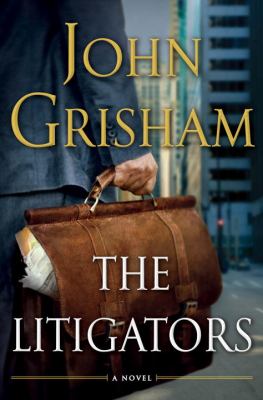
#29: The Litigators

The Litigators, by John Grisham (New York: Doubleday, 2011)

Summary:
"The partners at Finley & Figg -- all two of them -- often refer to themselves as 'a boutique law firm.' Boutique, as in chic, selective, and prosperous. They are, of course, none of these things. What they are is a two-bit operation always in search of their big break, ambulance chasers who've been in the trenches much too long making way too little. Their specialties, so to speak, are quickie divorces and DUIs, with the occasional jackpot of an actual car wreck thrown in. After twenty-plus years together, Oscar Finley and Wally Figg bicker like an old married couple but somehow continue to scratch out a half-decent living from their seedy bungalow offices in southwest Chicago.

"And then change comes their way. More accurately, it stumbles in. David Zinc, a young but already burned-out attorney, walks away from his fast-track career at a fancy downtown firm, goes on a serious bender, and finds himself literally at the doorstep of our boutique firm. Once David sobers up and comes to grips with the fact that he's suddenly unemployed, any job -- even one with Finley & Figg -- looks okay to him.

"With their new associate on board, F&F is ready to tackle a really big case, a case that could make the partners rich without requiring them to actually practice much law.

"The Litigators is a tremendously entertaining romp filled with the kind of courtroom strategies, theatrics, and suspense that have made John Grisham America's favorite storyteller."

Opening Lines:
"The law firm of Finley & Figg referred to itself as a 'boutique firm.' This misnomer was inserted as often as possible into routine conversations, and it even appeared in print in some of the various schemes hatched by the partners to solicit business."

My Take:
Meh. Yeah, I've said this before, but I think Grisham has, too, so that seems fitting. Sadly, it seems the John Grisham of A Time to Kill, The Firm, and The Pelican Brief has either retired or gone on extended hiatus. The Litigators reads like something he texted in on his smartphone while devoting most of his attention to something else.

The Point, in so much as there is one, seems mostly to be about Big Pharma. While paying a condolence call to a recent widow in hopes of being hired to handle the deceased's estate, Figg stumbles on what he's sure is The Next Big Thing: several deaths that just might be related to Krayoxx, a fairly new cholesterol-reducing wonder drug manufactured by New Jersey-based pharmaceutical giant Varrick. (Gee, I wonder what that's based on?) If Finley & Figg can get in on even a tiny piece of what they're sure will be a huge mass tort action and correspondingly huge settlement, they'll be in hog heaven. Trouble is, it's not quite clear who the real bad guy is here -- the Varrick minions, for having enough lawyers, money, and machinery to weather pretty much any legal hiccups that arise, or Finley & Figg, for being complete caricatures of every shady lawyer joke you've ever heard?

What was clear is that none of these players are especially likable. Zinc is more so, but his arrival at Finley & Figg and the way his path and the firm's go on from there are somewhat clumsy and unconvincing. What's supposed to be a sideline, about Zinc representing a family of Burmese immigrants whose son has suffered permanent brain damage from sucking on a cheap Halloween toy, is more compelling, but hasn't Grisham told us this story -- big shot lawyer gets burned out, but then finds more fulfillment in the less lucrative world of representing regular people -- already in The Street Lawyer?

Read it if you're bored or there's nothing else around, but don't expect serious entertainment here.

Wednesday, September 21, 2011

#69: The Confession

The Confession, by John Grisham (New York: Doubleday, 2010).

Summary:
"An innocent man is about to be executed.

"Only a guilty man can save him.

"For every innocent man sent to prison, there is a guilty one left on the outside. He doesn't understand how the police and prosecutors got the wrong man, and he certainly doesn't care. He just can't believe his good luck. Time passes and he realizes that the mistake will not be corrected: the authorities believe in their case and are determined to get a conviction. He may even watch the trial of the person wrongly accused of the crime. He is relieved when the verdict is guilty. He laughs when the police and prosecutors congratulate themselves. He is content to allow an innocent person to go to prison, to serve hard time, even to be executed.

"Travis Boyette is such a man. In 1998, in the small East Texas city of Slone, he abducted, raped, and strangled a popular high school cheerleader. He buried her body so that it would never be found, then watched in amazement as police and prosecutors arrested and convicted Donte Drumm, a local football star, and marched him off to death row.

"Now nine years have passed. Travis has just been paroled in Kansas for a different crime; Donte is four days away from his execution. Travis suffers from an inoperable brain tumor. For the first time in his miserable life, he decides to do what's right and confess.

"But how can a guilty man convince lawyers, judges, and politicians that they're about to execute an innocent man?"

Opening Line:
"The custodian at St. Mark's had just scraped three inches of snow off the sidewalks when the man with the cane appeared."


My Take:

Sometimes fiction parallels real life just a little too closely. Odd to be reading this book while the Troy Davis case has been at the forefront of the news.

John Grisham is John Grisham. You know what you're going to get -- solid legal thrillers with (usually) a Southern flair and a fairly high can't-put-it-down quotient -- and yep, you pretty much get more of the same here. Unfortunately, he and his characters can't help doing a bit too much grandstanding here, which tends to get in the way of the story line. Grisham's a big supporter of the Innocence Project, an organization devoted to exonerating those who've been wrongfully convicted. And hey -- more power to him; it's nice to see celebrities legitimately using their fame to do good for a cause they believe in. But if I want to learn about that cause, I'll look for books and articles about wrongful conviction -- not extended diatribes in what's supposed to be a fun/ junk novel. (Doesn't mean it wasn't still a fun/ junk novel, though.)

#66: Sing You Home

Sing You Home, by Jodi Picoult (New York: Atria Books, 2011).

Summary:
"Zoe Baxter has spent ten years trying to get pregnant, and after multiple miscarriages and infertility issues, it looks like her dream is about to come true -- she is seven months pregnant. But a terrible turn of events leads to a nightmare -- one that takes away the baby she has already fallen for, and breaks apart her marriage to Max.

"In the aftermath, she throws herself into her career as a music therapist -- using music clinically to soothe burn victims in a hospital; to help Alzheimer's patients connect with the present; to provide solace for hospice patients. When Vanessa -- a guidance counselor -- asks her to work with a suicidal teen, their relationship moves from business to friendship and then, to Zoe's surprise, blossoms into love. When Zoe allows herself to start thinking of having a family, again, she remembers that there are still frozen embryos that were never used by herself and Max.

"Meanwhile, Max has found peace at the bottom of a bottle -- until he is redeemed by an evangelical church, whose charismatic pastor -- Clive Lincoln -- has vowed to fight the 'homosexual agenda' that has threatened traditional family values in America. But this mission becomes personal for Max, when Zoe and her same-sex partner say they want permission to raise his unborn child.

"Sing You Home explores what it means to be gay in today's world, and how reproductive science has outstripped the legal system. Are embryos people or property? What challenges do same-sex couples face when it comes to marriage and adoption? What happens when religion and sexual orientation -- two issues that are supposed to be justice-blind -- enter the courtoom? And most importantly, what constitutes a 'traditional family' in today's day and age?"

Opening Line:
"One sunny, crisp Saturday in September when I was seven years old, I watched my father drop dead."


My Take:

One of Picoult's better ones. The fact that she limits herself to three characters' different vantage points (Zoe's, Vanessa's, and Max's) helps, as does the remarkable lack of surprise dead children at the end. (Other Picoult veterans will understand.) As one review I came across noted, the book's treatment of the fundamentalists isn't exactly even-handed, and something about Max's brother Reid just seemed too #$%^& perfect to be true (Reid's equally perfect wife, Liddy, works a wee bit better, partly because we see more of her and learn at least something of what makes her tick), but hey -- for a light but not too light piece o' chick lit, it was about what I'd hoped for and better than I'd expected.

Tuesday, January 4, 2011

#1 - My Sister's Keeper

Gotta love road trips. When else would I make a dent in the paperbacks I seem to accumulate till they're triple-stacked in my bookcase, but then never read because my library books are due back soon?

So, my less-than-auspicious first book of 2011 was My Sister's Keeper, by the prolific, popular, and predictable Jodi Picoult (New York: Atria, 2004).

Jacket Summary: "Can a parent love too much? Or is too much never enough?

"Anna is not sick, but she might as well be. By age thirteen, she has undergone countless surgeries, transfusions, and shots so that her older sister, Kate, can somehow fight the leukemia that has plagued her since childhood. The product of preimplementation genetic diagnosis, Anna was conceived as a bone marrow match for Kate -- a life and a role that she has never challenged ... until now. Like most teenagers, Anna is beginning to question who she truly is. But unlike most teenagers, she has always been defined in terms of her sister -- and so Anna makes a decision that for most would be unthinkable, a decision that will tear her family apart and have perhaps fatal consequences for the sister she loves. A provocative novel that raises some important ethical issues, My Sister's Keeper is the story of one family's struggle for survival at all human costs and a stunning moral parable for all time."


Opening Line: "When I was little, the great mystery to me wasn't how babies were made, but why."

My Take: I'm not usually a big fan of chain restaurants, but I'll grant that they have their place. Back when the Sapling was still just a wee shoot, many road trips were saved by a well-situated McDonald's Playplace. There's a sad little mall in Oneonta with a Subway that's just the thing on the not-quite-brief-enough-to-do-in-one-shot drive to Aunt & Uncle Thyme's house. And hey -- I may not have a minivan, but sometimes, when Sapling & I are running from errand to activity to friend's house on Saturdays, a quick swing by Panera is ... well, a mom's gotta do what a mom's gotta do. Pretentious foodie that I am, even I'll allow that sometimes, the ideal has to defer to the practical. The chains are quick, cheap, and reliable; you probably won't be transported when your lunch arrives, but nor will you be disappointed or disgusted.

And so it is with Jodi Picoult's books. They're incredibly formulaic, right down to the muted jewel tones on the covers: Take a hot contemporary legal/ ethical issue (bonus points if there's a medical component, though that's not strictly required), invent a family and associated professionals to go with it, choose different fonts to represent the perspectives of 5-7 different players in the story ... and eventually, cap it all off with a twist ending and at least one dead child. Even knowing all this, though -- I don't read 'em every day, any more than I eat at McD's or Subway on a regular basis -- sometimes, that's precisely what I want to read. Like here, when I was looking for something I a) owned in paperback, so as to conserve space and weight in my suitcase, and b) would find both compelling enough to overcome vacation inertia, but not so demanding that I couldn't concentrate despite the bustle and blaring TV in my parents' house. I had 2 yet-unread Picoults on the shelf, and this one won out over The Pact. I started it New Year's Eve and turned the last page before heading home on New Year's Day; I liked some of the characters more than others; I wished I'd stopped before reading the last few twist-ending chapters. In short, I got what I paid for and can't really complain.

Interestingly, the 6 characters Picoult chooses to tell the story don't include Kate -- at least not until the very end. Anna's voice, of course, comes first. Alternating chapters are narrated by Sara, the lawyer-turned-SAH mom who opts to represent herself and her husband in Anna's lawsuit against them; Brian, her firefighter husband and the kids' father, who harbors his own doubts about his kids' medical circumstances and lets Anna move into the fire house with him temporarily; Jesse, the Fitzgeralds' oldest child and only son, who's moved into the family's garage and been so utterly ignored over the years that he's turned to arson in hopes of finally attracting his parents' attention; Campbell Alexander, the attorney Anna convinces to represent her pro bono for reasons that aren't entirely clear; and Julia Romano, the court-appointed guardian at litem charged with getting to know the family and determining what's really in Anna's best interest (who, by the way, has a complicated romantic history with Campbell going way back). As you might surmise from my character summaries, some parts of the story are more interesting than others. The Campbell-Julia history and sexual tension didn't really do much for me, but perhaps that's just because I forgot to include "romantic sub-plot" in my required elements of Picoult blockbusters. On the other hand, I'd have liked to have heard more of Jesse's story -- which sheds considerable light on Anna's plight, and ended up being resolved far too quickly and smoothly for an author who seems to pride herself on capturing many shades of gray.

Wednesday, December 15, 2010

#89 - Innocent

Innocent, by Scott Turow (New York: Grand Central Publishing, 2010).

Summary: "More than twenty years after Rusty Sabich and Tommy Molto went head-to-head in the shattering murder trial of Presumed Innocent, the men are pitted against each other once again in a riveting psychological match. When Sabich, now over sixty years old and the chief judge of an appellate court, finds his wife, Barbara, dead under mysterious circumstances, Molto accuses him of murder for the second time, setting into motion a trial that is vintage Turow—the courtroom at its most taut and explosive.

"With his characteristic insight into both the dark truths of the human psyche and the dense intricacies of the criminal justice system, Scott Turow proves once again that some books simply compel us to read late into the night, desperate to know who did it."

Opening Lines: "A man is sitting on a bed. He is my father.

"The body of a woman is beneath the covers. She was my mother."


My Take: Not surprisingly, this one was about what I'd expected. Yes, it entertained; no, it didn't disappoint.

The latter's always a risk in a situation like this. It seems almost everyone's read Presumed Innocent, or at least seen the Harrison Ford movie. The ending there was surprising enough, and the characters sufficiently compelling, that you can't help wondering what happened to Sabich and Molto and all their other pals after all those years; heck, I don't think I've been as excited about a much-delayed sequel since Michael Tolliver Lives came out. But for all that readers are curious, we're also an oddly proprietary lot. Even for an accomplished author like Turow, it's a fine line to walk: the next installment needs to seem logical and plausible given what we know of the characters, but not so logical that it seems obvious or unsurprising.

Fortunately, Innocent seems to pull it off. Many of the characters we remember from Presumed Innocent are back, and one of the things that makes this book work so well both as a sequel and a stand-alone is that they've both changed ... and they haven't. Time has passed, and their lives have taken unexpected turns, but nothing we see here is out of character with the folks we've gotten to know. At 60, Tommy Molto has recently married a much-younger woman and is the proud father of a small son. After a brief separation following Rusty's first trial, he and Barbara reconciled, but Barbara struggles with bipolar disorder and their relationship is a rocky one. Their son, Nate, is 22, a newly-minted lawyer himself, and still wrestling to carve out an adult identity and relationships apart from his parents.

And that's where we come in. When we pick up the story, Barbara has just turned up dead one morning, apparently of natural causes ... or is it? If so, why did Rusty sit beside her body for a full day before notifying the police, or even his son? And what's the significance of Rusty's recent affair with a young law clerk (which we learn about in the first few chapters) -- his first since the ill-fated tryst recalled in Presumed Innocent? I formed a few theories early on about how the story would ultimately end, and for once, I'm glad to say I was wrong. Great literature it's not, but an enjoyable legal suspense novel -- absolutely.

Wednesday, October 20, 2010

#74 - Red Families v. Blue Families

Red Families v. Blue Families: Legal Polarization and the Creation of Culture, by Naomi Cahn and June Carbone (Oxford, NY: Oxford University Press, 2010).

Summary: "Red Families v. Blue Familieseared for the post-industrial economy. Rooted in the urban middle class, the coasts and the 'blue states' in the last three presidential elections, the Blue Family Paradigm emphasizes the importance of women's as well as men's workforce participation, egalitarian gender roles, and the delay of family formation until both parents are emotionally and financially ready. By contrast, the Red Family Paradigm -- associated with the Bible Belt, the mountain west, and rural America -- rejects these new family norms, viewing the change in moral and sexual values as a crisis. In this world, the prospect of teen childbirth is the necessary deterrent to premarital sex, marriage is a sacred undertaking between a man and a woman, and divorce is society's greatest moral challenge. Yet the changing economy is rapidly eliminating the stable, blue collar jobs that have historically supported young families, and early marriage and childbearing derail the education needed to prosper. The result is that the areas of the country most committed to traditional values have the highest divorce and teen pregnancy rates, fueling greater calls to reinstill traditional values. Featuring the groundbreaking research first hailed in The New Yorker, this penetrating book will transform our understanding of contemporary American culture and law. The authors show how the Red-Blue divide goes much deeper than this value system conflict -- the Red States have increasingly said 'no' to Blue State legal norms, and as a result, family law has been rent in two. The authors close with a consideration of where these different family systems still overlap, and suggest solutions that permit rebuilding support for both types of families in changing economic circumstances. Incorporating results from the 2008 election, Red Families v. Blue Families will reshape the debate surrounding the culture wars and the emergence of red and blue America."

Table of Contents:
  • Introduction
Part 1: Family Maps
  • 1. Moral Demography
  • 2. Sexual History
  • 3. The Age of Division
  • 4. Personality, Politics, and Religion
Part 2: The Legal Map
  • 5. Contraception: Securing the Pathways to Blue Family Life
  • 6. Abortion, Law and the Cognitive Map
  • 7. The Irrationality of Adolescence: What the Adults Are Really Fighting Over
  • 8. The Marrying Laws
  • 9. Custody and Compromise
Part 3: The Map to the Future
  • 10. Marriage Advice in Shades of Pink
  • 11. Making Ready for Baby: Painting the Nursery Sky Blue
  • 12. Work and Family: Retooling the Foundation in Deep Purple
  • Conclusion
My Take: Some interesting ideas and a reasonably even-handed presentation, but overall, far too oversimplified to hold water. The authors' thesis, and what makes it problematic, are evident in the first two pages of the introduction:
"Families are on the front lines of the culture wars. Controversies over abortion, same-sex marriage, teen pregnancy, single parenthood, and divorce have all challenged our images of the American family. Some Americans seek a return to the 'mom, dad, and apple pie' family of the 1950s, while others embrace all of our families, including single mothers, gay and lesbian parents, and cohabiting couples. ... [T]he new information economy is transforming the family -- and doing so in ways that create a crisis for marriage-based communities across the country.

"The 'blue families of our title are on one side of the cultural controversy. These families have reaped the handsome rewards available to the well-educated middle class who are able to invest in both their daughters' and sons' earning potential. Their children defer family formation until both partners reach emotional maturity and financial independence. Blue family champions celebrate the commitment to equality that makes companionate relationships possible and the sexual freedom that allows women to fully participate in society. Those who have embraced the blue family model have low divorce rates, relatively few teen births, and good incomes. Yet the ability to realize the advantages of the new blue family system appears to be very much a class-based affair. Women who graduate from college are the only women in American society whose marriage rates have increased, and they and their partners form the group whose divorce rates have most appreciably declined.


"The terms of the successful blue family order -- embrace the pill, encourage education, and accept sexuality as a matter of private choice -- are a direct affront to the 'red families' of our title and to social conservatives who see their families in peril. Driven by religious teachings about sin and guilt, and based in communities whose social life centers around married couples with children, the red family paradigm continues to celebrate the unity of sex, marriage, and procreation. Red family champions correctly point out that the growing numbers of single-parent families threaten the well-being of the next generation, and they accurately observe that greater male fidelity and female 'virtue' strengthen relationships. Yet, red regions of the country have higher teen pregnancy rates, more shotgun marriages, and lower average ages at marriage and first birth. What the red family paradigm has not acknowledged is that the changing economy has undermined the path from abstinence through courtship to marriage. As a result. abstinence into the mid-20s is unrealistic, shotgun marriage correspond with escalating divorce rates, and early marriages, whether prompted by love or necessity, often founder on the economic realities of the modern economy, which disproportionately rewards investment in higher education. Efforts to insist on a return to traditional pieties thus inevitably clash with the structure of the modern economy and produce recurring cries of moral crisis."

So there's the argument in a nutshell. On the surface, it's an intriguing idea: that "[t]he biggest differences between red and blue families center on age: age at marriage and age at first birth," and that "[w]hat happens during the teen years establishes the paths to adulthood. If teens postpone their assumption of adult roles, such as parenting or leaving school, until their mid-20s, they invest more in education, acquire independence, and learn how to navigate in the world before they marry. Conversely, those who marry before they turn 21 and have children soon after are likely to bear more children, interrupt their educations, and negotiate the terms of adulthood within a more fragile relationship." And I don't argue with the statistics that show the highest teen birth and marriage rates to be in solidly red states, and the lowest in consistently blue ones. (I'm not sure Cahn and Carbone's approach -- they look at the most extreme 5 states on either end of several distributions -- is an altogether valid way to draw conclusions about states in the middle and/or smaller geopolitical entities, though that's not my biggest quibble with the book.)

I do think, though, that reducing most or all of the red/ blue divide to "red families marry and have kids young, blue families wait" is grossly oversimplified. Might there be some nugget of truth here, or at least something worth further study? Sure, but this is still only part of the story at best. What about the blue collar, organized labor strain of blue families -- admittedly, there are far fewer of them than there were a generation ago, but they're still out there? Or the upper middle class, "prosperity gospel" red families? Heck, what about the complicated relationship between race and political affiliation; in particular, African-Americans are overrepresented in lower income ranges and underrepresented at higher educational levels, but still disproportionately "blue" voters. While the authors touch upon race briefly, it's almost presented as an inconvenience: well, the highest and lowest teen and nonmarital birth rates don't quite fit our red state-blue state split here, but that's because these states have high minority populations and minorities' rates are different anyway.

This isn't to say that I found Red Families v. Blue Families completely without merit. The overview of American attitudes and laws around sexual behavior, contraception, abortion, and marriage was concise and well-written (though there's not much new ground here for anyone who's taken a family law class or is familiar with Stephanie Coontz's work). I also appreciated the context and perspective the authors provide on same-sex marriage and custody issues. I'm not sure, though, how I feel about the conclusion. On one hand, pointing out areas where the red and blue positions aren't too far apart (promoting stable marriage by supporting adolescents' transition to adulthood; reducing the number of unwanted pregnancies; reconsidering the relationship among work, family, and education) doesn't happen often enough ... on the other, it sidesteps some of the more contentious issues the authors touch upon (i.e., abortion rights and same-sex parenting), and probably overstates the areas of overlap. (Yes, expanded funding for contraceptives may well reduce abortions, but that still doesn't mean the redder states will go for it. Yes, our health care system needs a comprehensive overhaul, but unless you've been asleep for the last 2 years, you know what a huge issue this is -- which makes sticking it in a single paragraph in the conclusion seem like a not-very-skilled dodge.)

In summary, worth a read (especially if you read anything, like me) and a discussion, but makes a far lesser contribution to the discussion than I'd hoped.

Monday, May 17, 2010

#39 - Beyond (Straight and Gay) Marriage

Beyond (Straight and Gay) Marriage: Valuing All Families under the Law, by Nancy D. Polikoff (Boston: Beacon Press, 2008) was excellent -- illuminating, clearly-written, and provocative.

Summary: "Polikoff (law, American U. Washington College of Law) takes issue with the concept of marriage and argues that it makes unmarried couples of any sexual orientation, single-parent households, extended family units, and others unable to reap the benefits of the law. She asserts that marriage is not the cure for the disadvantages faced by same-sex couples, but that married couples should not have rights that other family forms do not. She argues that the law should not give marriage more value, as it is not a family form that is more important than others. Topics addressed include feminism and gay rights, the marriage-equality movement, countries where marriage matters less than in the US, domestic partner benefits, medical care and family and medical leave, distribution of assets and providing for children, wrongful death, worker's compensation, and Social Security."

Table of Contents:
  1. The Changing Meaning of Marriage
  2. Gay Rights and the Conservative Backlash
  3. Redefining Family
  4. The Right and the Marriage Movement
  5. LGBT Families and the Marriage-Equality Movement
  6. Countries Where Marriage Matters Less
  7. Valuing All Families
  8. Domestic Partner Benefits for All Families
  9. Coping with Illness: Medical Care and Family and Medical Leave
  10. When a Relationship Ends through Dissolution or Death: Distributing Assets and Providing for Children
  11. Losing an Economic Provider: Wrongful Death, Workers' Compensation, and Social Security
My take: As suggested above, an excellent book. While Polikoff supports same-sex couples' right to marry, her chief argument here is that marriage should be beside the point. Rather, all family units -- gay couples, unmarried male-female couples, single parents, adults caring for elderly or disabled relatives -- should receive the same support we (the U.S.) currently reserve exclusively for marriage. She suggests that the caretaking dyad -- the relationship between those who can't help being dependent on someone else for their care and well-being, i.e., children and those with disabilities, and their caregivers -- rather than the marital relationship be the focus of our social safety net, whether that's survivors' benefits when a wage-earner dies or providing medical leave and insurance for whoever one has an interdependent relationship with. Good stuff -- the kind of thing that's so well-articulated that it seems like it should have been obvious a long time ago.

Sunday, October 4, 2009

#98 - Handle with Care

Back again to the same small-town New Hampshire of The Pilot's Wife for my 98th book of the year: Handle with Care, by Jodi Picoult (Atria Books, 2009). As Sean, one of the principals, reminds us, and as Picoult's earlier novels have illustrated, "every sleepy picture-postcard New England town [has] a split personality." This time, what's lurking beneath the surface is a severely disabled child; six-year-old Willow O'Keefe has osteogenesis imperfecta (OI, for short), or brittle bone disease. By the time the story begins, she's suffered 52 broken bones -- the first 7 in utero. As her mother, Charlotte, recounts:
"Your first seven breaks happened before you entered this world. The next four happened minutes after you were born, as a nurse lifted you out of me. Another nine, when you were being resuscitated in the hospital, after you coded. The tenth: when you were lying across my lap and suddenly I heard a pop. Eleven was when you rolled over and your arm hit the edge of the crib. Twelve and thirteen were femur fractures; fourteen a tibia; fifteen a compression fracture of the spine. Sixteen was jumping down from a stoop; seventeen was a kid crashing into you on a playground; eighteen was when you slipped on a DVD jacket lying on the carpet. We still don't know what caused number nineteen. Twenty was when Amelia was jumping on a bed where you were sitting; twenty-one was a soccer ball that hit your left leg too hard; twenty-two was when I discovered waterproof casting materials and bought enough to supply an entire hospital, now stocked in my garage. Twenty-three happened in your sleep; twenty-four and twenty-five were a fall forward in the snow that snapped both forearms at once. Twenty-six and twenty-seven were nasty fractures, fibula and tibia tenting through the skin at a nursery school Halloween party, where, ironically, you were wearing a mummy's costume whose bandages I used to splint the breaks. Twenty-eight happened during a sneeze; twenty-nine and thirty were ribs you broke on the edge of the kitchen table. Thirty-one was a hip fracture that required a metal plate and six screws. I stopped keeping track after that, until the ones from Disney World, which we had not numbered but instead named Mickey, Donald, and Goofy."
Clearly, not an ordinary childhood. Nonetheless, Willow is a smart, funny, engaging child, albeit a diminutive one; her parents, Charlotte and Sean, adore her; and her sister Amelia ... well, what are siblings for?

Things begin to change in the second chapter, when the O'Keefes depart New Hampshire for an almost-unheard of trip to Disney World. Minutes after entering the Magic Kingdom, Willow slips in an ice cream shop and suffers yet another three fractures, which land her in the nearest emergency room. Since the all-important letter from her doctor explaining her condition was left at home, the numerous prior breaks revealed by her X-ray raise some eyebrows -- enough so that Sean and Charlotte are held and questioned by the police, and Amelia is whisked away to a temporary foster home. While their ordeal lasts only a night, Sean is enraged, and returns home determined to sue everyone he can -- WDW, the hospital, the local social services agency -- for how the family was treated.

Their first attorney's visit starts the family down a long, tortured road. While they don't appear to have a strong case against Disney World or the hospital, their lawyer suggests a different, potentially lucrative avenue: a wrongful birth suit. Simply put, this would blame the doctor for failing to diagnose Willow's illness earlier, before she was born, and thus giving the O'Keefes the option of an abortion. Never mind that Sean and Charlotte desparately wanted this child they took so long to conceive; that they're devout Catholics who oppose abortion in general; that the doctor in question is Charlotte's best friend, Piper; or that this means standing before a court saying their daughter should never have been born. Charlotte, seeing only the opportunity to secure enough money to ensure a lifetime of comfort for Willow -- well-sized wheelchairs, adapted vehicles, OI camps -- signs on. Sean does not, and in fact, after the first article about the case hits the press, signs on as a witness for the defense.

And so begins a harrowing journey. In typical Picoult fashion, the tale is told from several different characters' perspectives, each represented by a different font: Charlotte, Sean, Amelia, Piper, and Marin Gates, the attorney who represents the O'Keefes in their suit. Unsurprisingly, the strain and publicity around a lawsuit that pits Charlotte and Sean against each other takes its toll on their marriage; by the midpoint of the book, Sean has moved from bedroom to couch to local motel, and ultimately files for divorce.

Piper, likewise, is devastated, both personally and professionally. While her initial reaction is relatively sanguine ("On some level, I'd known that my lack of lawsuits was sheer luck -- that it would happen sooner or later.), this changes once she realizes exactly who is suing her:
"Which disaster had precipitated this? My eyes scanned to the top of the page again, reading the plaintiffs' names, which I'd somehow missed the first time around.

"SEAN AND CHARLOTTE O'KEEFE v. PIPER REECE.

"Suddenly I couldn't see. The space between my eyes and the paper was washed red, like the blood that was pounding so loudly in my ears that I did not hear a nurse ask if I was all right. I staggered down the hall to the first door I could find -- into a supply closet filled with gauze and linens.

"My best friend was suing me for medical malpractice.

"For wrongful birth.

"For not telling her earlier about your disease, so that she would have had the chance to abort the child she'd begged me to help her conceive."
For Marin, the case comes at a personal crossroads. In the midst of a search for the birth mother who gave her up for adoption as a newborn, she struggles to reconcile her professional obligations with her personal knowledge if what it's like to grow up knowing your parents didn't want you.

Perhaps most poignant is Amelia's story. From the get-go, it's clear that she's lived most of her twelve years in the shadow of Willow's illness. As she explains in her first chapter,
"Pick ten strangers and stick them in a room, and ask them which one of us they feel sorrier for -- you or me -- and we all know who they'll choose. It's kind of hard to look past your casts, and the fact that you're the size of a two-year-old, even though you're five; and the funny twitch of your hips when you're healthy enough to walk. I'm not saying that you've had it easy. It's just that I have it worse, because every time I think my life sucks, I look at you and hate myself even more for thinking that my life sucks in the first place.

"Here's a snapshot of what it's like to be me:

"Amelia, don't jump on the bed, you'll hurt Willow.

"Amelia, how many times have I told you not to leave your socks on the floor, because Willow could trip over them?

"Amelia, turn off the TV
(although I've only watched a half-hour, and you've been staring at it like a zombie for five hours straight).

"I know how selfish this makes me sound, but then again, knowing something's true doesn't keep you from feeling it. And I may only be twelve, but believe me, that's long enough to know that our family isn't the same as other families, and never will be. Case in point: What family packs a whole extra suitcase full of Ace bandages and waterproof casts, just in case? What mom spends days researching the hospitals in Orlando?"
For her, the lawsuit means not only the breakup of her family, but the loss of her best friend (Piper's daughter Emma), and a painful ostracism at school. She responds with numbness and self-loathing, turning to bulimia, cutting, and shoplifting in an effort to at least feel something.

Charlotte is also a professional baker, and the novel is interspersed with her recipes -- each of which, in some way, relates back to what's currently going on in the story. For example, a recipe for divinity precedes one of Sean and Charlotte's earlier arguments about whether to proceed with the lawsuit, and includes the following notes:
"Hardball: one of the stages of sugar syrup in the preparation of candy, which occurs at 250 to 266 degrees Farenheit. ... It's ready if it forms a hard ball that doesn't flatten when fished out but whose shape can still be changed with significant pressure. Which, of course, leads to the more colloquial definition of hardball: ruthless, aggressive, competitive behavior; the kind that's designed to mold someone else's thinking to match your own."
I always think that I should look down on an author as prolific and popular as Picoult, but I just can't bring myself to do it; yeah, her books regularly make the bestseller list, but she tells a good story. She has a knack of drawing you into both (or all) sides of complicated, painful questions and convincing you that there really is no easy answer. Her usual ending-with-a-twist is in evidence here, too, and while I'm not particularly thrilled with this one, I enjoyed the rest of the book enough that I'm willing to pretend that last, short chapter just wasn't there.