About Me

Ithaca, New York
MWF, now officially 42, loves long walks on the beach and laughing with friends ... oh, wait. By day, I'm a mid-level university administrator reluctant to be more specific on a public forum. Nights and weekends, though, I'm a homebody with strong nerdist leanings. I'm never happier than when I'm chatting around the fire, playing board games, cooking up some pasta, and/or road-tripping with my family and friends. I studied psychology and then labor economics in school, and I work in higher education. From time to time I get smug, obsessive, or just plain boring about some combination of these topics, especially when inequality, parenting, or consumer culture are involved. You have been warned.
Showing posts with label sociology. Show all posts

Saturday, November 3, 2012

#95: Victory

Victory: The Triumphant Gay Revolution, by Linda Hirshman
(New York: Harper, 2012)
Summary:
"A Supreme Court lawyer and political pundit details the enthralling and groundbreaking story of the gay rights movement, revealing how a dedicated and resourceful minority changed America forever.

"When the modern struggle for gay rights erupted—most notably at a bar called Stonewall in Greenwich Village—in the summer of 1969, most religious traditions condemned homosexuality; psychiatric experts labeled people who were attracted to others of the same sex 'crazy;' and forty-nine states outlawed sex between people of the same gender. Four decades later, in June 2011, New York legalized gay marriage—the most populous state in the country to do so thus far. The armed services stopped enforcing Don't Ask, Don't Tell, ending a law that had long discriminated against gay and lesbian members of the military. Successful social movements are always extraordinary, but these advances were something of a miracle.

"Political columnist Linda Hirshman recounts the long roads that led to these victories, viewing the gay rights movement within the tradition of American freedom as the third great modern social-justice movement, alongside the civil rights movement and the women's rights movement. Drawing on an abundance of published and archival material, and hundreds of in-depth interviews, Hirshman shows, in this astute political analysis, how the fight for gay rights has changed the American landscape for all citizens—blurring rigid gender lines, altering the shared culture, and broadening our definitions of family.

"From the Communist cross-dresser Harry Hay in 1948 to New York's visionary senator Kirsten Gillibrand in 2010, the story includes dozens of brilliant, idiosyncratic characters. Written in vivid prose, at once emotional and erudite, Victory is an utterly vibrant work of reportage and eyewitness accounts, revealing how, in a matter of decades, while facing every social adversary—church, state, and medical establishment—a focused group of activists forged a classic campaign for cultural change that will serve as a model for all future political movements."

Table of Contents:
  • Introduction: How an Army of Good Gays Won the West
  • 1. Gays and the Cities: Community First, Politics Later
  • 2. Red in Bed: It Takes a Communist to Recognize Gay Oppression
  • 3. It Was the Sixties That Did It: Gays Get Radical, Radicals Get Gay
  • 4. Stonewall Uprising:  Gays Finally Get Some Respect
  • 5. The Good Gays Fight the Four Horsemen: Crazy, Sinful, Criminal, and Subversive
  • 6. Dying for the Movement: The Terrible Political Payoff of AIDS
  • 7. ACT UP: Five Years That Shook the World
  • 8. Failed Marriages and Losing Battles: The Premature Campaign for Marriage and Military Service
  • 9. Founding Fathers: Winning Modern Rights Before Fighting Ancient Battles
  • 10. Massing the Troops for the Last Battle: The New-Media Gay Revolution
  • 11. With Liberal Friends: Who Needs Enemies?
  • 12. Victory: The Civil Rights March of Our Generation
  • Epilogue
My Take:
I've gotten backlogged in my blogging again (backblogged?) and don't recall either any especially profound reactions to the text or vivid pictures of what else was going on while I read it, but this was a thorough, informative, and engaging history of the U.S.'s final (as of right now) civil rights frontier. Victory should be required reading not just for the LGBT community (many of whom won't require a mandate anyway) but for their mostly straight allies (even if they/ we're afraid of what someone will think if they see them/ us carrying it at work) and for anyone interested in contemporary politics, culture, and social movements.

Saturday, July 14, 2012

#55: Who's Your City?

Who's Your City? How the Creative Economy Is Making Where to Live the Most Important Decision of Your Life
by Richard Florida (New York: Basic Books, 2008)
 Summary:
"It’s a mantra of the age of globalization that where you live doesn’t matter: you can telecommute to your high-tech Silicon Valley job, a ski-slope in Idaho, a beach in Hawaii or a loft in Chicago; you can innovate from Shanghai or Bangalore.

"According to Richard Florida, this is wrong. Place is not only important, it’s more important than ever.

"Globalization is not flattening the world; on the contrary, the world is spiky. Place is becoming more relevant to the global economy and our individual lives. The choice of where to live, therefore, is not an arbitrary one. It is arguably the most important decision we make, as important as choosing a spouse or a career. In fact, place exerts powerful influence over the jobs and careers we have access to, the people meet and our 'mating markets' and our ability to lead happy and fulfilled lives.

"Who’s Your City? provides the first ever-rankings of cities by life-stage, rating the best places for singles, young families and empty-nesters. And it grounds its new ideas and data to provide an essential guide for the more than 40 million Americans and over 4 million Canadians who move each year. The book shows readers how to choose where to live, and what those choices mean for their lives, happiness and communities."

Table of Contents:
  • 1. The Question of Where
Part I: Why Place Matters
  • 2. Spiky World
  • 3. Rise of the Mega-Region
  • 4. The Clustering Force
Part II: The Wealth of Place
  • 5. The Mobile and the Rooted
  • 6. Where the Brains Are
  • 7. Job-Shift
  • 8. Superstar Cities
Part III: The Geography of Happiness
  • 9. Shiny Happy Places
  • 10. Beyond Maslow's City
  • 11. Cities Have Personalities, Too
Part IV: Where We Live Now
  • 12. Three Big Moves
  • 13. The Young and the Restless
  • 14. Married With Children
  • 15. When the Kids Are Gone
  • 16. Place Yourself
My Take: 
Interesting to think about. Wish I'd read this closer to when I read The World Is Flat, or perhaps in a book group that was reading both, so I could sink my teeth into Florida's and Friedman's competing ideas more deeply.

#54: Generation Debt

Generation Debt: Why Now Is A Terrible Time to Be Young 
by Anya Kamenetz
(New York: Riverhead Books/ Penguin, 2008)

Summary:
"In this thoroughly researched and rousing manifesto, Anya Kamenetz chronicles and questions the plight of the new 'youth class': 18 — to 29-year-olds who are drowning in debt and therefore seemingly unable to 'grow up.' Many older adults perceive today's youth as immature slackers, 'twixters,' or 'boomerang kids,' who simply cannot get their act together, but Kamenetz argues that this perception is a misinformed stereotype.

"Numerous economic factors have combined to create a perfect storm for the financial and personal lives of America's youth: a college degree is essential for employment yet financially crippling to many, government grants for education are at an all-time low, Social Security and Medicare are on their deathbeds, and our parents and grandparents are retiring earlier and living longer. How will we get ourselves out of this mess? By analyzing and explaining the causes of this phenomenon, Kamenetz demonstrates the urgent need for people to begin investing in our nation's youth. Generation Debt will get you thinking in new ways about American values — and America's future."

Table of Contents:
  1. Why Generation Debt?
  2. College on Credit
  3. Low Wage Jobs
  4. Temp Gigs ...
  5. ... Without Benefits
  6. Federal Rip-Offs: Deficits, Social Security, Medicare
  7. Family Troubles: Love and Independence
  8. Waking Up and Taking Charge
My Take:
As usual, I'm going to find a cop-out:  The Frugal Law Student's blog says it better than I can (especially as it's been about a month since I read it). In a nutshell, makes some interesting points but is a bit on the whiny side in places, especially when making a crisis out of problems faced chiefly by the privileged. (The whole book isn't like this, but it gets there in places and they're the ones where I found the whining particularly grating.)

Thursday, October 27, 2011

#89: Marriage Confidential

Marriage Confidential: The Post-Romantic Age of Workhorse Wives, Royal Children, Undersexed Spouses & Rebel Couples Who Are Rewriting the Rules, by Pamela Haag (New York: Harper, 2011)

Summary:
"Pamela Haag has written the generational 'big book' on modern marriage, a mesmerizing, sometimes salacious look at the semi-happy ambivalence lurking just below the surface of many marriages today. The spouses may rarely fight -- they may maintain a sincere affection for each other -- but one or both may harbor a melancholy sense that something important is missing.

"Remarkably, this side of the marriage story hasn't been told or analyzed -- until now.

"Meticulously researched and injected with insightful firsthand accounts and welcome doses of humor, Marriage Confidential articulates for a generation that grew up believing they would 'have it all' why they have ended up disenchanted. Haag introduces us to contemporary marriages where spouses act more like life partners than lovers; children occupy an uncontested position at the center of the marital relationship; and even the romantic staples of sexual fidelity and passion are assailed from all sides -- so much so that spouses can end up having affairs online almost by accident.

"Blending tales from the front lines of matrimony with cultural history, surveys, and research covert-ops (such as joining an online affair-finding site and posting a personal ad in the New York Review of Books), Haag paints a detailed picture of the state of marriage today. And to show what's possible as well as what's melancholy in our post-romantic age, Haag seeks out marriages with a twist -- rebels who are quietly brainstorming and evolving the scripts around career, money, social life, child rearing, and sex.

"Provocative but sympathetic, forward-thinking and bold, here, at last, is a manifesto for living large in marriage."


Table of Contents:

Introduction
- Marriage on the Edge
  • Chapter 1 - The Dilemmas of a Semi-Happy Marriage: Why We Settle for Ambivalence
Part I: The New Normals of Career and Marriage
  • Chapter 2 - 'Life Partners': How Too Much Intimacy Killed Intimacy
  • Chapter 3 - 'I Can Bring Home the Bacon': How Having It All Became Sort of Having Two Things Halfway
  • Chapter 4 - The Tom Sawyer Marriage: The Plight of the New Workhorse Wife
  • Chapter 5 - The Joy of Falling: Downwardly Mobile and Mutually Liberated
Part II: Parenting Marriages
  • Chapter 6 - The Have Children - Will Divorce Paradox: How Parenthood Inspires Marriage and Then Steals It
  • Chapter 7 - Children: The New Spouses: How the Strength of Family Values Became the Weakness of Family
  • Chapter 8 - Man-Cave in the Promised Land: How Spouses Reclaim Their Adulthood by Acting Like Children
  • Chapter 9 - Marital Habitats: Being Married with Children in Public Again
Part III: New Twists on Old Infidelities, or the Way We Stray Today
  • Chapter 10 - Stories of the 'AFFAIRS' Folder: The Underwhelming Crisis of Infidelity
  • Chapter 11 - 'I Call It Married Dating': The Accidental Cheater in the Age of Facebook and Google
  • Chapter 12 - ISO (In Search Of): A Bubble: The Philanderer's Defense
Part IV: The New Monogamy
  • Chapter 13 - 'The Fifty-Mile Rule': Affair Tolerators, Then and Now, or the Don't Ask, Don't Tell Marriage
  • Chapter 14 - 'We're Making It Up as We Go Along': Sexual Libertarianism and the Case Against Marital Monogamy
  • Chapter 15 - 'A Place Where a Sick Marriage Goes to Die?': The Hidden World of 'Ethical Nonmonogamy'
  • Chapter 16 - 'Free Love 2.0': The New Open Marriage
Epilogue - 'Why Can't We Have Our Cake and Eat It, Too?'

My Take:
Interesting, but a bit heavy on the anecdotes and light on actual data in some places. The author's basic premise is that a large number of Americans (I don't think she ever offers exact numbers or fractions) today are in what she calls low-conflict, low-stress marriages:
"[S]ecretly they are troubled by a feeling that there is something in their marriage that doesn't work, possibly cannot be made to work, and that it is not going to get any better. As far as their marriages are concerned, they fear that this is, indeed, it. These spouses are sad more than miserable, disappointed rather than chronically unhappy. As psychiatrists would say, their marriages are 'melancholy': They have a brooding sadness about them that often lacks an obvious, tangible cause.
"These melancholy spouses may not remember the dream they once had for marriage, but the dream remembers them. It tugs at them hauntingly. They know it's not their spouse's fault, per se, or even their own. After several years, a Marriage is more like a third character, with its own personality and life. It's not reducible to the sum of its all-too-human creators, any more than a child would be.

"... You shadowbox with yourself. In quiet moments when you ask yourself, 'Is this all it is?,' you simultaneously beat up on yourself for asking the question at all. You accuse yourself of being selfish to want more than you already have. You feel guilty thinking about lost or deferred dreams, and you wonder whether it is noble or useful to demand more from a marriage than the good things you have. You might even question your desires. Perhaps the longing for more out of marriage is just the vestige of a callow, self-defeating romantic ideal that you don't even entirely trust anymore, but can't entirely purge from your mind."
While I don't disagree, and think Haag offers some intriguing examples of marriages that seem to get around this problem by making some of their own rules, she largely ignores the explanation I believe Stephanie Coontz offered some years ago: now that we marry primarily for love and most women don't really need a husband to support them financially, our expectations of marriage and our spouse -- as best friend, lover, co-parent, etc. -- have become such a tall order that reality is bound to fall short. Haag argues that more and more people marry spouses not just with similar levels of education, but from the same or similar schools, and that this coupled with the Internet-era ability to pre-screen potential dates' hobbies, backgrounds, etc. to a degree unthinkable a generation ago means we're marrying people who are essentially just like us, rather than who complement us. At the same time, we're developing collegial, affectionate relationships at work that are increasingly indistinguishable from those we have with our spouses. I'm not sure I buy this latter point, nor do I get quite what the two trends have in common.

My biggest critique, though, is with Haag's "workhorse wife" chapter, where I think she makes far too big a leap. The hard facts are comparable to others I've encountered before: the percentage of men out of the labor force has increase from 5% in the 1960s to 13% today, and the percentage of married women who out-earn their husbands has increase from 24% in 1987 to 33% today. OK, fair enough. However, I'm not sure it automatically follows from this that the anecdote Haag offers -- a woman who's worked for years in lucrative but exhausting and soul-sucking jobs while her husband pursues a series of exciting but low-paying "big dream" careers, but still shoulders the bulk of the housework and child care -- is really a trend. I don't dispute the second shift (women do most of the housework and child care even when both partners work full time), but again, this isn't new news; Arlie Hochschild identified the issue more than 20 years ago. And I don't doubt that there are some couples in situations similar to Beth and Rich's (wife makes the big bucks, husband follows his dream) -- but I can think of plenty where the roles are reversed, and mom/ wife works an interesting/ flexible but poorly paid job while dad/ husband does the bulk of the earning. Also, thinking back to my grad school days, I believe the increased percentage of men not in the labor force is a function of a) increased availability of disability benefits and b) people living longer in retirement, and makes itself felt (especially at the lower end of the economic spectrum, which isn't very well-represented among Haag's anecdotes) less in wives supporting their selfish, underemployed husbands than in more men with lower levels of education and grimmer occupational prospects just not getting married at all.

Likewise, the section about how children impact a marriage has some interesting points (I'm all for anyone who points out that the over-the-top extremes to which some families take attachment parenting isn't good for either children or parents), but it's not exactly news that having children is stressful, and (particularly when the kids are young and demand a seemingly endless supply of parental time and energy) can weaken or even destroy a marriage.

Probably the most ground-breaking section of Marriage Confidential is its last, where Haag dares to question the assumption that marriage must equal monogamy, and anyone who thinks or practices otherwise is immoral/ a perv. Once again, she's not the first to voice the idea; sex columnist Dan Savage has been a proponent of what he calls "monogamish" relationships for years, i.e., provided you're honest with your partner and agree on parameters for what is and isn't OK (Are certain sex acts off-limits? Any not in our house/ not in our circle of friends rules? How much do you tell each other before and afterwards?), then hey -- some extra-marital recreation can be A Good Thing. However, as with the attachment parenting issue, questioning the monogamy assumption is still pretty bold, and in my book, any intimate arrangement that reduces the frequency of sordid revelations on the Spitzer/ John Edwards/ Ah-nuld continuum is a) fine by me, and b) unless it's my marriage, none of my beeswax anyway.

Overall, Haag has some interesting ideas, but the overall book reads more like a somewhat-disjointed outline or rough draft, rather than advancing a single cohesive thesis. Would make for some interesting discussions if you were to read it with friends, but definitely more of a starting point than a definitive treatment of the issues.

Sunday, April 3, 2011

#26: I'm Okay ... You're a Brat!

I'm Okay ... You're a Brat! Setting the Priorities Straight and Freeing You from the Guilt and Mad Myths of Parenthood, by Susan Jeffers (Los Angeles: Renaissance Books, 1999).

Summary:
"At last! A welcome declaration of independence for parents of all ages, a call to arms for would-be parents and those who want to remain child-free.

"In this refreshingly honest book, best-selling author Dr. Susan Jeffers breaks the conspiracy of silence, pulling no punches when she details just how difficult parenting can be. With humor and compassion she uncovers the guilt traps set for parents by many child-care experts. She questions the myths and half-truths that make parents feel inadequate and offers valuable survival tools for those whose kids are driving them crazy.

"I'm Okay ... You're a Brat! explains:
  • why parenthood is a joy for some and a nightmare for others
  • why 'what you put in doesn't necessarily come out'
  • why your relationship with your spouse suffers when children enter the picture
  • why parents' lives change so drastically when a child is born
  • how you can love you kids yet hate parenthood
  • how you can have great fulfillment in life with or without children
"Sure, raising a family can be joyful. But for all of us who have been awoken at 3 A.M. by a crying baby and screamed silently, 'I want my life back,' it is reassuring to know that we are not alone.

"Is parenthood always fulfilling? Is everything that goes wrong with a child really the parents' fault? Is breast always best? Is it always better for Mom to be at home instead of at work? You may be shocked at this book's answers. In challenging the basic values of our child-centered culture, Dr. Jeffers liberates parents and non-parents alike from guilt. She encourages all of us to think for ourselves when making vital decisions about our lives and our families.

"Drawing on her own experiences building a family and interviews with other parents, Dr. Jeffers lets us know that it's okay to be frustrated with childrearing -- that it isn't always the blissful experience we've been led to expect. She also shows us why contrary to popular opinion, choosing a life free of children is not selfish."

Table of Contents:

Introduction: It's About Time

Part I: Another Side of the Picture
  • Chapter 1: Why Didn't Anyone Tell Me?
  • Chapter 2: I Want My Life Back!
  • Chapter 3: Oil and Water: Sex and Diapers
  • Chapter 4: The Unspeakable Truth About Kids
Part II: Send the "Experts" Back to School
  • Chapter 5: What You Put In Doesn't Necessarily Come Out
  • Chapter 6: Down with the Guilt-Peddlers!
  • Chapter 7: The Top Ten Mad, Mad Myths
  • Chapter 8: The Dangers of Full-Time Parenting
  • Chapter 9: There's No Place Like Work
Part III: Should We ... Shouldn't We ... Why Did We?
  • Chapter 10: So Why Do We Do It?
  • Chapter 11: So Why Don't We Do It?
  • Chapter 12: If One Could Do It Over Again ...
Conclusion: And When All Is Said and Done

My Take:

A definite breath of fresh air and sanity in the crowded field of parenting literature. I only wish I'd read this book back when it first came out, when Twig was a wee one and I was deep in the grip of the mad myths and the guilt peddlers. I'm Okay is well-researched and end-noted, but very much accessible; the effect is more like Erma Bombeck with a grad degree than a serious scholarly tome. And that's just fine. I love, love, love that Jeffers acknowledges that yes, you can love your kids without loving every or most moments of The Parenting Process. It's rare indeed to find a book or article about the trials of parenting that doesn't end by wrapping everything up in a tidy little "But it's all worth it!" bow. If anything, I think the author overstates the difficulty and unpleasantness of parenting, but what do I know; maybe I have more of the LPB (Love Being a Parent) gene than I'd realized, or maybe I got off easy/ had the foresight to realize we'd all be happier at the House of Hazelthyme with a single-child family. Jeffers claims to have written the book in part for the fence-sitters -- those twenty- or thirtysomething adults who don't quite know whether they want kids -- to tell them it's OK to remain childfree, and if anything, that's the way the book's likely to push someone who's really undecided. Which, again is fine by me; heaven knows there's no shortage of books and individuals extolling the joys and ignoring or soft-pedaling the difficulties of parenthood.

Highly recommended for anyone with or about to have a baby -- not so you'll change your mind, but so you'll know that if it's not quite what you'd expected (OK, if you're miserable for a while postpartum), you'll know you're not alone.

Wednesday, March 2, 2011

#18: The No Asshole Rule

The No Asshole Rule: Building a Civilized Workplace and Surviving One That Isn't, by Robert I. Sutton (New York: Warner Business Books, 2007).

Summary:
Coming soon

Table of Contents:

  • Introduction
  • Chapter 1: What Workplace Assholes Do and Why You Know So Many
  • Chapter 2: The Damage Done: Why Every Workplace Needs the Rule
  • Chapter 3: How to Implement the Rule, Enforce It, and Keep It Alive
  • Chapter 4: How to Stop Your "Inner Jerk" from Getting Out
  • Chapter 5: When Assholes Reign: Tips for Surviving Nasty People and Workplaces
  • Chapter 6: The Virtues of Assholes
  • Chapter 7: The No Asshole Rule as a Way of Life
  • Epilogue
My Take:
Books like this are why I love the library. The cover caught my eye, the content had a few interesting points to ponder ... but there wasn't THAT much substance there even for a first read, and certainly not enough that I'll want to refer to it again, recommend it, store it, or dust it.

The author's argument? Jerks (I try to keep my own writing PG, though direct quotes that get a bit saltier are OK) at work are bad news. You know the type; the guy or gal who you always walk away from feeling belittled and humiliated, and who seems to take special delight in heaping abuse on those lower down on the food chain. Well, they're bad for workplace morale, bad for productivity, bad for employees' health, bad for client relations, and even a danger to themselves. If you can, don't hire them; if they sneak in anyway, make 'em shape up or ship out; if you're stuck working with a bumper crop, detach as best as you can till you can polish off the old resume and find a new job. Obviously, beating them by joining them should be out of the question.

Probably the most interesting piece of this thesis is Sutton's assertion that, in his words, "assholes breed like rabbits." If nasty, vile behavior is tolerated, even rewarded, well ... people who don't act like that will leave or be corrupted; people who do and are in positions of power will hire others just like themselves, and, well, you get the idea. I've been in a sufficient variety of workplaces to know that our behavior is very much shaped by our environment, so this piece resonated with my own experience. (Vague, yes, but this is nominally a public forum.)

Th-th-th-th-that's all, f-f-f-f-folks.

Monday, January 17, 2011

#9: The Race Card

The Race Card: How Bluffing About Bias Makes Race Relations Worse, by Richard Thompson Ford (New York: Farrar, Straus and Giroux, 2008).

Jacket Summary: "What do Katrina victims waiting for federal disaster relief, millionaire rappers buying vintage champagne, Ivy League professors waiting for taxis, and ghetto hustlers trying to find steady work have in common? All have claimed to be victims of racism. These days almost no one openly expresses racist beliefs or defends bigoted motives. So, many are victims of bigotry, but no one's a bigot? What gives? Either a lot of people are lying about their true beliefs and motivations, or a lot of people are jumping to unwarranted conclusions -- or just playing the race card. As the label of 'prejudice' is applied in more and more situations, the word loses a clear and agreed-upon meaning. This makes it easy for self-serving individuals and political hacks to use accusations of racism, sexism, homophobia, and other types of bias to advance their own ends.

"Richard Thompson Ford, a Stanford Law School professor, brings sophisticated legal analysis, lively and eye-popping anecdotes, and plain old common sense to this heated topic. He offers ways to separate valid claims from bellyaching. Daring, entertaining, and incisive, The Race Card is a call for us to treat racism as a social problem that must be objectively understood and honestly evaluated."

Table of Contents:
  • Introduction - Playing the Race Card
  • 1 - Racism Without Racists
  • 2 - The Wild Card: Racism by Analogy
  • 3 - Calling a Spade a Spade: Defining Discrimination
  • 4 - The Clash of Ends: Contested Goals
  • 5 - Post-Racism: Why the Race Card Is a Crisis of Success
My Take: Interesting and more balanced than I expected, if a bit muddled in places. Based on the jacket flap I expected to find this book maddeningly inflammatory. It's actually not; it's a complex, well-reasoned exploration of what racism looks like and doesn't look like in 21st-century, allegedly post-racist America.

Having spent so much time working on The Perfect Review for Some Sing, Some Cry, I had to return this one and several others to the library before I finished the review, so I'm going to cop out: William Grimes's 2008 review from the New York Times is here, and provides a good overview for those so inclined.

Wednesday, January 12, 2011

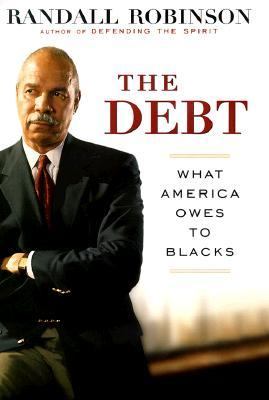
#6 - The Debt

The Debt: What America Owes to Blacks, by Randall Robinson (New York: Dutton, 2000).

Summary: "In Randall Robinson's view, racial problems can't be solved until America is willing to face up to the devastating effects of slavery and educate all Americans, black and white, about the history of Africa and its people. In his recent book, the highly successful Defending the Spirit: A Black Life in America, Robinson makes a stirring call to form the next legion of African-American leadership. Now, in The Debt, he argues that reclaiming the lost history of Africa and African-Americans will help provide a much-needed springboard for solving many of today's problems -- from finding new leadership within the black community to developing meaningful educational programs to helping black people empower themselves economically. Robinson also argues that the United States must be prepared to make restitution to African-Americans for 246 years of slavery, and the century of de jure racial discrimination that followed, via major educational programs and economic development. Robinson offers a solution-oriented approach to controversial issues of social justice in a style that is both personal and informative."

Table of Contents:
  1. Reclaiming Our Ancient Self
  2. Taking Account of the Long-Term Psychic Damage
  3. Race to Class to Race
  4. Self-Hatred
  5. Demanding Respect
  6. Race, Money, and Foreign Policy: The Cuba Example
  7. The Cost of Ignoring the Race Problem in America ...
  8. ... and in the Black World
  9. Thoughts about Restitution
  10. Toward the Black Renaissance
My Take: If you haven't guessed, I'm focusing on the theme of race and culture this month. It's interesting to be finishing and reviewing this book, with its discussion of the lasting impact of a 350-year history of slavery and racial discrimination, and simultaneously starting Some Sing, Some Cry, which begins just after emancipation as a former slave whose three children were all fathered by her white master prepares to leave the Low Country plantation on which she's lived her entire life.

This is a hard, hard book for me to review. As with so many other subjects, I'm both eager to learn more, and not sure I know enough to offer any intelligent criticism. The fact that it's a book about race and racism in the U.S., and on paper I'm as white-and-privileged as it gets, makes this post all the more challenging. Bottom line, though, is that I'm glad I read The Debt, and have just added its successor, The Reckoning, to my book list. While I'm not sure I agree with Robinson's call for reparations to the descendants of former slaves, or how on earth a reparations program might work in practice, the book made me think about much of America's history and culture in a new light. That's a valuable outcome, just by itself.

To be brief, Robinson's argument is that the 250-year practice of American slavery and the hundred-plus years of racism and de jure discrimination that followed it were, no question, the greatest crime against humanity the world's ever seen. There's no way to eliminate the socioeconomic gap between African-Americans and whites, he says, until we not only acknowledge the magnitude of this wrong, but truly commit to righting it.

The book's middle chapters were for me the most persuasive and compelling. Here, Robinson argues that the Middle Passage and the slave trade, by kidnapping and killing so many young, strong, and able people; separating countless children from their parents and extended families; and doing so on such a broad scale over so many generations, virtually annihilated many of Africa's ancient, highly sophisticated civilizations. The impact of this crime was compounded by a U.S. and Europe that consistently overlook both the role of African people in history and the racism of our own esteemed leaders. We know, if we give it much thought, that Jesus, born in the Middle East to a Jewish woman, was unlikely to have been blond and blue-eyed; that Cleopatra probably didn't look like Elizabeth Taylor; and that George Washington owned slaves. At this point, we've even heard something or other about Thomas Jefferson's affair with Sally Hemmings. But Robinson makes us think about what we don't hear: that Haiti owes its independence to those slaves who revolted against Napoleon's soldiers in 1791; that Jefferson's relationship with Hemmings likely began when she was in her mid-teens and he thirty years older; that even Abraham Lincoln considered shipping all American blacks back to Africa after emancipation; that Charles Lindbergh was "a self-described racist [who] had written in Reader' Digest in 1939 that aviation was 'a gift from heaven ... a tool specially shaped for Western hands ... one of those priceless possessions which permit the white race to live at all in a pressing sea of yellow, black, and brown" and urged the U.S. to enter World War II on the German side. Nor is Robinson inclined to let any of these popular heroes off easily, on account of their living in different times with different standards:
"It is often argued in Jefferson's defense that it is unfair to hold his behavior with regard to race to modern standards, that after all he was 'a man of his time.' But who isn't? ... What about Genghis Khan? ... As the first ruler of united Mongolia, he is thought of by Mongolians much the same way as most Americans think of George Washington. In the West, of course, he is remembered as a ruthless scourge. But he was every bit as much a man of his time as Jefferson was of his.

"For that matter, the same specious excuse can be offered for Ataturk or Franco or Lenin or Mao or Hitler. All of them committed great wrongs within permissive if not supportive environments. But this cannot be allowed to render their heinous wrongs any less reprehensible."
Robinson notes that Thomas Paine, a man of the same time as Washington and Jefferson, called the slave trade "lamentable," "wicked," "inhuman," and "barbarous." He also asks the reader to consider why Washington, D.C. boasts a Holocaust museum but not a slavery or African-American museum:
"For wasn't the practice of slavery at least as serious a system of human rights wrongs as the Nazi holocaust? Did not the holocaust of slavery last longer -- indeed, 234 years longer? Did it not claim at least twice as many lives, in the Middle Passage alone? Did it not savagely eviscerate the emotional core of a whole race of people on three continents?"
Understand that Robinson is not seeking here to blame the Jews for American racism, or minimize their own experience of discrimination and human rights crimes; in fact, on several occasions, he cites the Jewish community's call for post-Holocaust reparations and the German government's relative generosity in paying them as positive examples to be emulated. Rather, he argues that the utter absence of black or African faces in the American story as generally told tells African-Americans that they and their contributions are valueless.
"Since this nation's inception, taxpayers -- white, black, brown -- have spent billions on museums, monuments, memorials, parks, centers for the performing arts, festivals, and commemorative occasions. Billions more have been spent on the publication of history texts, arts texts, magazines, newspapers, and history journals. Formulaic television and large-screen historical fiction treatments virtually defy count. Almost none of this spending, building, unveiling, and publishing has been addressed to the needs of Americans who are not white. ... And, indeed, needs are what we are talking about here. ... Ancestor worship is not alone the exotic preoccupation of quaint people mired in superstition in some remote corner of the world. Larger-than-life evidence of its industrialized-world variants can be seen in virtually every public park in America. ...

"Trouble is, George Washington is not my ancestor, private or public. He owned my ancestors, abused them as chattel and willed them to his wife, Martha, upon his death. I and mine need to know about George and Martha but, assuredly, we do not need to revere them. Indeed, psychically we cannot afford to revere them. ... Blacks need to remember who we are, not remember with others who they are."

I'm not sure this distinction is as black and white as Robinson suggests here; the U.S. is, after all, a nation of immigrants and mutts, and I suspect many of us see Washington and Jefferson not strictly as ancestors or owners, but as both -- or neither. Even if his argument is oversimplified, though, his broader point is at least worthy of consideration.
"In every competitive society, instruction in history and the humanities is a valuable instrument with which the dominant group, consciously or unconsciously, attempts to sustain its primacy, ill-gotten or not. In America, whites control virtually every mainstream purveyor of instruction, academic and ephemeral. And in America, whites have caused all Americans to read, see, hear, learn, and select from a diet of their own ideas, with few others placed to make suggestions, not to mention decisions. ... State and federal budgets, to which Asians, Hispanics, and African Americans contribute, are uniformly controlled by whites who seem to uniformly believe that the only ancestor worship worth funding is theirs."
The end products of this whitewashed history, asserts the book, are a persistent self-hatred within the black community and pervasive low expectations that extend beyond it.
"[A] static, unarticulated, insidious racial conditioning, to which all Americans are subject, lifts the high-expectation meritless (Dan Quayle comes to mind here) and, more often than not, locks down in a permament class hell the natively talented but low-expectation black. The gap mocks the efforts of the best of us, black and white, like some ageless yawning crevasse that separates the perennially privileged on their gilded higher ground from those who learn from birth to expect and therefore to reach for little."
Or, from a later chapter:
"[I]t is the very normalcy of our self-denial, our self-ignorance, that is so troubling. It all leads me to wonder whether any group of people in the world has been more resolutely, if unconsciously, committed to notions of self-abnegation than blacks. Well-trained, quiet-flowing, oblivious, uncritical, near total cultural self-abnegation. It is akin to driving in heavy night fog. Little can be seen of where we're going, less still of where we've been. The thickness of the blanket pitch steals our confidence. We conclude that the only hope is to follow the broken white line that snakes in the darkness."

Self-hatred, says Robinson, is evident in the performance of many black comedians, but is not limited to African-American images and experience; Native Americans are marginalized in much the same way. This is a tough argument to make convincingly (here's the danger of reviewing this book while I'm in the middle of reading The Race Card), as it's easily trivialized by those who think the struggle for civil rights and equality is so over already, but an extended thought experiment offered here at least makes you think twice about how insidious and offensive the cultural mainstream can be:
"On occasion, between [televised sports] plays, I have allowed myself to imagine certain franchise transmutations. I would change the team's name and logo, and then try to gauge public reaction.

"The Washington Redskins would become the Washington Blackskins. The logo on the helmet would look like the old caricatured Aunt Jemima. That Sunday, the Blackskins would be playing in Atlanta against Ted Turner's renamed football team, the Atlanta Mafia, who were coached by an Irishman named Maloney but known to all America variously as the Don and the Assassin. On the side of their helmets was a likeness of Al Capone. Before the game, toy machine guns had been handed to the Turner Field faithful, who screamed throughout on cue from Miss Fonda: Rat tat tat. Thatsa deada Blackskin. Thatsa deada Blackskin.

"That same Sunday, the New York Jews had a bye and did not play. One nationally syndicated sports columnist had written that the Jews did not play because they had a 'buy.' No one seemed to notice. After all, it was all in good fun.

"Across town at George Armstrong Custer Stadium, the New York Genocidists were wrapping up a four-game World Series sweep of the Massachusetts Pilgrim Feeders. The Indians had lost the first three games by large margins. The Genocidists, who wore blue and yellow uniforms reminiscent of the old U.S. horse cavalry, were led by a coach who called himself the General. The team's logo was a half-tone of a slightly inebriated Ulysses S. Grant. That evening, when the eleven-to-one score was announced on the evening news, the New York announcer said, 'The Genocidists have slaughtered the Pilgrim Feeders once again.' ...

"As inclined as blacks understandably are by painful experience to believe the contrary, racism is not black-specific. It is like the Hydra, the lethal many-headed mythological snake whose heads regenerated as fast as they were severed. Racism is a social disease that exempts no race from either of its two rosters: victims and victimizers."

Robinson also acknowledges the complex interplay between race and class. A long anecdote about a poor, black girl growing up in Boston who's got the deck stacked against her suggests that this interaction is most apparent in education. Many middle- and upper-income people of color are doing so as we speak; likewise, many white people, especially those who are poor, are not. The key difference, however, is that one can be poor and white without people assuming you're poor because you're white; poverty isn't thought to be intrinsically linked with being white in America. By contrast, if you're poor and black, it's just assumed that you're poor because you're black. We believe poor students can succeed, and we believe black students can succeed -- but consciously or otherwise, teachers often expect students who are poor and black to fail. While I don't agree 100% with everything Robinson says in this book, I find him most persuasive when he's arguing for the vital role education must play in combating inequality and injustice:
"Give a black or white child the tools (nurture, nutrition, material necessities, a home/school milieu of intellectual stimulation, high expectation, pride of self) that a child needs to learn and the child will learn. Race, at least in this regard, is irrelevant. ... It is obvious that in any effort to balance America's racial scales, education, defined in the broadest sense, must be assigned the very highest priority."
Where The Debt loses me is in its final two chapters, where Robinson actually makes the call for reparations that he's been working up to all along. I started the book knowing very little about the particulars of the reparations discussion, but skeptical about the overall concept. By the time I reached Chapter 9, though, Robinson's claims had hit their mark; I was sufficiently moved by his discussion of the suppression and denial of the African and African-American role in US history and culture that I was at least willing to be persuaded. Perplexingly, though, the last two chapters don't even begin to do so. Having spent the bulk of the text convincing the reader that a grave injustice was done to black Americans, orders of magnitude greater than other now widely-acknowledged crimes against humanity, Robinson's last two chapters are curiously vague: long on well-written oratory about how something material is owed, but short on specifics as to what, how, and to/ from whom. And personally, that's exactly what I wanted to hear at this point: How, exactly, might reparations for slavery be funded? Who would reap the benefits? Again, look at the racial, ethnic, and class makeup of our country; not everyone fits neatly into a "former slave" or "former master" box. Some of us may be both; some neither; still others may have no way of knowing. Sure, a comprehensive answer to these questions is about as easy as a hard-and-fast definition of race, but given the book's title, I at least expected Robinson to take a more substantive stab at it.

Wednesday, October 20, 2010

#74 - Red Families v. Blue Families

Red Families v. Blue Families: Legal Polarization and the Creation of Culture, by Naomi Cahn and June Carbone (Oxford, NY: Oxford University Press, 2010).

Summary: "Red Families v. Blue Familieseared for the post-industrial economy. Rooted in the urban middle class, the coasts and the 'blue states' in the last three presidential elections, the Blue Family Paradigm emphasizes the importance of women's as well as men's workforce participation, egalitarian gender roles, and the delay of family formation until both parents are emotionally and financially ready. By contrast, the Red Family Paradigm -- associated with the Bible Belt, the mountain west, and rural America -- rejects these new family norms, viewing the change in moral and sexual values as a crisis. In this world, the prospect of teen childbirth is the necessary deterrent to premarital sex, marriage is a sacred undertaking between a man and a woman, and divorce is society's greatest moral challenge. Yet the changing economy is rapidly eliminating the stable, blue collar jobs that have historically supported young families, and early marriage and childbearing derail the education needed to prosper. The result is that the areas of the country most committed to traditional values have the highest divorce and teen pregnancy rates, fueling greater calls to reinstill traditional values. Featuring the groundbreaking research first hailed in The New Yorker, this penetrating book will transform our understanding of contemporary American culture and law. The authors show how the Red-Blue divide goes much deeper than this value system conflict -- the Red States have increasingly said 'no' to Blue State legal norms, and as a result, family law has been rent in two. The authors close with a consideration of where these different family systems still overlap, and suggest solutions that permit rebuilding support for both types of families in changing economic circumstances. Incorporating results from the 2008 election, Red Families v. Blue Families will reshape the debate surrounding the culture wars and the emergence of red and blue America."

Table of Contents:
  • Introduction
Part 1: Family Maps
  • 1. Moral Demography
  • 2. Sexual History
  • 3. The Age of Division
  • 4. Personality, Politics, and Religion
Part 2: The Legal Map
  • 5. Contraception: Securing the Pathways to Blue Family Life
  • 6. Abortion, Law and the Cognitive Map
  • 7. The Irrationality of Adolescence: What the Adults Are Really Fighting Over
  • 8. The Marrying Laws
  • 9. Custody and Compromise
Part 3: The Map to the Future
  • 10. Marriage Advice in Shades of Pink
  • 11. Making Ready for Baby: Painting the Nursery Sky Blue
  • 12. Work and Family: Retooling the Foundation in Deep Purple
  • Conclusion
My Take: Some interesting ideas and a reasonably even-handed presentation, but overall, far too oversimplified to hold water. The authors' thesis, and what makes it problematic, are evident in the first two pages of the introduction:
"Families are on the front lines of the culture wars. Controversies over abortion, same-sex marriage, teen pregnancy, single parenthood, and divorce have all challenged our images of the American family. Some Americans seek a return to the 'mom, dad, and apple pie' family of the 1950s, while others embrace all of our families, including single mothers, gay and lesbian parents, and cohabiting couples. ... [T]he new information economy is transforming the family -- and doing so in ways that create a crisis for marriage-based communities across the country.

"The 'blue families of our title are on one side of the cultural controversy. These families have reaped the handsome rewards available to the well-educated middle class who are able to invest in both their daughters' and sons' earning potential. Their children defer family formation until both partners reach emotional maturity and financial independence. Blue family champions celebrate the commitment to equality that makes companionate relationships possible and the sexual freedom that allows women to fully participate in society. Those who have embraced the blue family model have low divorce rates, relatively few teen births, and good incomes. Yet the ability to realize the advantages of the new blue family system appears to be very much a class-based affair. Women who graduate from college are the only women in American society whose marriage rates have increased, and they and their partners form the group whose divorce rates have most appreciably declined.


"The terms of the successful blue family order -- embrace the pill, encourage education, and accept sexuality as a matter of private choice -- are a direct affront to the 'red families' of our title and to social conservatives who see their families in peril. Driven by religious teachings about sin and guilt, and based in communities whose social life centers around married couples with children, the red family paradigm continues to celebrate the unity of sex, marriage, and procreation. Red family champions correctly point out that the growing numbers of single-parent families threaten the well-being of the next generation, and they accurately observe that greater male fidelity and female 'virtue' strengthen relationships. Yet, red regions of the country have higher teen pregnancy rates, more shotgun marriages, and lower average ages at marriage and first birth. What the red family paradigm has not acknowledged is that the changing economy has undermined the path from abstinence through courtship to marriage. As a result. abstinence into the mid-20s is unrealistic, shotgun marriage correspond with escalating divorce rates, and early marriages, whether prompted by love or necessity, often founder on the economic realities of the modern economy, which disproportionately rewards investment in higher education. Efforts to insist on a return to traditional pieties thus inevitably clash with the structure of the modern economy and produce recurring cries of moral crisis."

So there's the argument in a nutshell. On the surface, it's an intriguing idea: that "[t]he biggest differences between red and blue families center on age: age at marriage and age at first birth," and that "[w]hat happens during the teen years establishes the paths to adulthood. If teens postpone their assumption of adult roles, such as parenting or leaving school, until their mid-20s, they invest more in education, acquire independence, and learn how to navigate in the world before they marry. Conversely, those who marry before they turn 21 and have children soon after are likely to bear more children, interrupt their educations, and negotiate the terms of adulthood within a more fragile relationship." And I don't argue with the statistics that show the highest teen birth and marriage rates to be in solidly red states, and the lowest in consistently blue ones. (I'm not sure Cahn and Carbone's approach -- they look at the most extreme 5 states on either end of several distributions -- is an altogether valid way to draw conclusions about states in the middle and/or smaller geopolitical entities, though that's not my biggest quibble with the book.)

I do think, though, that reducing most or all of the red/ blue divide to "red families marry and have kids young, blue families wait" is grossly oversimplified. Might there be some nugget of truth here, or at least something worth further study? Sure, but this is still only part of the story at best. What about the blue collar, organized labor strain of blue families -- admittedly, there are far fewer of them than there were a generation ago, but they're still out there? Or the upper middle class, "prosperity gospel" red families? Heck, what about the complicated relationship between race and political affiliation; in particular, African-Americans are overrepresented in lower income ranges and underrepresented at higher educational levels, but still disproportionately "blue" voters. While the authors touch upon race briefly, it's almost presented as an inconvenience: well, the highest and lowest teen and nonmarital birth rates don't quite fit our red state-blue state split here, but that's because these states have high minority populations and minorities' rates are different anyway.

This isn't to say that I found Red Families v. Blue Families completely without merit. The overview of American attitudes and laws around sexual behavior, contraception, abortion, and marriage was concise and well-written (though there's not much new ground here for anyone who's taken a family law class or is familiar with Stephanie Coontz's work). I also appreciated the context and perspective the authors provide on same-sex marriage and custody issues. I'm not sure, though, how I feel about the conclusion. On one hand, pointing out areas where the red and blue positions aren't too far apart (promoting stable marriage by supporting adolescents' transition to adulthood; reducing the number of unwanted pregnancies; reconsidering the relationship among work, family, and education) doesn't happen often enough ... on the other, it sidesteps some of the more contentious issues the authors touch upon (i.e., abortion rights and same-sex parenting), and probably overstates the areas of overlap. (Yes, expanded funding for contraceptives may well reduce abortions, but that still doesn't mean the redder states will go for it. Yes, our health care system needs a comprehensive overhaul, but unless you've been asleep for the last 2 years, you know what a huge issue this is -- which makes sticking it in a single paragraph in the conclusion seem like a not-very-skilled dodge.)

In summary, worth a read (especially if you read anything, like me) and a discussion, but makes a far lesser contribution to the discussion than I'd hoped.

Sunday, July 25, 2010

#59 - Idiot America

Idiot America: How Stupidity Became a Virtue in the Land of the Free, by Charles P. Pierce (New York: Doubleday, 2009).

Jacket summary: "It was the saddle on the dinosaur that did it. In a legendary journalism career, Charles P. Pierce has interviewed vacuous movie stars, disingenuous politicians, cretinous sports heroes, and all manner of charlatans, demagogues, and fanatics. But it wasn't until his visit to the Creation Museum in Hebron, Kentucky, that he realized just how far gone America is. At the center of this popular tourist spot are models of dinosaurs, one of which is wearing a saddle. 'We are taking the dinosaurs back from the evolutionists!' cries the proprietor, who runs something called Answers in Genesis, an organization dedicated to the proposition that the biblical story of creation is inerrant in every word. Since the Bible says the world was created 6,000 years ago, then dinosaurs must have been around at the same time as humans, who were given mastery by God over all the creatures on earth ... ergo, the saddled dinosaur.

"This kind of thinking is not the exception in America, not the province of a few cranks who used to be viewed as eccentrics outside the mainstream. Idiocy is the mainstream. More people vote for the American Idol winner than vote in presidential primaries. Dire warnings from scientists about global warming and from engineers about our crumbling infrastructure are ignored, but gay marriage and flag-burning bans dominate political debate. Mass media divides its coverage between the latest arrests of Britney and Paris and demagogic scream fests led by populist multimillionaires. The Internet, far from 'letting information be free,' has devolved into a chaotic forum where ignorance spreads like a virus.

"The culture wars are over. The idiots have won.

"This pisses Pierce off immensely. Like all cynics, he's secretly a romantic at heart, and his disbelieving anger is fueled by the knowledge that America doesn't have to be this way. Like an Old Testament prophet (albeit an agnostic, funny one), Pierce lets loose on the foibles of society in the secret hope that, somehow, being smart will stop being a stigma and idiots will once again be pitied and not celebrated. But don't get your hopes up."

Table of Contents:
  • Introduction: Dinosaurs with Saddles (August 2005)
Part I: The American Way of Idiocy
  • Chapter 1: The Prince of Cranks
  • Chapter 2: The War on Expertise
  • Chapter 3: Beyond Atlantis
  • Chapter 4: The Templars in Town
Part II: Truth
  • Chapter 5: Radio Nowhere
  • Chapter 6: God and Judge Jones
Part III: Consequences
  • Chapter 7: A Woman Dies on Beech Street
  • Chapter 8: How We Look at the Sea
  • Chapter 9: The Principles of Automatic Pilot
Part IV: Mr. Madison's Library
  • Chapter 10: Torture in New Hampshire
  • Chapter 11: Mr. Madison's Library
My take: Extremely entertaining, if almost as extremely partisan, and I say this even tho' I mostly agree with Pierce's stance. Red staters, if you have blood pressure issues, you may want to pass this one by.

Pierce starts off with what seems like an extreme example: the saddled dinosaur, which you already know about if you read the jacket flap. Ayup, creationism gone wild. The same museum sports a eunuch-ized statue of Adam, and an Eve with strategically-arranged long hair that Pierce compares to an old Swedish art film. He makes it easy to laugh at this stuff, but at the same time, draws you into the half-perplexed, half-angry question at the heart of the book: How the heck did we get here? Why are we in this place where we're "drowning in information and thirsty for knowledge," and where it seems our whole country is "entertained but not engaged"?

Parts I and II, where Pierce explores this question, are the strongest and most intriguing parts of the book. He argues that wild and crazy ideas which nonetheless garner a respectable following are nothing new in the U.S.; in fact, the country was founded on them. Pierce calls this "the best country ever in which to peddle complete public lunacy. In fact, it's the only country to enshrine that right in its founding documents." Sure, this right has led to some wacky detours (Pierce is fond of citing Ignatius Donnelly, a 19th-century crank who believed the lost City of Atlantis provided the foundation of western civilization), but sometimes, cranks who initially seemed just as, er, unhinged provided the conflict by which the national consensus ultimately changed.

In short, it's not the eccentrics with the loopy ideas that are the problem. No, the problem comes when "the crank is devalued [and] his ideas are accepted untested and unchallenged into the mainstream." Pierce attributes this in large part to television, where anyone can look like an expert if they appeal to our emotions rather than our intellect. Ergo, you have what he calls the war on expertise, which is based on 3 premises:
  1. Any theory is valid if it sells books or soaks up ratings. This is the mechanism by which Mitch Albom's The Five People You Meet in Heaven -- a cute if somewhat treacly novel about one fictional man's after-death experience -- gets turned into someone's idea of inspirational theology. C'mon, people. I read the book and thought it was an interesting little story, but I thought The Lord of the Rings was interesting, too -- I'm still not looking for hobbit-holes beneath the nearest oak tree.
  2. Anything can be true if someone says it loudly or often enough. Did you know Al Gore never really claimed to have invented the internet? Again, here's where TV becomes a big part of the problem; before multiple screens in every home were commonplace, the cranks had to work much harder to get their ideas out to the public. Now, however, well -- "idiocy is almost always good television."
  3. Fact is that which enough people believe; truth is determined how fervently they believe it.
Pierce provides plenty of intriguing and entertaining examples of these premises in action, ranging from the transformation of a planned Texas superhighway into a trans-continental NAFTA superhighway (completely false, and managed to overshadow many legitimate concerns about the consequences of North American free trade) to the age-old belief that just about everything is a conspiracy controlled by the Masons. (Here again, shades of the same Mitch Albom Five People problem resurface with a vengeance, as a Mason-orchestrated conspiracy is central to Dan Brown's DaVinci Code. Brown, Pierce argues, probably never intended this. "To his credit, Brown wrote an intriguing thriller. It's hardly his fault that people read it and integrated into the personal views of the hidden world." He also includes an amusing interview with a long-term Mason from the Boston area, who invites Mason conspiracy theorists to attend his local lodge's annual dinner for a reality check. "Just plan that dinner and see if you think we're capable of pulling off some major conspiracy. You can barely get that dinner done."

Unfortunately, the more contemporary section -- from the Kennedy administration forward -- seems both less clear and harder to believe. While I enjoyed pondering Pierce's contrast of all the wacky conspiracy theories that still about (especially in Dallas) about the Kennedy assassination with our near-blindness to the real conspiracies that have dotted our political landscape since (i.e., the Iran Contra affair), this section of the book reads too much like a rough draft. Likewise, while I'm certainly no fan of the second Bush administration, I'm not sure all Pierce's assertions about their actions are true, or at least, fairly presented. It may very well have been, as Pierce suggests, that he focuses on right-wing idiocy and pandering because "it was the modern American right that consciously adopted irrationality as a tactic and succeeded very well," but I find it hard to believe there haven't been at least some similar examples on the other side of the aisle. Part of what makes this book a good read is that it doesn't try to be impartial, and I'm not suggesting that Pierce should have lost that -- but some acknowledgment that both sides have been known to pander and dissemble at least occasionally would have made for a much stronger argument.

Tuesday, July 6, 2010

#53 - Food, Inc.

Food, Inc.: How Industrial Food Is Making Us Sicker, Fatter, and Poorer -- and What You Can Do About It, edited by Karl Weber (New York: PublicAffairs, 2009).

Jacket summary: "The movie Food, Inc. is shaking up our perceptions of what we eat. This powerful documentary deconstructing the corporate food industry in America has been hailed by Entertainment Weekly as 'more than a terrific movie -- it's an important movie.'

"Now, this unique companion book explores the challenges raised by the movie in fascinating depth through thirteen essays, most of them written especially for this book, and many by experts featured in the film. Highlights include:
  • Eric Schlosser on the industrialization of our food supply
  • Michael Pollan on the benefits of locally-sourced, organic eating
  • Robert Kenner, director, on the making of Food, Inc.
  • Marion Nestle on sorting out food facts from fictions
  • Anna Lappe on how the U.S. food system promotes global warming
  • Muhammad Yunus on the global impact of food industrialization
  • Joel Salatin on how to declare your independence from industrial food
  • Gary Hirshberg on how organic food is going mainstream
"If daily headlines about food poisoning, pollution, labor abuse, and rampant hunger have left you worried or confused about the foods you eat, Food, Inc. provides the facts behind the problems -- and shows you what you can do to make a difference."

Table of Contents:

Part I: Food, Inc.: The Film
  • 1. Reforming Fast Food Nation: A Conversation with Eric Schlosser
  • 2. Exploring the Corporate Powers Behind the Way We Eat: The Making of Food, Inc.
Part II: Inside the Food Wars
  • 3. Organics -- Healthy Food, and So Much More
  • 4. Food, Science, and the Challenge of World Hunger -- Who Will Control the Future?
  • 5. The Ethanol Scam: Burning Food to Make Motor Fuel
  • 6. The Climate Crisis at the End of Our Fork
  • 7. Cheap Food: Workers Pay the Price
  • 8. The Financial Crisis and World Hunger
Part III: What You Can Do About It
  • 9. Why Bother?
  • 10. Declare Your Independence
  • 11. Eating Made Simple
  • 12. Improving Kids' Nutrition: An Action Tool Kit for Parents and Citizens
  • 13. Produce to the People: A Prescription for Health
My take: This book is exactly what it says it is: a companion volume to the movie. It's also well worth reading whether or not you've seen the movie, as it neither presupposes knowledge from the film or rehashes all the same ground that's visited there. Rather, it does a nice job of going into more detail about some of the points not really elaborated on in the movie -- specifically, the degree to which the "always low prices" in our industrial food system rest on the backs of exploited farm workers, and the role our food system plays in exacerbating climate change. On one hand, this is hardly a balanced perspective; on the other, I do believe Kenner's claim in the second chapter that he tried to present the big food companies' perspectives, but they simply refused to talk to him.

If you're wondering whether the movie is worth it, are interested in the subject without the visuals, or have seen the movie and want to know more, read Food, Inc. It just may put you off a lot of food items for good, though.

Friday, July 2, 2010

#51 - The Tyranny of E-Mail

The Tyranny of E-Mail: The Four-Thousand-Year Journey to Your Inbox, by John Freeman (New York: Scribner, 2009).

Jacket summary: "The first e-mail was sent less than forty years ago; by 2011, there will be 3.2 billion e-mail users. The average corporate worker now receives upwards of two hundred e-mails per day. The flood of messages is ceaseless and follows us everywhere. We check e-mail in transit; we check it in the bath. We check it before bed and upon waking up. We check it even midconversation, blithely assuming no one will notice. We no longer make our own to-do list. E-mail does.

"It's time for a break. In The Tyranny of E-Mail, John Freeman takes an entertaining look at the nature of correspondence through the ages. From love poems delivered on clay tablets through the art of the letter to the first era of information overload (via the telegraph) to the vast network brought on by the Internet, Freeman answers the difficult question, Where is this taking us?

"Put down your BlackBerry and consider the consequences. As the toll of e-mail mounts by reducing our time for leisure and contemplation and by separating us from one another in an unending and lonely battle with the overfull inbox, John Freeman -- one of American's preeminent literary critics -- enters a plea for communication that is more selective and nuanced and, above all, more sociable."


Table of Contents:
  1. Introduction
  2. Words in Motion
  3. The Invention of Now
  4. All Together Now
  5. This Is Your Brain on E-Mail
  6. Dawn of the Machines
  7. Manifesto for a Slow Communication Movement
  8. Don't Send
My take: This was an interesting read, but didn't quite live up to the promise suggested by its strong start. The first chapters offer a whirlwind overview of communication technology, from the world's oldest love poem, carved in cuneiform some 4,000 years ago, to the speed-of-light pace of today's email and chat offerings. In the Introduction, Freeman presents the contrast in a gorgeous and provocative manner, describing first the love poem:
"Love may not be forever, but this expression of it has outlasted swords forged by fire, cities designed by the finest architects, the largest machine ever to fly, and the most titanic boat ever to sail. To write his verse, the poet would have had to compose the lines in his head or recite them to a friend. Then he would have molded the clay tablet and slowly, but deliberately, carved his verse into it with a reed staff before the clay hardened. Finally, he would have dried the poem in the sun and waited another day for it to cool, when it could be delivered by his beloved by hand."
and then, a page or so later, the quantity-over-quality attitude exemplified by Google's unlimited storage:
"Thanks to a group of 450,000 machines scattered across the United States like underground missle bunkers, I could store more e-mails than there are blades of grass in Kansas. This is beyond unprecedented -- it is superhuman. Is God's inbox this big? ... What busy individual needs this industrial-strength capacity for his correspondence tool? What buzzing, humming megalopolis tunes in to this techno-rave of send and receive, send and receive? Is the human brain wired to receive this much stimuli? Can our eyes scan this many separate pieces of information? Is anyone listening?"
He goes on to argue that contemporary American worker bees are swamped by what he deems an email tsunami, sending and receiving an average of 200 emails per day, expected to be constantly on-call to a degree formerly reserved for doctors, plumbers, and heads of state.

Since I've long looked with skepticism on any claims that the world's going to hell in a handbasket, and that things were much better in the good old days, I got a chuckle or 3 out of Freeman's communication history, reading about how once upon a time, folks were shocked by the introduction of the postal service and the typewriter. I also found myself agreeing with some of what he suggests are the negative consequences of our constant connection to email, such as fractured attention spans and little or no uninterrupted time for complex, creative thinking. And I certainly don't think, for the majority of workers, being constantly tethered to our jobs by electronic leashes is a good thing (which is why I'm able to resist it for myself).

That said, though, I'm not sure Freeman's prescription -- essentially, calling for us to think before we send still more email, and train ourselves to check and respond to email only a few times a day -- is all that revolutionary (heck, almost any time management book will offer similar suggestions), or that email has been quite as bad for our social and familial lives as he'd have us believe. Could most of us stand to spend more time with our friends IRL, and less commenting on our Facebook friends' statuses? Sure. But in a world where many of us are like me -- relatives a good day's drive away, and dear friends on the other side of the globe -- there's also a lot to be said for having other options. And while I do indeed see plenty of people using their laptops in my local cafes, I also see plenty chatting with friends or reading low-tech books.

I don't want to suggest that The Tyranny of E-Mail is a bad book; I just think I may already be in the choir to which Freeman's preaching. If you're an early adopter and never really thought much about whether contemporary communication technologies are an unqualified good thing, give this one a read ... if you've pondered this some on your own, though, the book may not do much for you.