About Me

Ithaca, New York
MWF, now officially 42, loves long walks on the beach and laughing with friends ... oh, wait. By day, I'm a mid-level university administrator reluctant to be more specific on a public forum. Nights and weekends, though, I'm a homebody with strong nerdist leanings. I'm never happier than when I'm chatting around the fire, playing board games, cooking up some pasta, and/or road-tripping with my family and friends. I studied psychology and then labor economics in school, and I work in higher education. From time to time I get smug, obsessive, or just plain boring about some combination of these topics, especially when inequality, parenting, or consumer culture are involved. You have been warned.
Showing posts with label race. Show all posts

Wednesday, October 17, 2012

#90: The Immortal Life of Henrietta Lacks

The Immortal Life of Henrietta Lacks, by Rebecca Skloot
(New York: Crown Publishers, 2010)
Summary:
"Her name was Henrietta Lacks, but scientists know her as HeLa. She was a poor Southern tobacco farmer who worked the same land as her slave ancestors, yet her cells -- taken without her knowledge -- became one of the most important tools in medicine. The first 'immortal' human cells grown in culture, they are still alive today, though she has been dead for more than sixty years. If you could pile all HeLa cells ever grown onto a scale, they'd weigh more than 50 million metric tons -- as much as a hundred Empire State Buildings. HeLa cells were vital for developing the polio vaccine; uncovered secrets of cancer, viruses, and the atom bomb's effects; helped lead to important advances like in vitro fertilization, cloning, and gene mapping, and have been bought and sold by the billions.

"Yet Henrietta Lacks remains virtually unknown, buried in an unmarked grave.

"Now Rebecca Skloot takes us on an extraordinary journey, from the 'colored' ward of Johns Hopkins Hospital in the 1950s to stark white laboratories with freezers full of HeLa cells, from Henrietta's small, dying hometown of Clover, Virginia -- a land of wooden slave quarters, faith healings, and voodoo -- to East Baltimore today, where her children and grandchildren live and struggle with the legacy of her cells.

"Henrietta's family did not learn of her 'immortality' until more than twenty years after her death, when scientists investigating HeLa began using her husband and children in research without informed consent. And though the cells had launched a multimillion-dollar industry that sells human biological materials, her family never saw any of the profits. As Rebecca Skloot so brilliantly shows, the story of the Lacks family -- past and present -- is inextricably connected to the dark history of experimentation on African Americans, the birth of bioethics, and the legal battles over whether we control the stuff we are made of.

"Over the decade it took to uncover this story, Rebecca became enmeshed in the lives of the Lacks family -- especially Henrietta's daughter Deborah, who was devastated to learn about her mother's cells. Deborah was consumed with questions: Had scientists cloned her mother? Had they killed her to harvest her cells? And if her mother was so important to medicine, why couldn't her children afford health insurance?

"Intimate in feeling, astonishing in scope, and impossible to put down, The Immortal Life of Henrietta Lacks captures the beauty and drama of scientific discovery, as well as its human consequences."

Table of Contents:
Part One: Life
1. The Exam ... 1951
2. Clover ... 1920-1942
3. Diagnosis and Treatment ... 1951
4. The Birth of HeLa ... 1951
5. 'Blackness Be Spreadin All Inside' ... 1951
6. 'Lady's on the Phone' ... 1999
7. The Death and Life of Cell Culture ... 1951
8. 'A Miserable Specimen' ... 1951
9. Turner Station ... 1999
10. The Other Side of the Tracks ... 1999
11. 'The Devil of Pain Itself' ... 1951

Part Two: Death
12. The Storm ... 1951
13. The HeLa Factory ... 1951-1953
14. Helen Lane ... 1953-1954
15. 'Too Young to Remember' ... 1951-1965
16. 'Spending Eternity in the Same Place' ... 1999
17. Illegal, Immoral, and Deplorable ... 1954-1966
18. 'Strangest Hybrid' ... 1960-1966
19. 'The Most Critical Time on This Earth Is Now' ... 1966-1973
20. The HeLa Bomb ... 1966
21. Night Doctors ... 2000
22. 'The Fame She So Richly Deserves' ... 1970-1973

Part Three: Immortality
23. 'It's Alive' ... 1973-1974
24. 'Least They Can Do' ... 1975
25. 'Who Told You You Could Sell My Spleen?' ... 1976-1988
26. Breach of Privacy ... 1980-1985
27. The Secret of Immortality ... 1984-1995
28. After London ... 1996-1999
29. A Village of Henriettas ... 2000
30. Zakariyya ... 2000
31. Hela, Goddess of Death ... 2000-2001
32. 'All That's My Mother' ... 2001
33. The Hospital for the Negro Insane ... 2001
34. The Medical Records ... 2001
35. Soul Cleansing ... 2001
36. Heavenly Bodies ... 2001
37. 'Nothing to Be Scared About' ... 2001
38. The Long Road to Clover ... 2009

My Take:
Well worth waiting for. Just enough scientific detail about the history of cell culture and experimentation, with all its missteps and exciting developments, to provide context, but this is primarily a story about Henrietta Lacks herself, her family, and the racist, classist wrongs often done to poor, uneducated people of color in the name of science before we arrived at our current principles of medical ethics. Fascinating if often sad and infuriating read.

Wednesday, November 16, 2011

#98: The Girl Who Fell From the Sky

The Girl Who Fell From the Sky, by Heidi W. Durrow (Chapel Hill, NC: Algonquin Books of Chapel Hill, 2010)

Summary:
"Rachel, the daughter of a Danish mother and a black G.I., becomes the sole survivor of a family tragedy after a fateful morning on a Chicago rooftop.

"Forced to move to a new and strange city, with her strict African American grandmother as her new guardian, Rachel is thrust for the first time into a mostly black community, where her light brown skin, startling blue eyes, and beauty bring a constant stream of attention her way. It's there, as she grows up and tries to swallow her grief, that she comes to understand how the mystery and tragedy of her mother might be connected to her own uncertain identity. Raised by her mother to think of herself as white, Rachel is now expected to 'act black.' And all the while, she keeps asking herself why she has to be defined by her skin, and whether labels say more about who she is, or more about a world that attempts to brand her as black or white."

Opening Line:
"You my lucky piece," Grandma says.


My Take:
Not quite as clear and gripping all the way through as the first few chapters start out, but nonetheless an outstanding book. It opens in 1982, at which point the not-quite-teenaged Rachel has recently moved to Portland with her grandmother and much younger and warmer Aunt Loretta, and is still stung with fresh grief compounded by her new guardians' refusal to even mention her mother's name. We learn, in fairly short order, that Nella (Rachel's mother) had left not just her abusive husband, but the unique insularity of military base life ... only to find that Chicago @ 1980 couldn't quite wrap its brain around a white mother with three seemingly black children. Eventually, her inability to raise and guide them properly under the circumstances led her to jump (or perhaps be pushed) off a rooftop; only Rachel survived.

While the story centers primarily on Rachel, we do get to know other characters to some degree, including Brick, the young man who was fascinated with birds as a child until he saw Rachel's brother Robbie fall to his death, and Drew, Aunt Loretta's mover-and-shaker boyfriend whose influence in Rachel's life far outlasts his relationship with her aunt.

This may be one I'll want to buy and reread; I think there are probably layers of meaning I didn't quite get the first time around. Even so, I still enjoyed it.

Wednesday, February 2, 2011

#12: Yellow

Yellow: Race in America beyond Black and White, by Frank H. Wu (New York: Basic Books, 2002).

Jacket Summary: "The days when racial dialogue in the United States was limited to a discussion of black and white are through. As the twenty-first century dawns, the Asian-American population is growing at a faster rate than any other demographic, increasing by 48% throughout the 1990s and altering the nature of American color politics forever.

"Writing in the tradition of W.E.B. Du Bois, Cornel West, and others who confronted the 'color line' of the twentieth century, journalist, scholar, and activist Frank H. Wu offers a unique perspective on how changing ideas of racial identity will affect race relations in the new century.

"Wu's description of the alienation faced by Asian Americans tackles key milestones in history, suc as the 1940s internment camps and the 1992 L.A. riots, as well as surprising statistics about the continuing presence of anti-Asian sentiment. In May 2001, a major national survey of highly educated individuals showed that almost half of all Americans believe that Chinese Americans are likely to pass secret information to China. About a third agree that Chinese Americans are probably more loyal to China than the United States, and few distinguish between Chinese Americans and other Asians.

"Yellow looks at the problems of racial diversity with a new focus, elevating the age-old debate from its formerly static terms. Wu examines affirmative action, globalization, immigration and other controversial contemporary issues through the lens of the Asian-American experience. Mixing personal anecdotes, legal cases, and journalistic reporting, Wu confronts damaging Asian-American stereotypes such as 'the model minority' and 'the perpetual foreigner.' By offering new ways of thinking about race in American society, Wu's work dares us to make good on our great democratic experiment."

Table of Contents:
  • 1 - East Is East, West Is West: Asians as Americans
  • 2 - The Model Minority: Asian American "Success" as a Race Relations Failure
  • 3 - The Perpetual Foreigner: Yellow Peril in the Pacific Century
  • 4 - Neither Black Nor White: Affirmative Action and Asian Americans
  • 5 - True But Wrong: New Arguments Against New Discrimination
  • 6 - The Best "Chink" Food: Dog-Eating and the Dilemma of Diversity
  • 7 - The Changing Face of America: Intermarriage and the Mixed Race Movement
  • 8 - The Power of Coalitions: Why I Teach at Harvard
  • Epilogue - Deep Springs
My Take: Interesting, but in places, a bit too dense and philosophical for the layperson. Did offer a different take on race in American life, but I think I need to read about something else for a while.

Thursday, January 27, 2011

#11: Native Son

Don't think I've mentioned this here yet, but I've been listening to an audiobook of Richard Wright's Native Son (New York: Random House, 1940).

Summary: "After 58 years in print, Wright's Native Son has acquired classic status. It has not, however, lost its power to shock or provoke controversy. Bigger Thomas is a young black man in 1940s Chicago who accidentally kills the daughter of his wealthy white employer. He tries to frame the young woman's fiance for the crime and attempts to extort ransom from the victim's family, but his guilt is discovered, and he is forced into hiding. After a terrifying manhunt, he is arrested and brought to trial. Though his fate is certain, he finds that his crimes have given meaning and energy to his previously aimless life, and he goes to his execution unrepentant. Wright avoids the trap of making his hero a martyr, for Bigger is a vicious and violent bully. But out of this tale the author develops a profoundly disturbing image of racism and its results that puts Bigger's experience in horrifying perspective." (-Library Journal Review)

Opening Lines:
"Brrrrrriiiiiinnng!

"An alarm clock clanged in the dark and silent room. A bed spring creaked. A woman's voice sang out impatiently:

"'Bigger, shut that thing off!'"


My Take: I'm just about halfway through the book right now (Bigger's just fled his employer's home, knowing his crime is about to be discovered). Incredibly disturbing, suspenseful, and surprisingly contemporary. I suspect this will be one of this books I appreciate deeply, but can't really say I like.

Wow. Maybe it's the way I took this book in -- a few tracks at a time over several weeks, while in the car or doing the dishes -- but when I finished it last night, I felt both bereft and deeply satisfied. The book's a classic, and synopses/ study guides/ Cliff Notes abound on the internet; I won't spend time providing another one here. But the way Wright unfolds Bigger's story is nothing short of masterful. Even now, having finished the novel, it's hard to wrap my brain around how I could feel at once appalled by the murders Bigger's committed and unconvinced that things could have gone any other way. His jail conversations with Boris Max, lawyer and eventual friend, bring about an ending that's simultaneously devastating, terrifying, and ever-so-slightly hopeful. Frankly, I can't do this book justice.

Monday, January 24, 2011

#10 - The Gendarme

The Gendarme, by Mark T. Mustian (New York: G.P. Putnam's Sons, 2010)

Summary: "What would you do if the love of your life, and all your memories, were lost -- only to reappear, but with such shocking revelations that you wish you had never remembered?

"Emmett Conn is an old man, near the end of his life. A World War I veteran, he's been affected by memory loss since being injured during the war. To those around him, he's simply confused, fading in and out of senility. But what they don't know is that Emmett has been beset by memories, of events he and others have denied or purposefully forgotten.

"In Emmett's dreams he's a gendarme, escorting Armenians from Turkey. A young woman among them, Araxie, captivates and enthralls him. But then the trek ends, the war separates them. He is injured. Seven decades later, as his grasp on the boundaries between past and present begins to break down, Emmett sets out on a final journey, to find Araxie and beg her forgiveness."

Opening Line: "I awake in a whispering ambulance."

My Take: A good story, but didn't quite live up to the potential it suggested at first. I'm reminded of one oft-offered criticism of the movie Julie & Julia: that Meryl Streep's performance as Julia Child was so compelling, the contemporary storyline featuring Amy Adams as the underemployed blogger seemed lacking by comparison. So it is here. By itself, the account of young Turkish Ahmet's service as a gendarme, overseeing the Armenian deportation to Syria, and then deserting the army to follow Araxie, the young Armenian woman who's somehow captivated him, is serviceable enough, albeit not completely convincing. As is almost always true of war stories involving genocide, the Turkish treatment of the Armenians was unimaginably brutal; we see this hear in Ahmet's descriptions of his comrades' behavior, and we simply don't learn enough about who he was before joining the army to know why he'd be any different. Why, then, does he become so enchanted with Araxie that he believes himself in love with her? Even more implausibly, why does Araxie seem to return his affections to some degree, when he's attempted to rape her and murdered her adoptive father in cold blood? And how, exactly, does Ahmet Khan find himself returned to the battlefield, wounded at Gallipoli, and eventually swept off by an American nurse to his new life as Emmett Conn?

Surprisingly, it's the story of 92-year-old Emmett, set in Georgia in 1990, that's far more captivating. Having lost his wife Carol (the aforementioned American nurse) to Parkinson's disease some years earlier, Emmett is alone, though daughter Violet visits often. At the novel's outset, he learns from the irrepressibly positive Dr. Wan that he's suffering from a brain tumor. Violet, Dr. Wan, and nearly everyone else in Emmett's orbit is quick to blame the tumor for the seizures and visions Emmett's been having, but in fact, Emmett is merely remembering, even reliving, his past. Violet and the doctors just assume these dreams need to stop, but Emmett needs them somehow -- desperate to remember who he was and what he did during the war, however shameful it may be, and to find out what became of Araxie. Ultimately, he is confined to a state psychiatric hospital for monitoring, but refuses medication after but one night when he realizes it suppresses his dreams.

Again, the elderly Emmett's story is well-written and gives the reader a lot to chew on, but I was left feeling like I myself was confused and drifting in and out of the story line. Perhaps this was deliberate on Mustian's part, but it seemed more like there were just plain pieces left out of the puzzle. It's the author's first novel, so I'm inclined to think maybe he just hasn't hit his stride yet. Be that as it may, I still think the book was a bit overrated. The horrors of war have been done many times before in literature; making the perpetrator an old man who now looks back with some horror on what he's done is an interesting spin, but doesn't by itself overcome the novel's shortcomings. In short, liked the book well enough, but wasn't overwhelmed.

Monday, January 17, 2011

#9: The Race Card

The Race Card: How Bluffing About Bias Makes Race Relations Worse, by Richard Thompson Ford (New York: Farrar, Straus and Giroux, 2008).

Jacket Summary: "What do Katrina victims waiting for federal disaster relief, millionaire rappers buying vintage champagne, Ivy League professors waiting for taxis, and ghetto hustlers trying to find steady work have in common? All have claimed to be victims of racism. These days almost no one openly expresses racist beliefs or defends bigoted motives. So, many are victims of bigotry, but no one's a bigot? What gives? Either a lot of people are lying about their true beliefs and motivations, or a lot of people are jumping to unwarranted conclusions -- or just playing the race card. As the label of 'prejudice' is applied in more and more situations, the word loses a clear and agreed-upon meaning. This makes it easy for self-serving individuals and political hacks to use accusations of racism, sexism, homophobia, and other types of bias to advance their own ends.

"Richard Thompson Ford, a Stanford Law School professor, brings sophisticated legal analysis, lively and eye-popping anecdotes, and plain old common sense to this heated topic. He offers ways to separate valid claims from bellyaching. Daring, entertaining, and incisive, The Race Card is a call for us to treat racism as a social problem that must be objectively understood and honestly evaluated."

Table of Contents:
  • Introduction - Playing the Race Card
  • 1 - Racism Without Racists
  • 2 - The Wild Card: Racism by Analogy
  • 3 - Calling a Spade a Spade: Defining Discrimination
  • 4 - The Clash of Ends: Contested Goals
  • 5 - Post-Racism: Why the Race Card Is a Crisis of Success
My Take: Interesting and more balanced than I expected, if a bit muddled in places. Based on the jacket flap I expected to find this book maddeningly inflammatory. It's actually not; it's a complex, well-reasoned exploration of what racism looks like and doesn't look like in 21st-century, allegedly post-racist America.

Having spent so much time working on The Perfect Review for Some Sing, Some Cry, I had to return this one and several others to the library before I finished the review, so I'm going to cop out: William Grimes's 2008 review from the New York Times is here, and provides a good overview for those so inclined.

Thursday, January 13, 2011

#7 - Some Sing, Some Cry

Some Sing, Some Cry, by Ntozake Shange and Ifa Bayeza (New York: St. Martin's Press, 2010).

Jacket Summary: "From Reconstruction to both world wars, from the Harlem Renaissance to Vietnam, from spirituals and arias to torch songs and the blues, Some Sing, Some Cry brings to life the monumental story of one American family's journey from slavery into freedom, from country into city, from the past to the future, bright and blazing ahead. Real-life sisters Ntozake Shange, award-winning author of for colored girls who have considered suicide/when the rainbow is enuf, and Ifa Bayeza, award-winning playwright of The Ballad of Emmett Till, achieve nothing less than a modern classic in this story of seven generations of women, and the men and music in their live.

"Opening dramatically at a sprawling plantation just off the South Carolina coast, recently emancipated slave Bette Mayfield quickly says her good-byes before fleeing for Charleston with her granddaughter, Eudora, in tow. She and Eudora carve out lives for themselves in the bustling port city as fortune-teller and seamstress. Eudora marries, and the Mayfield line grows and becomes an incredibly strong, musically gifted family, a family that is led, protected, and inspired by its women. Some Sing, Some Cry chronicles their astonishing passage through the watershed events of American history."


Opening Line: "The first orange light of sunrise left a flush of rose and lavender on Betty's hands as she fingered the likenesses of her children."


My Take: I've long acknowledged my fondness for grand, sweeping family sagas, so this one was on my Must Read list from the moment I read the review. Though parts get a bit confusing, the book as a whole is a good read -- enough action to keep you reading, but meaty enough to be satisfying. Tracing the seven generations of the Mayfield family from the end of the Civil War up to the present day, Some Sing, Some Cry takes the reader on a whirlwind tour of American history as experienced by Bette and her (mostly female) descendants. It's always difficult for me to sum up the plot of multi-generational epics like this one -- heck, it's hard enough even to explain who the main characters are and how they relate to one another -- but I'll give it a shot:

Already a grandmother when the Civil War ends, Bette Mayfield remains at Sweet Tamarind, the Carolina Low Country plantation where she's lived her entire life, until she absolutely can't stay any longer. Although her late ex-master, Julius Mayfield, was both her own father and the father of all but one of her children, Bette nonetheless seems to have loved him, and considers herself his "slave wife." (Not surprisingly, Julius's legal, white wife was far less enamored of her.) After saying goodbye to all her loved ones, past and present, she and granddaughter Eudora set out for Charleston, expecting to begin their free life by moving in with Bette's married daughter Blanche. Blanche, however, has fought long and hard to claim her place among Charleston's black elite, and having a countrified, Geechee mother and niece in residence doesn't quite fit her lifestyle. Under considerable pressure from her husband, Roswell Diggs, and young children, Benny and Francina (who are thrilled to have a Nana), Blanche relents, but Bette is too proud and stubborn to stay where she's not welcome. Instead, with the help of Blanche's stepson, Roswell Jr., Bette and Dora rent an apartment the Diggs's own in the poor but vibrant black neighborhood of Little Mexico. Here, Bette establishes herself as a conjurer and fortuneteller who is simultaneously scorned, revered by younger generations.

Eudora
arrives in Charleston on the threshold of womanhood, with dreams of being not a mere seamstress but une modiste -- a designer and dressmaker whose talents are sought after by the very best of Charleston society. She gets her start operating a sewing machine for Yum Lee, a Little Mexico neighbor who runs a Chinese laundry and shirtmaker's shop, but quickly gains enough money and experience to strike out on her own. While she enjoys a budding friendship with Tom Winrow, hack driver by day and enthusiastic horn player/ card sharp by night, she aspires to better things, and politely ignores his romantic overtures. When she is hired to make a wedding dress for Miss Matilda, a debutante from one of white Charleston's best families, she earns even Blanche's grudging respect, and is invited to a book party for Ida B. Wells. Here, she meets the mysterious Yves Desallines, a Haitian diplomat turned sailor. When Yves sends her a bolt of exquisite lace, she is both flattered and shocked, knowing she ought to refuse the gift ... until Yves explains that he wants Dora to make a wedding dress for his fiancee back in Haiti. In time, though, the two grow closer, and Yves sets sail intending to call off his Haitian engagement and marry Dora. Unfortunately, Eudora has also caught the eye of Miss Matilda's brother, and is brutally raped during the course of the bachelor party. She tells no one, but the wedding is inexplicably called off. By the time Yves returns to Charleston, the pregnant Dora has already married Tom Winrow, and does her best to heed Bette's advice:
"'We got nothin' but to choose life. Find the honor in it. Make it so. Will it so. You a fighter, Eudora May -- in life, there is hope. In life -- choose not to give up. New day means a new day's battle begun. This child is the child of your womb, and if she is born of this hell all the more power to deliver us from it. To the seventh generation.'"

Not long after Dora's daughter Elma is born, gossip about Yves and Eudora reaches Tom's ears. Already suspicious about how little the baby's coloring resembles his own, he erupts in fury. This turns quickly to tenderness, however, when Dora breaks down and confesses everything; the result is the Winrows' second daughter, Lizzie. Sadly, over time, the tenderness and affection Tom and Dora share is strained by the repeated failure of Tom's farm to produce a viable crop, his insistence on staying out late to play his horn, and their disagreement over just how much one ought to curry favor with the white folks. Their bills mount ever higher. Shamed and broken by his inability to support his family, Tom sells his father's farm without telling Dora, and abandons them to work in the mines of West Virginia, his state of mind recalling that evoked by Langston Hughes' "A Dream Deferred"
"Tom's anger stirred. Folks all day telling him no to every simple request he made. He was a man. He didn't need to beg for groceries. He needed to stay in this game to turn his luck around."
Owing to her brutal beginnings, Elma is quite light-skinned -- so much so that when she enters a whites-only train car by mistake, the conductor asks her not to leave. Dora takes pride in Elma's color and singing talent, and is determined that her daughter will succeed where she herself did not. The two work hard to make this happen; Elma adopts Diggs as a surname to capitalize on her wealthy relations, and the family makes considerable sacrifices to send her to Fisk University, where she sings with the Fisk Jubilee Singers. As her freshman year ends, she is on top of the world, and expects to do great things with her voice. When her biology teacher, Professor Minor, tries to steer her toward a more practical career, she insists that "[s]inging is a gift from the Lord, not a profession." When she meets Minor's nephew Raymond, an architect, the two are instantly smitten with one another -- so much so that when Elma leaves for Charleston the next day, Ray follows without her knowing.

The grand homecoming Eudora had planned is tarnished, however; not only has Tom abandoned the family, but they've been evicted from the farm they no longer own. Not wanting to see her mother spend more money on her education at a time like this, Elma elopes with Ray, and the two move to the Great White Hope that is early twentieth-century New York.
"A wave of great inventions -- electric lights, moving pictures, telephones, phonographs, human flight, automobiles for the common man -- had made the world suddenly exhilarated and confusing, wide-eyed with hope and an unconditional faith in possibility, speeding into the future."
As Elma's vague letters to Lizzie reveal, though, the promised land isn't quite what it's cracked up to be:
"Elma's letters were always cheerful and short. Life with Raymond was getting better. New York, where buildings touched the sky, things were always looking up. Lizzie could read through the lines. She could see within the picture ... Her sister was gaunt, a smile forced on her thin lips, her large dark eyes wide and frightened, one fist clenched at the end of an arm seemingly bound to her side, her beautiful mane of hair pulled close to her head. Elma, too proud to ask, but always tacitly accepting the few dollars her mother dutifully sent."
The Minors' first two children die in the 1919 influenza epidemic, Ray loses a plum job under suspicious circumstances, and the whole country seems caught up in the exhilaration and fright of the 1920s:
"Between 1919 and 1929, the world exploded, expelling grief, death, and rage. The highways bled and flooded upstream with refugees from Southern weevils, blight, and terror. Death Riders and riots swept St. Louis, Tulsa, Charleston, Chicago. Red Scare, Red Summer, Red -- the age was hot! Burning the gut with liquor, feet slashin' up the dance floor. A perpetual party and ticker tape parade -- on borrowed time and borrowed money. With underground economies propping things up, the Depression came as no surprise to the criminal class. Their trauma came later with the repeal of Prohibition."
In partnership with a neighbor, he supports his family as a bootlegger, making enough money to turn some profit from the Harlem Renaissance.

Lizzie Winrow is as much Tom's daughter as sister Elma is Dora's. She's inherited his love of music and showmanship, but his wild and ornery streak, and is devastated by his sudden departure. "Running away, leavin' behind what you love, Pa, what made you? She could not believe her Pa would do that."
"Since her pa was gone, she felt disobliged to obey anyone. She was full of anger with no place to put it but into trouble. She could win most any fight, but she rarely had to. She'd made an early discovery -- get loud and improvise a barrage of epithets to make your assailant shrink from blows of pure sound.
Together with her lifelong best friend, Osceola Turner, she plans a career as a songwriter and entertainer, but these plans are derailed when Ossie's foster brother, Deke, steals their savings for a can't-miss business opportunity. Inspired by his idol, bandleader James Reese Europe,
who insists that war "condenss and compresses a whole lotta manhood into a veryshort period of time," Ossie enlists in the Great War, hoping for a chance to play in the army band with Reese.

Lizzie, who already blames Deke for his role in her father's disappearance, is furious, and a chain of events that begins with Deke trying to rescue Ossie from the recruiting station and ends with him jailed and sent out to work on a turpentine plantation makes him enraged. When he finally escapes and gets back to Charleson, he sneaks into Lizzie's home and rapes her. By the time Ossie returns, she is visibly pregnant, and Ossie can only assume the worst. Sadly, before the two are able to explain themselves, the combination of "black folks naive enough to think that the 'war for democracy' would make a place for them at the table" and "white ire at such audacity" proves deadly:
"Pumped-up soliders were comin' home wantin' sensing it, feelin' it -- something changed. Colored weren't colored. They were 'Negroes.' On the street, they looked new, acted new, proud and entitled. Expecting the war over there would change something over here, they had a new way of walking in the world, and these Southern soldier-boy soldiers weren't havin' it. They trashed the billiard hall, then like bees, a swarm of blue jackets came flying down the boulevard. They stormed out the tavern, knocking black fellahs in the head, throwin' them to the ground. They then spilled into the side streets and alleys, looking for anybody black. Their numbers grew to a thousand. The swarm blew over the city and formed a swath of rage and lust and fun. ... he city that had been the gem of the South was never the same afterwards."
Neither is Lizzie, as Ossie is killed in the riots. Two wrenching years later, she and daughter Cinnamon Turner head north to join Elma in Harlem. Here, she takes the stage name of Mayfield Turner and achieves some success as an entertainer, but eventually finds the U.S. too constraining.
"On the road half the year, the permanent exile found no world to her liking. Paris at least was a life of her own design. Paris was where she was staked and where she was going to stay. My worthless friends, my sorry club, my lousy bookings, but mine. She was tired of runnin'."
And stay she does, leaving Cinnamon in the care of Elma and Ray while she goes on to achieve near-legendary status as a chanteuse suspiciously reminiscent of Josephine Baker. Her heyday lasts until World War II dawns, irrevocably altering the character of her adopted city. "Paris was no longer a city of light but a city haunted by shadows, the Lost Generation replaced by a constant traffic of lost souls."

Not surprisingly, Cinnamon is forever haunted by her mother's abandonment, despite being raised with love by the Minors. Although hers is perhaps the most promising musical talent in the Mayfield family to date, she is determined to sing opera and opera alone, insisting "I already know that my life won't be involved in that gaudy, vulgar Negro jazz life my mother's chosen for herself. No, that's not for me." She overcomes considerable discrimination to study music at Hunter College and later, Julliard. But her single-minded focus on opera proves problematic. Most operatic roles are reserved for whites, so the only gigs Cinnamon can get are with the National Negro Opera Company -- even as she resists singing the old Negro spirituals that are coming back into fashion. Her contempt for jazz and swing remains unshaken, even at the price of a broken heart; at a rare nightclub appearance -- a favor to cousin Memphis, who doesn't share her mistrust of the night life -- she meets jazz musician Baker Johnson. The two fall deeply in love, yet Cinnamon categorically dismisses the music Baker plays and loves:
"I am singing opera. ... And I'm going to continue to sing opera. I'm not going to wallow in the gutter with this swing, this 'jazz,' like you and Memphis. Don't you see there's nothing hallowed about swing? It's colored folks doing what colored folks have always done, making things up as they go along. Just noise and pelvis grinding is what it is ... "
Stung by her rejection, Baker turns instead to the all-too-willing Memphis. Cinnamon's focus, however, garners the attentions of two unlikely patrons: Harlem kingpin Deacon Holstein and his wife Iolanthe. While Deacon admits immediately that he used to go by Deacon Turner ("'When I married into Mr. Holstein's family, I took the name on -- for the sake of the business"), he does not tell Cinnamon that it's he who bankrolls the National Negro Opera Company that gives her a stage -- or, until he's on his deathbed, what he meant to Lizzie and who he was to Cinn herself:
"I'm dyin', Cinn. But before I do, I must tell you somethin'. I have wronged your family. Run off the father, deceived and betrayed my brother, but the greatest wrong was to Lizzie. Broke her body, her heart, warped her spirit. I cannot undo that. I cannot give these things back to her, but maybe I could give her back her daughter. ...

"When I was a young man, I was a wild one, a roustabout -- got so the police arrested me before the crime, sayin' 'I know you gonna do it,' ... "We both loved Osceola. Competed. I came outta prison, took your mother by force. Your mother. Hurt her, hurt her bad. Most likely, you my daughter. ...

"Please, please. Hear me out. I cannot rest while there is distance between you and Lizzie, distance that was caused by me. When she left, she wasn't runnin' from you, she was runnin' from me. ...

"I cannot undo that night. Would not want to. You are my pride, Cinn Turner. I have done my best to do right by you."

Under the Turners' tutelage, Cinnamon travels to Washington, D.C. to hear Marian Anderson's famous concert at the Lincoln Memorial; to to Chicago. Here, she meets labor activist and Tuskegee airman Lawrence Walker, who embarks on a gentle courtship, even though he knows Cinnamon is still in love with Baker. Sadly, her nascent career is cut short when she develops a case of laryngeal dystonia. Lawrence's unflagging, unconditional love and support as this tragedy unfolds ultimately win her over, and the two are married, finding in each other a mutual, tender affection that grows steadily deeper over the years:
"Cinnamon wrapped her arms round her husband, feeling his weight and warmth. She thanked the Lord again that he'd come home unscathed from the war, giving her a chance to discover how much she loved him. How precious his life was to her! When she lost her ability to sing, he had stood by her through the sorrow and anger. The emptiness had been filled with love and laughter and three rambunctious children. At the same time Lawrence hoped his wife understood that while he couldn't play a horn or piano like most of her family, he had tried to surround her with creativity. ... [S]he missed her own voice. He knew that. Still, to him, Cinnamon's music was never lost. It lingered in the way she walked and laughed and smelled, in how she loved. She was every woman Ellington ever composed for, every lady Prez ever serenaded, every girl Smokey ever crooned to."
Jesse Minor, Elma and Ray's eldest surviving child and only son, survives the flu that killed his older sisters, but his speechlessness and overall slowness greatly worry his grief-stricken parents. Healing comes from a surprising source, however, when Lizzie and Cinnamon arrive in New York, and Jesse slowly but surely learns to walk and talk from watching and playing with his slightly-older cousin. Years later, when the Minors journey south to attend Grandma Bette's funeral, Jesse remains in Charleston at Dora's urging, and finds himself thriving on the slower pace of southern life. He eventually marries a young woman named Mabel and becomes a pastor. Their only son, Joshua, is killed before their eyes in 1953 when an Alabama voting rights protest march turns violent.

Jesse's younger sister Memphis is born to Elma and Ray after the flu epidemic, and named by her aunt Lizzie (who mistakenly thought it was Memphis, rather than Nashville, where Ray and Elma had met). She inherits her mother's singing talent and Lizzie's wild streak, and idolizes her older cousin Cinnamon. After her fling with Baker fizzles, she weds one of his bandmates. Their marriage lasts just long enough to produce a daughter, Alelia, before dissolving. Memphis then follows in Lizzie's footsteps, decamping for Paris while leaving Alelia behind in New York.

Each of Cinnamon and Lawrence's three children, Abbott, Tokyo, and James, is shaped in his or her own way by two watershed events. The first is their service on the front lines of Chicago's busing controversy:
"It was an ominous fall morning, like a heroin haze kind of day, like a lazy Charlie Parker day, taut, delicate, and spiraling to God knows where. Trash dropped into the gutters was thrown at the lil mess of colored children. But the Walker family was prideful ... They'd seen burning crosses and KKK parades before, but this was different. It was their backs that carried the weight of the race and nobody had said a word. ... They'd been so proud this morning and here they were now, disheveled and soiled. How could they explain that the white grown-ups just didn't want them there? That any Negro youth found west of Halsted was imperiled? The first day of school -- turned away at the door. They hadn't done anything. Just being colored and trying to learn. What could they possibly say? They were now the ones to be ashamed or beat with a cat-o'-nine tails, that's how fearful they were of messing up their parents' dream."
The second is, of course, witnessing their cousin Joshua's murder.

Abbott finds an outlet for his anger in Elijah Muhammad's Black Muslim movement, and becomes his volatile sister Tokyo's rock, reminding her "that the only freedom for black people was liberation and they were busy enslaving themselves to cocaine and booze." Tokyo becomes the family's most successful musician, winning several Grammys and even seeing her biggest R&B hit used in a presidential campaign (unspecified, but obviously 2008), despite a lifelong struggle with drugs and alcohol.

Memphis's daughter Alelia becomes a singer in her own right, although her instrument of choice is the guitar, and she finds herself drawing on both her ancestors' sounds and the new strains of folk music she encounters. As a young woman, she travels to Paris to see her mother and now-venerable Aunt Lizzie, and immerses herself in that city's emerging beat/ folk scene. Here, she meets Raoul Johnson, son of Lizzie and Memphis's former paramour, Baker, and his Algerian wife, Raschel. (In an even-smaller-world coincidence, Raschel's mother Genya was an old friend of Lizzie's who died at Nazi hands in World War II.) Alelia and Raoul quickly discover that they're on the same wavelength emotionally as well as musically; they fall in love, marry, and have a daughter, Liberty, a deejay and cancer survivor who struggles to define her own place in the by-now-august Mayfield family pedigree.
"Sweet memories ... Each generation had its collector. For her Great-Nana Dora it was swatches of fabric and buttons, photos and shoes. For Lizzie it was costumes and poster, a kaleidoscope of stuff from her ragged, rollicking life. Rare LPs from Uncle Ray and her grandmere Memphis. Always the music. Aunt Cinn's precious librettos. The last time she had visited her beloved Cinn, the woman was just a grip of shaking bones, the skin soft, holding fast to her hand. Memories dissolving, even her beloved arias. Aida, Carmen, Butterfly, the heroine always dying. Cinn ... clinging to her with desperate fingers, one last grasp at life. Liberty had gone to confide in her, seeking that quiet solace she had always found. I can't do this alone.

"She reminded herself that she wasn't alone. .. Though her blood family was scattered all over the globe, she had family. People who loved her for all of her eccentricity. ...

"Life, Liberty ... or death. All of this rich history, this past I'm supposed to be able to stand on and draw from. Instead I'm already part of the past even before I've begun.
The Seventh Generation. The what? ... New life. To the seventh generation. What then? What now?"

As is probably evident from the epic-length book report this has become, I really enjoyed this book. I don't know that it quite lives up to the "modern classic" status the dust jacket proclaims, though. For one thing, a story this long and convoluted gets confusing real fast if some important points aren't made crystal-clear ... and occasionally, this is a problem. The chief example is whether Julius Mayfield truly was Bette's father as well as her master/ lover. The authors hint at this, but don't come out and confirm it for certain -- not a trivial issue, as there's otherwise no way for the other characters to blame their much-hyped unusual (read: white) coloring on his genes (given that Eudora's mother, Juliet, was the only one of Bette's children fathered by a fellow slave rather than by Mayfield).

For another, I like my historical fiction best when the history lessons don't detract from the narrative. There are passages here, like the long aside that interrupts Marian Anderson's concert, where it feels like I just clicked a hyperlink and ended up on Wikipedia by mistake:
"The Norwegian composer Dvorak in 1893 had declared American Negro spirituals the root of truly new American music. Since the end of the Civil War, the Fisk Jubilee Singers had stunned the world with their repertoire of these indigenous songs by anonymous composers. The great baritone Paul Robeson and tenor Roland Hayes in concert performances across the globe had through their renditions of American Negro spirituals ... "
I also had a similar reaction to that expressed in Mike Fischer's Milwaukee Journal-Sentinel review, which suggests that the authors "dutifully [checked] all the boxes. The end of Reconstruction and the rise of Jim Crow. World War I and the 1919 race riots. ... " and points out that the history presented is often sloppy and inaccurate.

That aside, there's a lot to enjoy and appreciate about Some Sing, Some Cry, and its 558 pages are crammed with complex and compelling themes. Most obvious among these is the complicated definition of success in the black community. Especially in the novel's earlier years, the characters can only get ahead by denying their pasts and their very selves. Certainly this is evident during Reconstruction; Blanche can't hurry her freed-slave mother and country Geechee niece out of her home fast enough, and even groundbreaking author Ida Wells is judged for her dark skin and nappy hair. A generation later, Elma's light skin and ability to "pass" gain her entree into the better colored circles in Charleston, and her husband Raymond is respected as the son of a higher-class black man. However, the price of their success is "[erasing] from consciousness facts and experiences they could not face, inventing stories more to their liking;" Elma is the product of rape, and Ray the son of a prostitute.

In addition to denying their pasts, generations of Mayfields find themselves denying their dreams in order to survive. After becoming pregnant with Elma, Dora is forced to give up on being an esteemed designer and work merely as a seamstress; the difference between her dreams and Tom's, and his unwillingness to give his own up, ultimately cause their marriage to collapse. Dora finds herself in the still-familiar position of working her fingers to the bone to send Elma to college, only to find that education changes her daughter in a way that can't help but separate her from the family. Many years later, Cinnamon explains this to Deacon, describing how "at school the white students are always yapping at me" while "at home, even at home, it's not my home." Cinnamon, at least, fares better than most; despite being abandoned by her mother (who saw in her daughter's face the rape that robbed her of a future with Ossie), and having to abandon her own dreams of being an opera singer, she does manage to build a loving, honest relationship with Lawrence and their three children.

In contrast to those who deny their pasts and their dreams, the characters who embrace them seem to lead far happier and more authentic lives. When the family travels to Charleston for Bette's funeral, Eudora embraces the chance to be "Nana" -- undoubtedly remembering her Aunt Blanche, who had ordered her own children to call Bette "Grandmother." On the same trip, Dora proudly tells Jesse that the slaves are in the family's blood, and that their history keeps the Mayfields strong. Similarly, Memphis emphatically rejects Cinnamon's insistence that only opera is good music: "If you got an idea you never let it go and never present it as if you understand it to be an opinion ... Just cuz I don't like that white folk shit make me ignorant?"

Through all their trials and varied history, the characters of Some Sing, Some Cry share a reliance on music as a solace in hard times and a means of preserving their history. Tom tells Eudora this with great earnestness shortly after they meet, explaining that while he makes his living driving a hack by day, the music he plays in Little Mexico at night is what makes his life. Years later, his daughter Lizzie is both inspired by and makes her mark on the Harlem renaissance and ultimately, the Paris jazz scene. Jim Europe is vehement about the importance of music not just to the individual but to society, telling Ossie during World War I that "the world is changing ... What has captured it is the music," and then acknowledging on his deathbed that words "take away from a man everything that he knows [so] what is he to do? He sings." Hearing Marian Anderson sing in D.C., "Cinnamon's faith in the power of voice to draw people, to awaken them, was reaffirmed. More than speeches, more than protests;" later, at the height of the Chicago busing crisis, her nonmusical husband Lawrence reminds their children that "the music of our forebears ... tells us that we can survive anything."

Wednesday, January 12, 2011

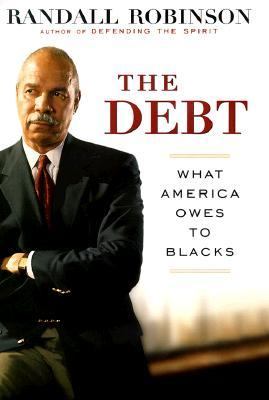
#6 - The Debt

The Debt: What America Owes to Blacks, by Randall Robinson (New York: Dutton, 2000).

Summary: "In Randall Robinson's view, racial problems can't be solved until America is willing to face up to the devastating effects of slavery and educate all Americans, black and white, about the history of Africa and its people. In his recent book, the highly successful Defending the Spirit: A Black Life in America, Robinson makes a stirring call to form the next legion of African-American leadership. Now, in The Debt, he argues that reclaiming the lost history of Africa and African-Americans will help provide a much-needed springboard for solving many of today's problems -- from finding new leadership within the black community to developing meaningful educational programs to helping black people empower themselves economically. Robinson also argues that the United States must be prepared to make restitution to African-Americans for 246 years of slavery, and the century of de jure racial discrimination that followed, via major educational programs and economic development. Robinson offers a solution-oriented approach to controversial issues of social justice in a style that is both personal and informative."

Table of Contents:
  1. Reclaiming Our Ancient Self
  2. Taking Account of the Long-Term Psychic Damage
  3. Race to Class to Race
  4. Self-Hatred
  5. Demanding Respect
  6. Race, Money, and Foreign Policy: The Cuba Example
  7. The Cost of Ignoring the Race Problem in America ...
  8. ... and in the Black World
  9. Thoughts about Restitution
  10. Toward the Black Renaissance
My Take: If you haven't guessed, I'm focusing on the theme of race and culture this month. It's interesting to be finishing and reviewing this book, with its discussion of the lasting impact of a 350-year history of slavery and racial discrimination, and simultaneously starting Some Sing, Some Cry, which begins just after emancipation as a former slave whose three children were all fathered by her white master prepares to leave the Low Country plantation on which she's lived her entire life.

This is a hard, hard book for me to review. As with so many other subjects, I'm both eager to learn more, and not sure I know enough to offer any intelligent criticism. The fact that it's a book about race and racism in the U.S., and on paper I'm as white-and-privileged as it gets, makes this post all the more challenging. Bottom line, though, is that I'm glad I read The Debt, and have just added its successor, The Reckoning, to my book list. While I'm not sure I agree with Robinson's call for reparations to the descendants of former slaves, or how on earth a reparations program might work in practice, the book made me think about much of America's history and culture in a new light. That's a valuable outcome, just by itself.

To be brief, Robinson's argument is that the 250-year practice of American slavery and the hundred-plus years of racism and de jure discrimination that followed it were, no question, the greatest crime against humanity the world's ever seen. There's no way to eliminate the socioeconomic gap between African-Americans and whites, he says, until we not only acknowledge the magnitude of this wrong, but truly commit to righting it.

The book's middle chapters were for me the most persuasive and compelling. Here, Robinson argues that the Middle Passage and the slave trade, by kidnapping and killing so many young, strong, and able people; separating countless children from their parents and extended families; and doing so on such a broad scale over so many generations, virtually annihilated many of Africa's ancient, highly sophisticated civilizations. The impact of this crime was compounded by a U.S. and Europe that consistently overlook both the role of African people in history and the racism of our own esteemed leaders. We know, if we give it much thought, that Jesus, born in the Middle East to a Jewish woman, was unlikely to have been blond and blue-eyed; that Cleopatra probably didn't look like Elizabeth Taylor; and that George Washington owned slaves. At this point, we've even heard something or other about Thomas Jefferson's affair with Sally Hemmings. But Robinson makes us think about what we don't hear: that Haiti owes its independence to those slaves who revolted against Napoleon's soldiers in 1791; that Jefferson's relationship with Hemmings likely began when she was in her mid-teens and he thirty years older; that even Abraham Lincoln considered shipping all American blacks back to Africa after emancipation; that Charles Lindbergh was "a self-described racist [who] had written in Reader' Digest in 1939 that aviation was 'a gift from heaven ... a tool specially shaped for Western hands ... one of those priceless possessions which permit the white race to live at all in a pressing sea of yellow, black, and brown" and urged the U.S. to enter World War II on the German side. Nor is Robinson inclined to let any of these popular heroes off easily, on account of their living in different times with different standards:
"It is often argued in Jefferson's defense that it is unfair to hold his behavior with regard to race to modern standards, that after all he was 'a man of his time.' But who isn't? ... What about Genghis Khan? ... As the first ruler of united Mongolia, he is thought of by Mongolians much the same way as most Americans think of George Washington. In the West, of course, he is remembered as a ruthless scourge. But he was every bit as much a man of his time as Jefferson was of his.

"For that matter, the same specious excuse can be offered for Ataturk or Franco or Lenin or Mao or Hitler. All of them committed great wrongs within permissive if not supportive environments. But this cannot be allowed to render their heinous wrongs any less reprehensible."
Robinson notes that Thomas Paine, a man of the same time as Washington and Jefferson, called the slave trade "lamentable," "wicked," "inhuman," and "barbarous." He also asks the reader to consider why Washington, D.C. boasts a Holocaust museum but not a slavery or African-American museum:
"For wasn't the practice of slavery at least as serious a system of human rights wrongs as the Nazi holocaust? Did not the holocaust of slavery last longer -- indeed, 234 years longer? Did it not claim at least twice as many lives, in the Middle Passage alone? Did it not savagely eviscerate the emotional core of a whole race of people on three continents?"
Understand that Robinson is not seeking here to blame the Jews for American racism, or minimize their own experience of discrimination and human rights crimes; in fact, on several occasions, he cites the Jewish community's call for post-Holocaust reparations and the German government's relative generosity in paying them as positive examples to be emulated. Rather, he argues that the utter absence of black or African faces in the American story as generally told tells African-Americans that they and their contributions are valueless.
"Since this nation's inception, taxpayers -- white, black, brown -- have spent billions on museums, monuments, memorials, parks, centers for the performing arts, festivals, and commemorative occasions. Billions more have been spent on the publication of history texts, arts texts, magazines, newspapers, and history journals. Formulaic television and large-screen historical fiction treatments virtually defy count. Almost none of this spending, building, unveiling, and publishing has been addressed to the needs of Americans who are not white. ... And, indeed, needs are what we are talking about here. ... Ancestor worship is not alone the exotic preoccupation of quaint people mired in superstition in some remote corner of the world. Larger-than-life evidence of its industrialized-world variants can be seen in virtually every public park in America. ...

"Trouble is, George Washington is not my ancestor, private or public. He owned my ancestors, abused them as chattel and willed them to his wife, Martha, upon his death. I and mine need to know about George and Martha but, assuredly, we do not need to revere them. Indeed, psychically we cannot afford to revere them. ... Blacks need to remember who we are, not remember with others who they are."

I'm not sure this distinction is as black and white as Robinson suggests here; the U.S. is, after all, a nation of immigrants and mutts, and I suspect many of us see Washington and Jefferson not strictly as ancestors or owners, but as both -- or neither. Even if his argument is oversimplified, though, his broader point is at least worthy of consideration.
"In every competitive society, instruction in history and the humanities is a valuable instrument with which the dominant group, consciously or unconsciously, attempts to sustain its primacy, ill-gotten or not. In America, whites control virtually every mainstream purveyor of instruction, academic and ephemeral. And in America, whites have caused all Americans to read, see, hear, learn, and select from a diet of their own ideas, with few others placed to make suggestions, not to mention decisions. ... State and federal budgets, to which Asians, Hispanics, and African Americans contribute, are uniformly controlled by whites who seem to uniformly believe that the only ancestor worship worth funding is theirs."
The end products of this whitewashed history, asserts the book, are a persistent self-hatred within the black community and pervasive low expectations that extend beyond it.
"[A] static, unarticulated, insidious racial conditioning, to which all Americans are subject, lifts the high-expectation meritless (Dan Quayle comes to mind here) and, more often than not, locks down in a permament class hell the natively talented but low-expectation black. The gap mocks the efforts of the best of us, black and white, like some ageless yawning crevasse that separates the perennially privileged on their gilded higher ground from those who learn from birth to expect and therefore to reach for little."
Or, from a later chapter:
"[I]t is the very normalcy of our self-denial, our self-ignorance, that is so troubling. It all leads me to wonder whether any group of people in the world has been more resolutely, if unconsciously, committed to notions of self-abnegation than blacks. Well-trained, quiet-flowing, oblivious, uncritical, near total cultural self-abnegation. It is akin to driving in heavy night fog. Little can be seen of where we're going, less still of where we've been. The thickness of the blanket pitch steals our confidence. We conclude that the only hope is to follow the broken white line that snakes in the darkness."

Self-hatred, says Robinson, is evident in the performance of many black comedians, but is not limited to African-American images and experience; Native Americans are marginalized in much the same way. This is a tough argument to make convincingly (here's the danger of reviewing this book while I'm in the middle of reading The Race Card), as it's easily trivialized by those who think the struggle for civil rights and equality is so over already, but an extended thought experiment offered here at least makes you think twice about how insidious and offensive the cultural mainstream can be:
"On occasion, between [televised sports] plays, I have allowed myself to imagine certain franchise transmutations. I would change the team's name and logo, and then try to gauge public reaction.

"The Washington Redskins would become the Washington Blackskins. The logo on the helmet would look like the old caricatured Aunt Jemima. That Sunday, the Blackskins would be playing in Atlanta against Ted Turner's renamed football team, the Atlanta Mafia, who were coached by an Irishman named Maloney but known to all America variously as the Don and the Assassin. On the side of their helmets was a likeness of Al Capone. Before the game, toy machine guns had been handed to the Turner Field faithful, who screamed throughout on cue from Miss Fonda: Rat tat tat. Thatsa deada Blackskin. Thatsa deada Blackskin.

"That same Sunday, the New York Jews had a bye and did not play. One nationally syndicated sports columnist had written that the Jews did not play because they had a 'buy.' No one seemed to notice. After all, it was all in good fun.

"Across town at George Armstrong Custer Stadium, the New York Genocidists were wrapping up a four-game World Series sweep of the Massachusetts Pilgrim Feeders. The Indians had lost the first three games by large margins. The Genocidists, who wore blue and yellow uniforms reminiscent of the old U.S. horse cavalry, were led by a coach who called himself the General. The team's logo was a half-tone of a slightly inebriated Ulysses S. Grant. That evening, when the eleven-to-one score was announced on the evening news, the New York announcer said, 'The Genocidists have slaughtered the Pilgrim Feeders once again.' ...

"As inclined as blacks understandably are by painful experience to believe the contrary, racism is not black-specific. It is like the Hydra, the lethal many-headed mythological snake whose heads regenerated as fast as they were severed. Racism is a social disease that exempts no race from either of its two rosters: victims and victimizers."

Robinson also acknowledges the complex interplay between race and class. A long anecdote about a poor, black girl growing up in Boston who's got the deck stacked against her suggests that this interaction is most apparent in education. Many middle- and upper-income people of color are doing so as we speak; likewise, many white people, especially those who are poor, are not. The key difference, however, is that one can be poor and white without people assuming you're poor because you're white; poverty isn't thought to be intrinsically linked with being white in America. By contrast, if you're poor and black, it's just assumed that you're poor because you're black. We believe poor students can succeed, and we believe black students can succeed -- but consciously or otherwise, teachers often expect students who are poor and black to fail. While I don't agree 100% with everything Robinson says in this book, I find him most persuasive when he's arguing for the vital role education must play in combating inequality and injustice:
"Give a black or white child the tools (nurture, nutrition, material necessities, a home/school milieu of intellectual stimulation, high expectation, pride of self) that a child needs to learn and the child will learn. Race, at least in this regard, is irrelevant. ... It is obvious that in any effort to balance America's racial scales, education, defined in the broadest sense, must be assigned the very highest priority."
Where The Debt loses me is in its final two chapters, where Robinson actually makes the call for reparations that he's been working up to all along. I started the book knowing very little about the particulars of the reparations discussion, but skeptical about the overall concept. By the time I reached Chapter 9, though, Robinson's claims had hit their mark; I was sufficiently moved by his discussion of the suppression and denial of the African and African-American role in US history and culture that I was at least willing to be persuaded. Perplexingly, though, the last two chapters don't even begin to do so. Having spent the bulk of the text convincing the reader that a grave injustice was done to black Americans, orders of magnitude greater than other now widely-acknowledged crimes against humanity, Robinson's last two chapters are curiously vague: long on well-written oratory about how something material is owed, but short on specifics as to what, how, and to/ from whom. And personally, that's exactly what I wanted to hear at this point: How, exactly, might reparations for slavery be funded? Who would reap the benefits? Again, look at the racial, ethnic, and class makeup of our country; not everyone fits neatly into a "former slave" or "former master" box. Some of us may be both; some neither; still others may have no way of knowing. Sure, a comprehensive answer to these questions is about as easy as a hard-and-fast definition of race, but given the book's title, I at least expected Robinson to take a more substantive stab at it.

Tuesday, January 11, 2011

#5: The Black Girl Next Door

The Black Girl Next Door: A Memoir, by Jennifer Baszile (New York: Simon & Schuster, 2009).

Jacket Summary: "A powerful, beautifully-written memoir about coming of age as a black girl in an exclusive white suburb in 'integrated,' post-Civil Rights California in the 1970s and 1980s. At six years of age, after winning a foot race against a white classmate, Jennifer Baszile was humiliated to hear her classmate explain that black people 'have something in their feet to make them run faster than white people.' When she asked her teacher about it, it was confirmed as true. The next morning, Jennifer's father accompanied her to school, careful to 'assert himself as an informed and concerned parent and not simply a big, black, dangerous man in a first-grade classroom.' This was the first of many skirmishes in Jennifer's childhood-long struggle to define herself as 'the black girl next door' while living out her parents' dreams. Success for her was being the smartest and achieving the most, with the consequence that much of her girlhood did not seem like her own but more like the 'family project.' But integration took a toll on everyone in the family when strain in her parents' marriage emerged in her teenage years, and the struggle to be the perfect black family became an unbearable burden. A deeply personal view of a significant period of American history, The Black Girl Next Door deftly balances childhood experiences with adult observations, creating an illuminating and poignant look at a unique time in our country's history."

Opening Line: "On an early autumn morning in 1975, as fog rolled off the Pacific Ocean and covered the Vista Grande School playground, my first-grade girlfriends and I decided to squeeze in a quick foot race before school began."


My Take: Liked this one a lot. As I've tried to articulate why, I couldn't help but remember a poem by Pat Parker that I came across about a gazillion years ago, entitled "For the white person who wants to know how to be my friend." It begins,
"the first thing you do is to forget that i'm Black.
Second, you must never forget that i'm Black."
Sounds contradictory, of course, but after reading Baszile's memoir, I think I understand better what Parker meant. On one hand, The Black Girl Next Door has wide appeal; it tells the story of the author's childhood, from age six through the end of high school, through a series of vignettes. Many of these will resonate with anyone who grew up in the 1970s and '80s, particularly in a well-off suburb like Palos Verdes Estates: the pains our mothers took to make us presentable for picture day; the unscripted summer evenings playing Kick the Can until the streetlights came on; the excruciating self-consciousness of attending your first middle school dance; the endless pre-DVD-era road trips to spend holidays in a house crammed with relatives you barely knew.

On the other hand, for every forty-something who smiles knowingly and nods at these memories, the experience was just a little bit different. In Baszile's case, that difference often hinged upon being the only black family in her neighborhood, and close to it at school. For a well-intentioned white liberal like me, this makes her book a kaleidoscope, at once familiar and new. Baszile's second-grade picture captures a disheveled braid and a torn shirt, courtesy of the young thugs-in-training who insisted on fighting the [racial epithet] on the playground. One night of street games takes an unexpected and disturbing turn when the kids go inside, get into some old clothes in the attic, and Jennifer finds herself mimicking a poor, rural, Southern black woman she claims is her grandmother. And the middle school dance marks a fork in the road for Baszile and her (until then) similarly gangly and gawky best friend Amy. Before the dance, the girls hit the mall for makeovers, but only Amy is transformed; Jennifer, who slowly remembers that her own mother always needs to go out of town for makeup, comes away looking more like a kabuki dancer. Perhaps the most poignant illustration, though, comes with the Christmas visit to Mr. Baszile's tiny, rural home town of Elton, Louisiana. From their arrival, when Grandmother compliments (?) Jennifer and her sister by pronouncing them "perfect little white girls," the Louisiana Basziles seem both wonderfully exotic and alien:
"For all of the Christmas cheer, Dad was sullen and again stayed outside on the porch. He talked to everyone, but his nerves seemed flimsy like tinsel. Whenever he saw one of his cousins, he called Natalie and me outside to meet them. He held us up like shields to these people and put us on display. I knew Dad was proud of us, but it felt to me like a distraction even more than pride. When I wasn't being paraded out to meet people, I mostly sat on the edge of the bed where I had slept, out of the way; I didn't want to met anyone else. I didn't want another kiss on the cheek, another stranger's hug, or another person's comment about my 'funny' California speech."
Later, when an argument between Jen's father and his brother Sunny gets a bit heated, she observes:
"No one cheered for Dad, even though we were related to nearly everyone there and he was right to defend me. I couldn't figure out why. ... Suddenly I felt the way I often did in California, like it was the four of us against everyone else. I didn't expect to feel such a thing among all these relatives. ... I stayed on the porch, afraid of what I wanted to do to them. The magic had disappeared for me. This had been a strange and terrible Christmas, maybe the worst one ever. I wanted to go to bed and then back to California."
If this makes it sound like The Black Girl Next Door is one complaint after another about how racism traumatized Baszile, it's not. Like anyone's childhood, Baszile's had its ups and downs; some of these were related to her ethnicity, but some weren't. Readers of all hues can cheer Jennifer on when she makes lemons out of lemonade at the dance. When Amy abandons her to dance with a boy, she remembers her mother telling her that she went there to dance, not to get a boyfriend -- and asks one male wallflower after another to join her on the dance floor until someone accepts. What young woman hasn't had a welcome-to-the-club trip to the beauty parlor that didn't quite go as she'd expected (even if she decided in the end that it looked pretty good anyway)? And I'm sure I'm not alone in cringing and wanting to shut my eyes when Jen and her dad have their climactic fight towards the book's end.

One criticism Dwight Garner raises in his New York Times review is that Baszile's memoir lacks "adult wit and complexity," and that her decision "to write almost entirely from the necessarily blinkered perspective of herself as a girl" proves detrimental to the narrative. I can see his point -- I, too, would have liked to know more about where Mr. Baszile went on Friday nights and why Mrs. Baszile seemed so cut off from her family in Detroit -- but saw this as a reasonable choice on Baszile's part. There are memoirs aplenty on the shelves whose authors retell their stories from an older, wiser adult's perspective; I found it a refreshing change to read one that felt more like I was there beside the 6-, 9-, and 12-year-old Baszile, without a grown-up narrator looking over our shoulders.

The author's own web site indicates that her next book will pick up her story at Columbia, just after this one leaves off. I, for one, will be eagerly waiting.

Wednesday, September 1, 2010

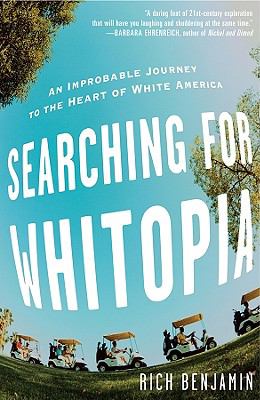
#66 - Searching for Whitopia

So far, this is a welcome change of pace from some of the books I've been slogging through of late: Rich Benjamin's Searching for Whitopia: An Improbable Journey to the Heart of White America (New York: Hyperion, 2009).

Summary: "Widely reported demographic shifts in contemporary America include the increase and diffusion of Latino populations and the relative population decline of Caucasians. Alongside these is a perhaps more subtle corollary, a phenomenon journalist Benjamin calls Whitopia ('white'opia'): disproportionately (generally over 90 percent) white communities that have grown rapidly in recent years, with most of the population growth also white. To learn about such communities, Benjamin here immerses himself in the life, culture, and politics of St. George, UT; Cour d'Alene, ID; Forsyth County, GA; and Manhattan's Upper East Side Carnegie Hill area. A well-traveled black writer from a multiracial family, Benjamin hardly undertakes this venture incognito. But with his tact, genuine interest in people, and zest for golf, real estate, and socializing, Benjamin ingratiates himself nearly everywhere he goes and gains significant insights from residents, businesspeople, and civic leaders. Benjamin's timely journey is surprising and provocative. He critically examines racial and economic segregation, structural racism, hostility to immigration, the rising political power of exurbs, and other sociopolitical realities that bespeak, in his assessment, a growing failure in commitment to the common good -- yet he also demonstrates respect for his interviewees and offers his pointed assessments only after a thoughtful, open-minded exploration. Verdict: Written at the lay reader's level and in highly anecdotal narrative fashion, this is for all readers interested in the sociopolitics of America today. It will also be valued by policymakers and social scientists." (-Janet Ingham Dwyer, Library Journal Review).

My take: An excellent and provocative book, and far more nuanced than I might have expected. Rich does for the lily-white neighborhoods he studies what Self-Made Man tries to do, with far less success, for selected all-male enclaves; namely, without (much) subterfuge, penetrates well enough to give us a balanced, complex portrait of both their appeal and their shortcomings.

Gated communities are an easy target for ridicule in some circles, and I'll admit that I'm not above taking the occasional (metaphorical) swing myself. Rich doesn't do that; he says up front and more importantly, shows us throughout the book that most of the individuals he met were kind, thoughtful people; very welcoming to him individually; and settled where they did because they wanted a safe community in which to raise their kids. And those who know me know I can't not appreciate a writer who pays careful attention to the class factor in the U.S. His distinctions between small towns, boom towns, and dream towns are definitely worth chewing over, and his observations on the tensions between longer-term, working- to middle-class residents and more recently arrived, wealthier transplants were fascinating.

Aside from a sprinkling of eye-rolling at some of the more-moneyed-than-tasteful architectural and design elements he encounters in his real estate searches, Rich is almost religious about not poking fun at or even condescending to the exurban residents he gets to know -- which makes the book far stronger and more compelling. He also avoids the obvious East Coast/ West Coast and Northern/ Southern states finger-pointing by visiting Carnegie Hill, Manhattan and Warren County, New Jersey, as well as Forsyth County, Georgia and St. George, Utah. I do wish he'd devoted more time and space to the final section on why we should care, as it seemed a bit cursory -- but that's a fairly minor complaint overall.

Wednesday, May 26, 2010

#42 - Sag Harbor

My 42nd book of the year was Sag Harbor, by Colson Whitehead (New York: Doubleday, 2009)

Summary: "Fifteen-year-old Benji has spend every summer since he can remember in Sag Harbor, NY. The rest of the year, he's a black preppie from Manhattan, with a doctor father and a lawyer mother and a younger brother, Reggie. It is 1985, and Reggie gets a job at Burger King, leaving Benji (who would prefer to be called Ben) to hang with his summer friends (the term posse wasn't invented yet), other black prep school refugees. Not a lot happens during those three months. Or does everything happen, all that matters to an insecure, nerdy teen just beginning to realize the man he might become? Scooping ice cream at Jonni Waffle, riding to the 'white beach' with the one guy who's got a car, trying to crash a Lisa Lisa concert at the hip club, and kissing a girl and copping a feel are significant events in a life that encompasses generations of folks who call Sag Harbor home."

Opening lines: "First you had to settle the question of out. When did you get out? Asking this was showing off, even though anyone you could brag to had the same gift and had come by it the same way you did."

My take: Well-written and oh-so-perfectly evocative of both summer vacations and growing up in the 1980s. I'll have to agree with Donna Seaman's Booklist review, though: "Whitehead sticks to the frothy shoreline and avoids the deep." Funny and nicely detailed, but not very substantial.