About Me

Ithaca, New York
MWF, now officially 42, loves long walks on the beach and laughing with friends ... oh, wait. By day, I'm a mid-level university administrator reluctant to be more specific on a public forum. Nights and weekends, though, I'm a homebody with strong nerdist leanings. I'm never happier than when I'm chatting around the fire, playing board games, cooking up some pasta, and/or road-tripping with my family and friends. I studied psychology and then labor economics in school, and I work in higher education. From time to time I get smug, obsessive, or just plain boring about some combination of these topics, especially when inequality, parenting, or consumer culture are involved. You have been warned.
Showing posts with label 1980s. Show all posts

Saturday, October 27, 2012

#93: Ten Thousand Saints

Ten Thousand Saints, by Eleanor Henderson
(New York: Ecco, 2011)
Summary:
"Adopted by a pair of diehard hippies, restless, marginal Jude Keffy-Horn spends much of his youth getting high with his best friend, Teddy, in their bucolic and deeply numbing Vermont town. But when Teddy dies of an overdose on the last day of 1987, Jude's relationship with drugs and with his parents devolves to new extremes. Sent to live with his pot-dealing father in New York City's East Village, Jude stumbles upon straight edge, an underground youth culture powered by the paradoxical aggression of hardcore punk and a righteous intolerance for drugs, meat, and sex. With Teddy's half brother, Johnny, and their new friend, Eliza, Jude tries to honor Teddy's memory through his militantly clean lifestyle. But his addiction to straight edge has its own dangerous consequences. While these teenagers battle to discover themselves, their parents struggle with this new generation's radical reinterpretation of sex, drugs, and rock 'n' roll and their grown-up awareness of nature and nurture, brotherhood and loss.

"Moving back and forth between Vermont and New York City, Ten Thousand Saints is an emphatically observed story of a frayed tangle of family members brought painfully together by a death, then carried along in anticipation of a new and unexpected life. With empathy and masterful skill, Eleanor Henderson has conjured a rich portrait of the modern age and the struggles that unite and divide generations."

 Opening Lines:
"'Is it dreamed?' Jude asks Teddy. 'Or dreamt?'"

My Take:
Perhaps I was feeling unusually uncharitable here, as I read this one right after Imperial Bedrooms and had had it up to here with drug-addled adolescents before I tackled the first chapter. That said, Ten Thousand Saints didn't overwhelm me. It wasn't repugnant the way IB was, and the characters here were rather more sympathetic -- partly because it's set in the '80s and definitely conveys that this was a different time, and partly because it's easier to excuse adolescent behavior when it actually comes from adolescents.

And perhaps I just bring too much of my own baggage to the story. Jude and Teddy are of my generation, a mere two years older than I am, which means I should be able to relate to their world ... but I really can't. Sure, I grew up 30 miles from the NYC where much of the story is set, but that may as well have been another universe, and my suburban adolescence was probably more sheltered than most. Mine wasn't a drugging or even hard drinking crowd, if the motley handful of not-yet-cool nerds I occasionally socialized with constituted a "crowd" at all. I never had any burning desire to fit in either with the stoners who make up Jude & Teddy's clique at the beginning, and I don't think I knew such a thing as straight-edge existed at the time. Punk, yes, but much as I loved the music, I was well aware a big-haired teeny bopper from the 'burbs would have been eaten alive in that environment. Instead, I contented myself with volunteering at a crisis line throughout high school and growing vicariously wise through the lives that touched me there.

It's interesting, too, to look back on the '80s with enough distance and perspective that you're aware of the hallmarks of the era. As a middle and high schooler, I knew something about the culture and history of the 1920s or '40s or '60s -- enough to reference an era convincingly in a term paper, or make guesses about how my grandparents' adolescence differed from my parents' or my own. But I couldn't articulate what made the '80s the '80s or what future generations would see as the hallmarks of my decade, any more than my daughter can define the 2010s or a particularly conscious fish could tell you what it's like to breathe water rather than air. Ten Thousand Saints depicts the era as a very long, unglamorous morning after the hedonistic '70s, with the principals' parents as the clueless hung over guests you just know will spend the next week bragging about how awesome the party was and how wasted they were, and Jude, Johnny, and Eliza the housemates who get stuck cleaning up all the spilled food and broken glass. Jude's mom, Harriet, is the canonical leftover hippie, naming her kids after Beatles songs (Jude's sister is Prudence), selling handblown glass in a small town in Vermont, and earning the bulk of her income selling bongs; his father, Lester, is a successful Manhattan pot grower who takes pride in being a cool, approachable pseudo-stepdad to his girlfriend's daughter Eliza but hasn't bothered to contact his own kids in who knows how long. After Teddy's death, Jude and Eliza's guilt leads them (with Johnny's help) to discover the no-drugs, no-drinking, no-sex world of straight edge, drawing spiritual sustenance from a Hare Krisha temple whose connection to the former is never exactly clear.

Henderson's writing is clear, understated, and sad, and the setting an interesting, unusual one. I only wish the characters (yes, this is always a sticking point for me) felt big or complex enough to live up to it. The book was OK, and I finished it -- but it felt more like a duty than a pleasure to get through (although it did get somewhat better in the latter part).

Friday, May 4, 2012

#40: Agent 6

Agent 6, by Tom Rob Smith (New York: Grand Central Publishing, 2012)


Summary:
"Leo Demidov is no longer a member of Moscow's secret police. But when his wife, Raisa, and daughters Zoya and Elena are invited on a 'Peace Tour' to NewYork City, he is immediately suspicious. 


"Forbidden to travel with his family and trapped on the other side of the world, Leo watches helplessly as events in New York unfold and those closest to his heart are pulled into a web of political conspiracy and betrayal -- one that will end in tragedy.


"In the horrible aftermath, Leo demands only one thing: to investigate the killer who destroyed his family. His request is summarily denied. Crippled by grief and haunted by the need to find out exactly what happened on that night in New York, Leo takes matters into his own hands. It is a quest that will span decades, and take Leo around the world -- from Moscow, to the mountains of Soviet-controlled Afghanistan, to the backstreets of New York -- in pursuit of the one man who knows the truth: Agent 6."

Opening Line:
"The safest way to write a diary was to imagine Stalin reading every word."

My Take:
Not bad, but certainly the weakest in the trilogy that includes Child 44 and The Secret Speech. The first two books were solidly entertaining political thrillers; this one alternates between dragging a bit and jumping abruptly across way too much time and space for the reader to have a good grasp of what's going on. It's not clear if Smith's trying to write a thriller about the Soviet occupation of Afghanistan or a psychological novel about a secret policeman who starts having doubts about the rightness of all he's done, and it doesn't quite fit either niche correctly.

Monday, April 23, 2012

#34: Swimming

Swimming, by Nicola Keegan (New York: Alfred A. Knopf, 2009)


Summary:
"A spectacular debut about the rise of an Olympic champion -- a novel about competition, obsession, the hunger for victory, and a young girl with an unsinkable spirit struggling to stay afloat in the only way she can.

"When we first meet Pip, the extraordinary heroine of Nicola Keegan's first novel, she is landlocked in a small town in the center of Kansas, literally swimming for her life. Pip is tall and flat and smart and funny and supernaturally buoyant. On land, she has her share of troubles: an agoraphobic mother, a lost father, a drug-addled sister, and a Catholic education dominated by a group of high-energy nuns. But in the water, Pip is unstoppable. In the water, her suffering and rage are transmuted into grace and speed and beauty.

"Swimming is the story of Pip's journey from a small Midwestern swim team to her first state meet, her brutal professional training, and the final, record-breaking swims that lead to her dizzying ascent to the Olympic podium in Barcelona. It's the story of a girl who discovers, in the loneliness of adolescence, in the family tragedies that threaten to engulf her, the resilience of the human spirit and the spectacular power of her own body."

Opening Lines:
"I'm a problematic infant but everything seems okay to me. I'm sitting in Leonard's arms grabbing at his nose."

My Take:
This was one of those books that left me feeling a bit stupid and lightweight because I didn't enjoy it more than I did. It was OK, but as Ron Charles's Washington Post review points out, 
Swimming remains an unusually interior novel, contained entirely in Pip's discordant head. Even the dialogue is mediated by her voice, rendered only in italics, no quotation marks, sometimes slipping into shorthand and ellipses. This can feel a bit claustrophobic, as though we're missing a lot of what's happening outside her narrow attention. Moscow, Paris, Stanford University and other colorful locales are hard to see in much detail through the scrim of Pip's self-absorption, but if you've spent time around precocious teenagers (or been one), you'll recognize how true this sounds.
Charles' review was a positive, almost laudatory one nonetheless, but for me, the interior nature of the novel was a real roadblock. It was hard to get a real feel for any of the other characters, or even a vivid, objective picture of Pip (nee Philomena) herself. I'm glad I read the book and appreciate Keegan's literary skill, but think there's something I just didn't get here.

Tuesday, March 20, 2012

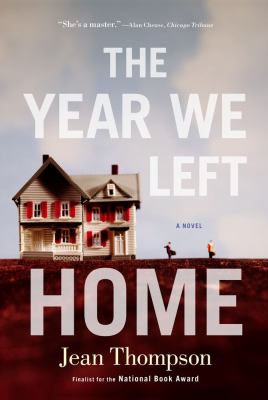
#18: The Year We Left Home

The Year We Left Home, by Jean Thompson (New York: Simon & Schuster, 2011)

Summary:
"Named a New York Times Editors' Choice, a People magazine "Pick of the Week," and an Indie Next and Midwest Connections selection, The Year We Left Home is the career-defining novel that Jean Thompson's admirers have been waiting for: a sweeping and emotionally powerful story of a single American family during the tumultuous final decades of the twentieth century.

"Stretching from the early 1970s in the Iowa farmlands to suburban Chicago and across the map of contemporary America, The Year We Left Home follows the Erickson siblings as they confront prosperity and heartbreak, setbacks and triumphs, and seek their place in a country whose only constant seems to be breathtaking change.

"Ambitious and richly told, this is a vivid and moving meditation on our continual pursuit of happiness and an incisive exploration of the national character."

Opening Line:
"The bride and groom had two wedding receptions: the first was in the basement of the Lutheran church right after the ceremony, with punch and cake and coffee and pastel mints."

My Take:
Liked this one a lot. Spare, beautiful, mostly sad, but ending on a just slightly hopeful note. A good one.

Wednesday, March 7, 2012

#16: The Marriage Plot

The Marriage Plot, by Jeffrey Eugenides (New York: Farrar, Straus, & Giroux, 2011)

Summary:
"It's the early 1980s -- the country is in a deep recession, and life after college is harder than ever. In the cafes on College Hill, the wised-up kids are inhaling Derrida and listening to Talking Heads. But Madeleine Hanna, dutiful English major, is writing her senior thesis on Jane Austen and George Eliot, purveyors of the marriage plot that lies at the heart of the greatest English novels.

"As Madeleine tries to understand why 'it became laughable to read writers like Cheever and Updike, who wrote about the suburbia Madeleine and most of her friends had grown up in, in favor of reading the Marquis de Sade, who wrote about deflowering virgins in eighteenth-century France,' real life, in the form of two very different guys, intervenes. Leonard Bankhead -- charismatic loner, college Darwinist, and lost Portland boy, suddenly turns up in a semiotics seminar, and soon Madeleine finds herself in a highly charged, erotic and intellectual relationship with him. At the same time, her old friend Mitchell Grammaticus -- who's been reading Christian mysticism and generally acting strange -- resurfaces, obsessed with the idea that Madeleine is destined to be his mate.

"Over the next year, as the members of the triangle in this amazing, spellbinding novel graduate from college and enter the real world, events force them to reevaluate everything they learned in school. Leonard and Madeleine move to a biology laboratory on Cape Cod, but can't escape the secret responsible for Leonard's seemingly inexhaustible energy and plunging moods. And Mitchell, traveling around the world to get Madeleine out of his mind, finds himself face-to-face with ultimate questions about the meaning of life, the existence of God, and the true nature of love.

"Are the great love stories of the nineteenth century dead? Or can there be a new story, written for today and alive to the realities of feminism, sexual freedom, prenups, and divorce? With devastating wit and an abiding understanding of and affection for his characters, Jeffrey Eugenides revives the motivating energies of the Novel, while creating a story so contemporary and fresh that it reads like the intimate journal of our own lives."


Opening Line:
"To start with, look at all the books."


My Take:
Really enjoyed Middlesex and have heard mixed things about how this one compares. First chapter's been a bit slow to get into, but not lethally so.

(later) Better than average, but Middlesex it ain't. Fortunately, it did get a lot more engaging, at least for me, when we got past Madeleine's college days and out of the copious senior-English-major-seminar, pretentious literary jargon that seemed to take place there. Perhaps some of my more literary friends would have really enjoyed this piece, and even I admit -- I'd encountered enough of this gobbledygook peripherally, by osmosis, that I could recognize Eugenides's skill as a satirist. Even so, I'm a two-time social scientist, and as such, like both my fiction and my academics to be a bit more concrete.

I've also become a fan lately of truth in advertising when it comes to book jackets, and in all honesty -- this wasn't really a proper triangle. "Triangle," to me, implies that there's some sort of relationship among three parties that would be drastically altered if one of those parties were removed. Here that's not the case: Madeleine loves Leonard, Leonard loves her back (though perhaps not quite as much) but is really too consumed by his bipolar disorder (then known as manic depression) to be a proper partner, and Mitchell's had a long-standing unrequited crush on Madeleine. A brief flirtation or frisson between the two years earlier does not a triangle make. To some extent, this is a nitpick, but it does get at what I see as one of the book's chief weaknesses: while both the Mitchell-traveling-around-the-world storyline and the Madeleine-living-on-Cape-Cod-with-Leonard-while-figuring-out-what-to-do-with her-life one are reasonably well-done, they don't ever come together in a satisfactory fashion. We see them cross paths early in the novel (technically in flashbacks, as the story begins with Madeleine's graduation and running into Mitchell in a coffee shop), and then again, briefly and insignificantly, towards its end. Mitchell obsesses about Madeleine while backpacking around Greece and India, sure, but I don't recall her thinking much about him at all for the bulk of the book.

Again, I may be coming off a bit too harsh here; Marriage Plot certainly isn't awful. It's entirely possible that I just Didn't Get It, that I'm not sufficiently well-steeped in the Romantic novels Madeleine favors to really appreciate the whole marriage plot novel and thus, to understand the ways in which Eugenides is trying to allude to the same. If so, perhaps it's my loss. This was a decent book, and solidly written -- but not necessarily one I'll need to read again.

Monday, June 8, 2009

#49 - Gorky Park

On Friday night, while Mrhazel and Littlehazel were engrossed in original Star Trek reruns, I finished Martin Cruz Smith's Gorky Park (Ballantine, 1981). This one's been on my list since I read Child 44 a few months ago; eventually, I'll go back to The Gulag Archipelago and complete the Soviet-era political thriller troika.

The verdict? A decent read, engaging enough, but definitely a period piece. Set (mostly) in the Soviet Union in the early 1980s, it tells the story of Arkady Renko, a Moscow homicide investigator of average ambition and less-than-average Party loyalty who (we suspect) achieved his position only by dint of his father, a famous Stalinist-era general. The novel opens with the case that will change Arkady's life forever: the discovery of three frozen bodies, fingertips removed and faces mutilated to thwart identification, in Moscow's Gorky Park. He and his old nemesis, Major Pribluda of the KGB, respond at the same time, but after tromping around contaminating the crime scene, the KGB washes its hands of the case. Their lack of interest remains even when Arkady discovers one of the victims is an American. Given his history with Pribluda, something about this doesn't sit well with Arkady, and to distract himself from the collapse of his marriage, he immerses himself in an ill-advised investigation to find out who the Gorky Park victims are and who killed them.

For a suspense novel, I found the book a bit slow-paced. Smith's descriptions of Moscow are rich and vivid, and definitely succeeded in giving the reader a sense of place. Unfortunately, his descriptions of his characters are less so (yeah, I know I complain about this with almost every suspense novel I read ... you think I'd learn), and with so many of them to keep track of, this made the story line a bit confusing in places. Suffice it to say that there are elements of international intrigue and plain old ordinary greed at play here, and Arkady ultimately becomes unable to trust anyone. This would be more compelling if we'd gotten to know him well enough to be moved by his plight, but for me, this didn't happen.

All in all, Gorky Park is worth reading if you stumble across a copy and want something you don't need to think too much about (though maybe if I had, the characters and plot twists would have made a bit more sense) -- but not really something that, in our post-Cold War era, seems to have aged very well.