About Me

Ithaca, New York
MWF, now officially 42, loves long walks on the beach and laughing with friends ... oh, wait. By day, I'm a mid-level university administrator reluctant to be more specific on a public forum. Nights and weekends, though, I'm a homebody with strong nerdist leanings. I'm never happier than when I'm chatting around the fire, playing board games, cooking up some pasta, and/or road-tripping with my family and friends. I studied psychology and then labor economics in school, and I work in higher education. From time to time I get smug, obsessive, or just plain boring about some combination of these topics, especially when inequality, parenting, or consumer culture are involved. You have been warned.
Showing posts with label college. Show all posts

Friday, July 20, 2012

#61: Rebels in White Gloves

Rebels in White Gloves: Coming of Age 
with Hillary's Class -- Wellesley '69, by Mirian Horn 
New York: Times Books/ Random House, 1999
 Summary:
"'Freak out, Suzy Creamcheese. Drop out of school before your brain rots,' urged Frank Zappa. 'Protest boxy suits! Protest big ugly shoes!' exhorted the Wellesley News. 'Get your ring before spring,' cooed the women's magazines. Reject 'inauthentic reality' in favor of 'a more penetrating existence,' advised Hillary Rodham to her fellow graduates. Whipsawed by these conflicting mandates, the Wellesley Class of '69 were women on the cusp, feeling out the new rules. Rebels in White Gloves is their story.
"When these women entered Wellesley's ivory tower, they were initiated into a rarefied world where the infamous 'marriage lecture' and white gloves at afternoon tea were musts. Many were daughters of privilege; many were going for their 'MRS.' Four years later, by the time they graduated, they found a world turned upside down by the Pill, Betty Friedan's The Feminine Mystique, Roe v. Wade, the Vietnam War, student protests, the National Organization for Women, and the battle for the Equal Rights Amendment. 'Coming of age at a rare moment in history and with the equally rare privilege of an elite college education,' writes Miriam Horn, 'the women who graduated from Wellesley in 1969 were destined to be the monkeys in the space capsule, the first to test in their own lives the consequences of the great transformations wrought by the second wave of feminism.'

"For the thirtieth anniversary of the Class of '69 -- 'Hillary's class' -- Horn has created trenchant, remarkably nuanced portraits of these women, chronicling their experiments with sex, work, family, politics, and spirituality. Horn follows them as they joined SDS, tumbled into free-love communities, prosecuted pot growers, ministered to Micronesian natives, fled trust-fund security, forged and surrendered marriages, plumbed the challenges of motherhood, and coped with the uncertainties of growing older. As Horn writes, 'The women of '69 have come out as debutantes. They have also come out as lesbians, as victims of domestic abuse, as alcoholics.' In all their guises, these are wise, well-spoken women who look back on the last thirty years with great eloquence and humor, and whose coming of age mirrors all women's struggles to define themselves.

"On Commencement Day at Wellesley thirty years ago, Hillary Rodham told her classmates, 'We are, all of us, exploring a world that none of us understands and attempting to create within that an uncertainty. The only tool we have ultimately to use is our lives.' In Rebels in White Gloves, Miriam Horn has created raw and intimate portraits of women on the verge. Their tumultuous life paths -- wild, funny, heartbreaking, unforgettable -- are a primer in women's history of the past fifty years and a timely attempt to make sense of the increasingly blurred line between the personal and the political."

Table of Contents:
  1. The Wellesley Years
  2. Mothers and Daughters
  3. Rebellions and New Solidarities
  4. Reinventing Womanhood
  5. Breaking the Barriers
  6. Balancing Work and Family
  7. Full-Time Moms
  8. On Their Own
  9. Spiritual Journeys
  10. In Search of Self
  11. Life's Afternoon
My Take:
Not surprisingly, I really enjoyed this one -- not least because it didn't purport to offer any neat, tidy answers. An intriguing read for anyone interested in latter twentieth century history, women's history, or how our paths are shaped by and diverge after our college experiences (I can check all of those boxes). Thankfully, less navel-gazing than some accounts I've read that try with less skill to extrapolate some greater significance from a small, non-representative sample of individuals' experiences.

Wednesday, March 7, 2012

#16: The Marriage Plot

The Marriage Plot, by Jeffrey Eugenides (New York: Farrar, Straus, & Giroux, 2011)

Summary:
"It's the early 1980s -- the country is in a deep recession, and life after college is harder than ever. In the cafes on College Hill, the wised-up kids are inhaling Derrida and listening to Talking Heads. But Madeleine Hanna, dutiful English major, is writing her senior thesis on Jane Austen and George Eliot, purveyors of the marriage plot that lies at the heart of the greatest English novels.

"As Madeleine tries to understand why 'it became laughable to read writers like Cheever and Updike, who wrote about the suburbia Madeleine and most of her friends had grown up in, in favor of reading the Marquis de Sade, who wrote about deflowering virgins in eighteenth-century France,' real life, in the form of two very different guys, intervenes. Leonard Bankhead -- charismatic loner, college Darwinist, and lost Portland boy, suddenly turns up in a semiotics seminar, and soon Madeleine finds herself in a highly charged, erotic and intellectual relationship with him. At the same time, her old friend Mitchell Grammaticus -- who's been reading Christian mysticism and generally acting strange -- resurfaces, obsessed with the idea that Madeleine is destined to be his mate.

"Over the next year, as the members of the triangle in this amazing, spellbinding novel graduate from college and enter the real world, events force them to reevaluate everything they learned in school. Leonard and Madeleine move to a biology laboratory on Cape Cod, but can't escape the secret responsible for Leonard's seemingly inexhaustible energy and plunging moods. And Mitchell, traveling around the world to get Madeleine out of his mind, finds himself face-to-face with ultimate questions about the meaning of life, the existence of God, and the true nature of love.

"Are the great love stories of the nineteenth century dead? Or can there be a new story, written for today and alive to the realities of feminism, sexual freedom, prenups, and divorce? With devastating wit and an abiding understanding of and affection for his characters, Jeffrey Eugenides revives the motivating energies of the Novel, while creating a story so contemporary and fresh that it reads like the intimate journal of our own lives."


Opening Line:
"To start with, look at all the books."


My Take:
Really enjoyed Middlesex and have heard mixed things about how this one compares. First chapter's been a bit slow to get into, but not lethally so.

(later) Better than average, but Middlesex it ain't. Fortunately, it did get a lot more engaging, at least for me, when we got past Madeleine's college days and out of the copious senior-English-major-seminar, pretentious literary jargon that seemed to take place there. Perhaps some of my more literary friends would have really enjoyed this piece, and even I admit -- I'd encountered enough of this gobbledygook peripherally, by osmosis, that I could recognize Eugenides's skill as a satirist. Even so, I'm a two-time social scientist, and as such, like both my fiction and my academics to be a bit more concrete.

I've also become a fan lately of truth in advertising when it comes to book jackets, and in all honesty -- this wasn't really a proper triangle. "Triangle," to me, implies that there's some sort of relationship among three parties that would be drastically altered if one of those parties were removed. Here that's not the case: Madeleine loves Leonard, Leonard loves her back (though perhaps not quite as much) but is really too consumed by his bipolar disorder (then known as manic depression) to be a proper partner, and Mitchell's had a long-standing unrequited crush on Madeleine. A brief flirtation or frisson between the two years earlier does not a triangle make. To some extent, this is a nitpick, but it does get at what I see as one of the book's chief weaknesses: while both the Mitchell-traveling-around-the-world storyline and the Madeleine-living-on-Cape-Cod-with-Leonard-while-figuring-out-what-to-do-with her-life one are reasonably well-done, they don't ever come together in a satisfactory fashion. We see them cross paths early in the novel (technically in flashbacks, as the story begins with Madeleine's graduation and running into Mitchell in a coffee shop), and then again, briefly and insignificantly, towards its end. Mitchell obsesses about Madeleine while backpacking around Greece and India, sure, but I don't recall her thinking much about him at all for the bulk of the book.

Again, I may be coming off a bit too harsh here; Marriage Plot certainly isn't awful. It's entirely possible that I just Didn't Get It, that I'm not sufficiently well-steeped in the Romantic novels Madeleine favors to really appreciate the whole marriage plot novel and thus, to understand the ways in which Eugenides is trying to allude to the same. If so, perhaps it's my loss. This was a decent book, and solidly written -- but not necessarily one I'll need to read again.

Friday, December 16, 2011

#108: Falling Together

Falling Together, by Marisa de los Santos (New York: William Morrow, 2011)

Summary:
"
Following Love Walked In and Belong to Me, de los Santos's third novel embraces the draw of college friendships. Catalina, Will, and Pen (short for Penelope) meet on a drama-filled night their freshman year and from that moment are completely inseparable, a solid trio whose bonds seem unbreakable. But something serious does come between them, and after college the friends stop speaking to one another. Yet each one feels the others' absence deeply. Until one day when Pen and Will receive a curt email from Cat: 'Please come to the ten-year reunion, I need you.' It's a mystery that neither Pen nor Will can ignore. What they find at the reunion is unexpected. This novel is partly a deep look into a friendship and what strengthened it as well as what ruined it, and partly a mystery that sends Pen and Will halfway around the world to the Philippines. The story unfolds in pieces-why the friendships fell apart and what reunites the friends in ways they would not have thought possible are slowly unveiled. While the characters are lovely and the writing is heartfelt, the pacing can be slow. VERDICT: The author's fans will enjoy this nostalgic mystery with romantic elements." -Beth Gibbs, from Library Journals

Opening Line:
"Pen would not use the word summoned when she told Jamie about the e-mail later that night."


My Take:
A solid B to B-minus. Not awful but not especially original or memorable either. Either it was never made convincingly clear why such epically wonderful friends just plain stopped speaking, or I'd half lost interest by then and missed something important. Wanted to like it and care about the characters more than I did, but didn't quite get there.

Monday, June 6, 2011

#47: The Gatekeepers

The Gatekeepers: Inside the Admissions Process of a Premier College, by Jacques Steinberg (New York: Viking, 2002).

Summary:
"From the fall of 1999 to the spring of 2000, New York Times education reporter Jacques Steinberg was given unparalleled access to an entire admissions season at Wesleyan University in Connecticut. In that time, he discovered just how difficult it could be to winnow down a list of nearly seven thousand applicants to seven hundred freshmen for the class of 2004. Steinberg follows an admissions officer and his eight counterparts through the daunting task of recruiting students nationwide, reading through each of their applications, and meeting behind closed doors for a week in March to finalize the incoming class. He also recounts the personal experiences of a half dozen high school seniors of various ethnic and economic backgrounds as they struggle through the often byzantine selection process. Find out why:
Table of Contents:
  1. The Tortilla Test
  2. Don't Send Me Poems
  3. Istanbul (Not Constantinople)
  4. Considered Without Prejudice
  5. Read Faster, Say No
  6. Thundercats and X-Men
  7. Nothing to Do With the Dope
  8. Things Seem to Have Gone Well
  9. 420-ed
  10. Unnamed Gorgeous Small Liberal Arts School
My Take:
First, this is one of those works of non-fiction that reads like a novel. OK, maybe you won't think so if the inner workings of a highly-selective college admissions office sounds like Snoresville to you, but still. In following senior Wesleyan admissions officer Rafael (Ralph) Figueroa and his top prospects through the course of the admissions cycle, you really start to care about who gets in and who doesn't, who decides to come, and so on. Again, I do work in higher ed, so I may be biased in my interest -- but I also think it's a sign of Steinberg's skill as an author and journalist that he makes you care, and feel mostly like you're reading a story rather than being lectured to.

#46: Debt-Free U

Debt-Free U: How I Paid for an Outstanding College Education without Loans, Scholarships, or Mooching Off My Parents, by Zac Bissonnette (New York: Portfolio/Penguin, 2010).

Summary:
"This book can save you over $100,000. These days, most people assume you need to pay a boatload of money for a quality college education. As a result, students and their parents are willing to go into years of debt and potentially sabotage their entire financial futures just to get a fancy name on their diploma. But Zac Bissonnette is walking proof that this assumption is not only false, but dangerous -- a class con game designed to rip you off and doom your student to a post-graduation life of near poverty . From his unique double perspective -- he's a personal finance expert (at Daily Finance) AND a current senior at the University of Massachusetts -- Zac figured out how to get an outstanding education at a public college, without bankrupting his parents or taking on massive loans. Armed with his personal knowledge, the latest data, and smart analysis, Zac takes on the sacred cows of the higher education establishment. He reveals why a lot of the conventional wisdom about choosing and financing college is not only wrong but hazardous to you and your child's financial future. You'll discover, for instance, that:
"Zac can prove every one of those bold assertions -- and more. No matter what your current financial situation, he has a simple message for parents: 'RELAX! Your kid will be able to get a champagne education on a beer budget!'"

My Take:
Grr. OK, I'll admit up front that my impression of Bissonnette's book is colored in part by his impression of me. No, we haven't met personally, but this guy really, really, REALLY doesn't like financial aid administrators -- says, in fact, that we're a far lower life form than admissions staffers, and our job is just to convince students to attend the schools for which we work by any means necessary (e.g., beaucoup loans). Not since New York's current governor made an anti-corruption name for himself on my colleagues' backs have I felt so publicly insulted. Are there rotten apples in and drawbacks to every profession? Absolutely -- but having some smarmy 20something tar an entire profession with this broad and misleading brush sticks in my craw. All right, I'm done with that rant now.

Sigh. Grudgingly, I do think Bissonnette has some valid points to make here. Prospective students and their families should think long and hard about the value of a private school education if it means borrowing big bucks (in either the parents' or student's name) to get it. The vast majority of privates don't meet students' need, and if that's the case, well ... State U. looks pretty darned good. Contrary to the author's belief, I've said as much to many families in my office. And the majority of students can and should be contributing more from their own earnings toward their educational costs -- both from summer and academic-year work. He also makes several good arguments for not borrowing more money to fund discretionary or lifestyle items while you're in school -- specifically, it may not make sense to borrow through the nose just because you've always wanted to go to school in ___ location, or to live in a luxury dorm room while you're in college, when doing so may well impact where and how you're able to live for WAY more than 4 years after you graduate.

In general, though, the book is best approached as food for thought and an interesting proposal, rather than something that can, should, and will work for everyone. Should parents and high school students question their assumptions about the importance of a college education and where/ how to get it? Absolutely. But replacing the current model with Bissonnette's for everyone, IMO, is no big improvement.

Thursday, May 19, 2011

#41: Higher Education?

Higher Education? How Colleges Are Wasting Our Money and Failing Our Kids -- and What We Can Do About It, by Andrew Hacker and Claudia Dreifus (New York: Times Books, 2010)

Summary:
"A quarter of a million dollars. It's the going tab for four years at most top-tier colleges. Why does it cost so much and is it worth it?

"In this provocative investigation of what really happens on campus today, the renowned sociologist Andrew Hacker and the New York Times writer Claudia Dreifus make an incisive case that the American way of higher education -- now a $420 billion per year business -- has lost sight of its primary mission: the education of our young people. Going behind the myths and mantras, they probe the true performance of the Ivy League, the baleful influence of tenure, an unhealthy reliance on part-time teachers, and supersized bureaucracies that now have lives of their own.

"As Hacker and Dreifus call for a thorough overhaul of a self-indulgent system, they take readers on a road trip from Princeton and Harvard to Evergreen State and Florida Gulf Coast University, revealing those faculties and institutions that need to adjust their priorities and others that are getting it right, proving that teaching and learning can be achieved -- and at a much more reasonable price.

"For parents wondering if they're getting fair value for their tuition dollars, for students who sense that they are an afterthought to professors and administrators, and for citizens concerned about America's ability to foster innovation and compete in an ever more challenging world, Higher Education? is a wake-up call and a call to arms."


Table of Contents:
  • Introduction: Higher Education?
Part 1: What Went Wrong?
  • The World of the Professoriate
  • Administrative Overload
  • Contingent Education
Part 2: Ideals and Illusions
  • The Golden Dozen
  • Teaching: Good, Great, Abysmal
  • The Triumph of Training
Part 3: Some Immodest Proposals
  • Why College Costs So Much
  • Fireproof: The Tangled Issue of Tenure
  • The Athletics Incubus
  • Student Bodies
Part 4: Facing the Future
  • Visiting the Future in Florida
  • The College Crucible: Add Students and Stir
  • Schools We Like -- Our Top Ten List
My Take:
Not expecting to like this one, maybe 'cause I've been one of the bloated administrators the book's going to rail about for most of my career and expect it will hit too close to home. We shall see.

End verdict: Flawed, yes, but much better and less polemic than I was expecting. While there is indeed a chapter on the bloating of college administrative staff in recent decades which questions the necessity of many of the newest additions (registrar, yes; "assistant student success coordinator" and the like, not so much), this isn't the authors' main point. What is is a fairly controversial one: The tenure system, as it currently stands, drives the cost of college education way up without doing much to directly benefit the undergrads whose tuition (at least in part) pays faculty salaries. Lifetime tenure + profs who (in some cases) teach only 2-3 classes per year + generous sabbaticals = the bulk of student course-hours, and nearly all large intro-level classes at many schools, end up taught by adjuncts or grad students anyway. Moreover, Hacker and Dreifus argue that most faculty research contributes little to undergrad education; rather, it tends to be so arcane and specialized that you need to be a grad student (or perhaps a bright upper-level undergrad) to understand it anyway.

I'm not sure I buy all the authors' arguments about the sorry state of modern undergrad education; at least not to the extent that they're advanced here. The too many entitled profs teaching too few courses, too many indentured adjuncts teaching for poverty-level wages argument is interesting, as is the chapter on college athletics (too costly, with too little benefit for either the students or institution) and the one on the "Golden Dozen" (the Ivy League, Stanford, Duke, Amherst, and Williams) and why these schools are neither the only nor a surefire ticket to a successful, lucrative future. But their attack on "training," i.e., colleges offering and students electing anything more than a classical liberal arts education, seems over the top. I'll concede that some specialized schools and majors may be overly narrow, and not worth shelling out $50,000 per year for. But to lump all non-liberal arts majors in this camp seems a bit much. Engineering and architecture, for example, aren't quite the same as (say) fashion merchandising or resort management. Sure, it's possible in any of these cases that a student who choses a specialized major at 18 will decide a year or 2 later that it's not really for her ... but I'm not sure more philosophy and English majors are really the answer here. A generation or 2, 18 or 19 was considered plenty old enough to choose either college or a job, and start trying to make a living. Yes, changes in the economy have made the straight-to-work route far less viable, but I don't know that this justifies postponing the selection of a profession or academic interest still further. Besides, the anti-training bias seems to directly contradict the authors' argument against many of the frills that drive up the price tag of college (moving away from home to live in the dorms, fancy food courts and fitness centers, et al.) If one way to keep college costs manageable is to axe those frills that don't contribute directly to an undergrad's degree, is it unreasonable to want that degree to be worth something and help you get a decent, non-dead-end job when your four years are done?

Also, the authors' closing Top Ten list of schools they like seems random at best, and disingenuous at worst. Arizona State University makes the list even though it's guilty of some pretty egregious adjunct exploitation, and their undergrad education doesn't seem to be all that remarkable ... because they make a positive economic contribution to an otherwise-depressed region of the country, even though the authors have complained in multiple other places about colleges offering institutes for the study of this, that, or the other thing but not actually instructing students. MIT also makes the list because it pays its adjuncts particularly well, with the explicit suggestion that other colleges should be able to do the same ... even though MIT has a tremendous endowment and far more resources than the vast majority of colleges.

For a more detailed review I mostly agree with, check out Richard Kahlenberg's piece in The New Republic. Worth a read, but best to borrow and not buy this one -- especially as I don't think it'll stand the test of time.

Tuesday, May 10, 2011

#35: I'm Going to College -- Not You!

I'm Going to College -- Not You! Surviving the College Search with Your Child, edited by Jennifer Delahunty (New York: St. Martin's Press, 2010).

Summary:
"Acceptance by a top college is more than a gold star on a high school graduate's forehead today. It has morphed into the ultimate 'good parenting' stamp of approval -- the better the bumper sticker, the better the parent, right? Parents of juniors and seniors in high school fret over SAT scores and essays, obsessed with getting their kids into the right college, while their children push for independence.

"I'm Going to College -- Not You! is a godsend for parents, written by parents who've been in their shoes. Kenyon College dean Jennifer Delahunty shares her unique perspective (and her daughter's) on one of the toughest periods of parenting, and has assembled a top-notch group of writers that includes bestselling authors, college professors and admissions directors, and journalists. Their experience with the difficult balancing act between control freak and resource answer questions such as:
  • How can a parent be less of a 'helicopter' (hovering) and more of a 'booster rocket' uplifting?
  • What do you do when your child wants to put off college to become a rock star?
  • How will you keep from wanting to kill each other?"
Table of Contents:
Part 1 - Where It All Begins
  • An Unsentimental Education, by Neal Pollack
  • A Cautionary Tale, by Christine VanDeVelde
  • Personal Statement, by Wendy MacLeod
Part 2 - From the Outsiders
  • How to Get Into College Without Really Trying, by Gail Hudson
  • The Age of Reasons, by Joe Queenan
  • Application Madness, by Anne C. Roark
  • A Piece of Cake, by Jan Brogan
Part 3 - From the Insiders
  • Impersonating Wallpaper: The Dean's Daughter Speaks, by Jennifer Delahunty and Emma Britz
  • A Life of Too Much, by Lisa Gates
  • The Kids Are Alright (With Apologies to The Who), by Debra Shaver
  • Let It/Them Be (With or Without Apologies to the Beatles), or How Not to Spend Your Child's Summer Vacation, by Katherine Sillin
Part 4 - From a Mother's Perspective
  • The Deep Pool, by Anna Quindlen
  • When Love Gets in the Way, by June Hamilton
  • Hooked, by Laurie Kutchins
  • Our Quixotic Quests for Utopia U, by Anna Duke Reach
Part 5 - From a Father's Perspective
  • Market Lambs and Chaos Warriors, by Dan Laskin
  • Flowers Will Grow, by Sean Callaway
  • The Worst of Times, the Best of Times: The Scholar-Athlete Applies to College, by David Latt
  • From the Belly of the Whale, by David H. Lynn
  • Where the Chips Fall, by Scott Sadil
Part 6 - Road Trippin'
  • The Most Difficult Year to Get into College in the History of the World: Excerpts from 'The Neurotic Parent' Blog, by The Neurotic Parent
  • Laundry, Lost Luggage, and Lord of the Rings, by Lisa K. Winkler
  • Sound Tracks, by Joy Horowitz
Part 7 - A User's Guide for Parents
  • Love in the Time of College Angst, by S. X. Rosenfeld
  • Wait Outside, by Sarah Kahrl
  • Sophie, Real and Imagined, by Ellen Waterston
  • T-minus Thirteen Minutes and Forty-one Seconds, by Steve Thomas
My Take:
OK, but not exactly what I was expecting. Sure, we're still a few years from this particular milestone in Hazel House, but hey -- sending a sweet, funny girl off to school one morning and getting a moody tween home is sorta the same kind of strange country experience, and I spend enough professional time in the freshman-admissions hothouse to be curious about how it feels from the other side.

In short, this is an anthology of essays. Like all anthologies, it's a mixed bag; I enjoyed some of the pieces more than others, and given the subject matter, it's not surprising that at least a few come off as being a wee bit self-congratulatory. You all know my tolerance for what I recently heard called "first-world annoyances," i.e., upper-middle-class, mostly white people kvetching about problems most folks would give their eyeteeth to have. Yeah, there's some of that here, but it's not all like that. There were two essays by the parents of scholar-athletes, which provided a window on a part of the college selection process I didn't really know much about. I also enjoyed the one by the editor and her daughter, which essentially describes the former's efforts (at the latter's insistence) to remain as invisible as possible while her daughter made a decision that would ultimately surprise them both.

Don't read it seeking advice or coping tips, really -- but if you're in this position and want to feel like someone else understands, or have other reasons to hear what the process is like from a panel of parents who've been there fairly recently, it's worth a read-through.


Monday, January 10, 2011

#4: Cum Laude

Cum Laude, by Cecily von Ziegesar (New York: Hyperion, 2010).

Jacket Summary: "Dexter College is a small liberal arts college in the quiet town of Home, Maine. But it won't stay quiet for long with this group of freshmen. There's Shipley -- blonde and beautiful, the object of envy and more than a little lust. Determined to assert herself and to shed her good-girl image, she buys cigarettes and condoms, because that's what every self-respecting college girl does. Her edgy roommate, Eliza, came to Dexter to get noticed, and she has the attitude and the mouth to prove it. There's Tom. Handsome, privileged, used to getting his own way, he's a jock-turned-artist who thinks his paintings will change the world. Sensitive Nick, Tom's wake-and-bake pot-smoking roommate, wants to follow in the footsteps of his boarding-school hero. And then there's brother and sister Adam and Tragedy Gatz. The freckle-faced farm boy lives at home with his parents and his little sister, who does all she can to stop him from being a wuss.

"As Shipley, Eliza, Tom, Nick, and Adam find out, that first year of college is more than credits and cramming. Between the lust and the love, the secrecy and the scandal, they'll all receive an unexpected education. It's a time of shifting alliances, unrequited crushes, and coming of age. Find Yourself is Dexter's motto. And they are determined to do just that."

Opening Lines: "College is for lovers. At least, this one was."

My Take:
Not great literature by any means, yet better than it had any right to be.

When a serious relationship ends, conventional wisdom tells us it's better to be alone for a while than to jump right into another one. And when I return from a week's vacation, treating myself to restaurant-sized portions and/or the guilty pleasures of someone else's home cooking, I somehow just want to eat oatmeal and veggies for a while.

In the same vein, sometimes when I've just finished a Really Good Book, I want some white space around it. As I'd hoped, Cum Laude delivers. While the characters themselves aren't particularly deep or compelling, they're just offbeat enough that this isn't a fatal flaw. Likewise, von Ziegesar's eye for the minute, often ridiculous, but nonetheless realistic details that comprise the freshman experience make the story both familiar and entertaining (in that quasi-awkward, "wow, I'm glad that part of my life's over" sort of way). Some examples: Eliza taking a work-study job as a nude art model, and milking every minute of it. Patrick, the homeless, Dumpster-diving Dexter dropout, floating around the edges of the main characters' consciousness. Every straight man in town developing a sudden, simultaneous obsession with the "It" girl du jour (in this case, Shipley). Tom deciding on a whim to be an art major, and going off on week-long, X-fueled painting binges. Shipley, who loses her virginity to Tom their first night on campus, staying with him mostly because he looks like good boyfriend material, even though she really has the hots for loner townie Adam.

Not surprisingly, other parts of the story line strain credibility. It may be that the characters' family relationships are supposed to be over the top, but still -- only Tom's and Eliza's parents seem remotely realistic or sympathetic (and we never actually see Eliza's on screen, anyway). Likewise, it's hard to imagine that even a relatively sheltered, still-lives-at-home freshman like Adam would opt to spend most of his free time with his 15- or 16-year-old sister (though I will say, for the squeamish among you, that von Ziegesar does resist the urge to add an incest plot line to the novel). I also don't buy the Dexter administration's blithely allowing Nick to construct a yurt on campus, or Eliza's blithe willingness to let Shipley's mom foot the bill (albeit unwillingly) for her new clothes.

Still kept me entertained for an evening, though.

Tuesday, January 4, 2011

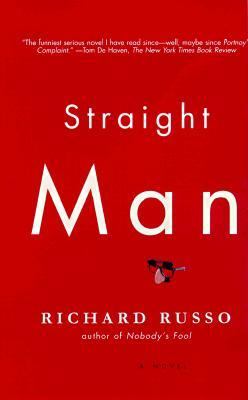
#94 - Straight Man

Yes, I know I'm not actually posting this till 2011, but my 94th & final book of 2010 was Straight Man, by Richard Russo (New York: Vintage Books, 1997).

Jacket Summary: "In this uproarious new novel, Richard Russo performs his characteristic high-wire walk between hilarity and heartbreak. Russo's protagonist is William Henry Devereaux, Jr., the reluctant chairman of the English department of a badly underfunded college in the Pennsylvania rust belt. Devereaux's reluctance is partly rooted in his character -- he is a born anarchist -- and partly in the fact that his department is more savagely divided than the Balkans. In the course of a single week, Devereaux will have his nose mangled by an angry colleague, imagine his wife is having an affair with his dean, wonder if a curvaceous adjunct is trying to seduce him with peach pits, and threaten to execute a goose on local television. All this while coming to terms with his philandering father, the dereliction of his youthful promise, and the ominous failure of certain vital body functions. In short, Straight Man is classic Russo -- side-splitting and true-to-life, witty, compassionate, and impossible to put down."

Opening Line: "When my nose finally stops bleeding and I've disposed of the bloody paper towels, Teddy Barnes insists on driving me home in his ancient Honda Civic, a car that refuses to die and that Teddy, cheap as he is, refuses to trade in."

My Take: I always enjoy Russo's books and this one didn't disappoint. Straight Man does for second-tier liberal arts colleges what Jane Smiley's Moo did for the gargantuan public universities of the Midwest. Obviously, most back-cover blurbs tend toward the hyperbolic, but here I have to agree: this is either the saddest comic novel or the funniest sad novel I've read in quite a while. The above summary notwithstanding, it's not quite the laugh-a-minute riot you might expect. Rather, the humor here comes in Hank Devereax's, the supporting characters', and the town of Railton's unvarnished warts-and-all humanity.

I've often said that even when a novel's primarily a character study or portrait of a place, I need at least some plot to hold my interest. In Straight Man, Russo's kind enough to oblige me in this regard. The frame story -- Russo's colleagues' efforts to oust him as chair, while at the same time his dean and old friend is trying desperately to throw him a life jacket -- is serviceable, if not particularly meaty in itself. What holds the reader's attention, though, is wanting to know how all the secondary story lines and characters turn out. Will Hank give in and sleep with his alcoholic colleague's lovely adjunct daughter, the peach-eating Meg? Will his daughter Julie ever grow up and turn responsible? Will his wife, Lily, accept a plum out-of-town job -- and what would that mean for his comfortable, if uninspired, small-town academic life?

Probably one of the most interesting and, to me, appealing aspects of the story and Hank's character is his complete refusal to take anything seriously. I've worked with people like this (hell, I've probably been a person like this), and frankly, usually find them as exasperating as Hank's colleagues and family seem to find him. Here, though, I also saw the pathos and loneliness just beneath the surface -- a testament to Russo's subtlety and skill at capturing the nuances of personality.

Entertaining enough to pass muster as a vacation read, but serious enough not to leave you feeling like you've just eaten a bag of M&Ms. If you're looking for an interesting, moving character story, and can accept its somewhat slow pace as part of its charm, I recommend it highly.

Wednesday, April 28, 2010

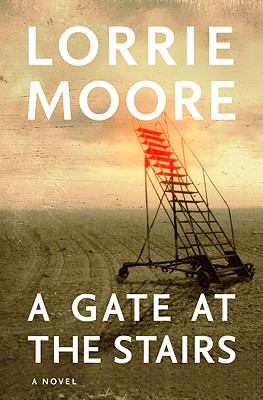
#30 - A Gate at the Stairs

A Gate at the Stairs (New York: Alfred A. Knopf, 2009) was my first of Lorrie Moore's books, and frankly, was more than a little disappointing.

Jacket summary: "As the United States begins gearing up for war in the Middle East, twenty-year-old Tassie Keltjin, the Midwestern daughter of a gentleman hill farmer -- his 'Keltjin potatoes' are justifiably famous -- has come to a university town as a college student, her brain on fire with Chaucer, Sylvia Plath, Simone de Beauvoir. Between semesters, she takes a job as a part-time nanny. The family she works for seems both mysterious and glamorous to her, and although Tassie had once found children boring, she comes to care for, and to protect, their newly adopted little girl as her own. As the year unfolds and she is drawn deeper into each of these lives, her own life back home becomes ever more alien to her: her parents are frailer; her brother, aimless and lost in high school, contemplates joining the military. Tassie finds herself becoming more and more the stranger she felt herself to be, and as life and love unravel dramatically, even shockingly, she is forever changed."

My take: Hard to articulate exactly what I didn't like about this book, except that I expected it to really grab me by the throat and reel me in, and instead, while the writing was solid, the plot was fairly slow-paced and plodding, and the characters not particularly deep or compelling. Even when what should be major, game-changing events happen, it was hard to care too much. Moore tends, in my experience, to be well-reviewed, which further increases my annoyance; is the proverbial emperor really naked, or do I just not get it? At any rate, I may give another of her books a try if the opportunity presents itself, but I won't be spending much time to seek them out.

Saturday, March 20, 2010

#21 - Commencement

Got my groove back, in terms of quantity if not quality. Commencement, by J. Courtney Sullivan (Alfred A. Knopf, 2009) is just the kind of touchy-feely, girl book I enjoy, even if I feel vaguely guilty about it sometimes. (Once a Catholic....)

Summary (from Library Journal Review): "Graduating from college and moving into the 'real world' is a rite of passage for many people. For Celia, Bree, April, and Sally, it's bittersweet to leave the confines of Smith College, where they all met. As first years, they bonded not only because they were new but because they lived together in the worst rooms in King House, third-floor maids' quarters. Celia's a Catholic schoolgirl, April an angry young feminist, and Bree the Southern belle who is already engaged, while Sally has just lost her mother to cancer. Despite these differences, they become best friends, and what they share at Smith carries them into their later lives-even as they go on to very different realities. Sullivan's first novel is a coming-of-age tale of young women in contemporary society where some of the battles of the women's movement have been won-but not all. The characters still face issues about sexuality, equality, and cultural expectations, and Sullivan's intriguing treatment partly refreshes the novel's familiar concept. For fans of contemporary women's fiction."

Fans of contemporary women's fiction. A dressed-up translation of "chick lit," perhaps, but yeah, I guess that's me. The story opens a few years after graduation, as the four former dorm-mates reconvene at Smith for Sally's wedding. As we'd expect, we then move backward in each character's memory to their freshman-year meeting and their college years together, and eventually forward, to how their lives continue to unfold after the wedding. Celia comes to Smith from a large, close-knit Massachusetts Irish-Catholic family, and finds herself gun-shy around men after a blind date with a Dartmouth guy goes horribly wrong. Homecoming queen Bree, despite a long-distance fiance, finds herself falling suddenly, passionately in love with Lara, who she can never bring home to her traditional Southern family. Sally is the consummate poor little rich girl, with a dead mother and remote father, whose impeccable study habits lead (albeit indirectly) to an affair with a brooding-but-romantic poetry professor. And then there's April, penniless daughter of a neo-hippie/ radical single mom, who's never really had friends or even a childhood before now.

Commencement isn't perfect. Of the four main characters' story lines, only Bree's really seemed gripping. Celia's and Sally's were both familiar and believable, but underdeveloped, and April's just seemed a bit preposterous. Sullivan also drops a few references to Celia's heavy drinking, but never goes anywhere with it, which left me wishing she'd either followed the thread through or just not shown us the gun in the first place.

To its credit, though, the novel does do a first-rate job at capturing the intense, intoxicating nature of college friendships. Says New York Times reviewer Maria Russo,
"[T]he real power of a women’s college has little to do with what goes on in the classroom. This affable first novel about four friends who bond during their first week at Smith unfolds mainly in dorm rooms, dining halls, the Quad — anywhere the girls can freely inhabit the passion that is the central fact of their college years and that stays charged-up into their 20s. At Smith, the days and nights are filled with lounging, eating, crying and getting drunk, all while the women constantly analyze one another’s families and romantic partners. Studying is occasionally in the mix. ...

"Sullivan’s characters are often motivated by urges that are taboo to admit in certain quarters: getting love and nurture from men, or staying protected in a cocoon of female friendship rather than confronting the larger world. She’s brave to characterize the modern female condition as equally bewildering and empowering: 'They were the first generation of women,' one character notes, 'whose struggle with choice had nothing to do with getting it and everything to do with having too much of it — there were so many options that it felt impossible and exhausting to pick the right ones.' The novel’s remedy for that predicament — friendships forged at a college that’s 'entirely and unabashedly feminine' — is as ambiguity-free as an issue of an alumni magazine. The girls’ bond occasionally turns claustrophobic and judgmental, and at one point it bursts apart altogether, but it endures. 'In each of her friends, her Smith College self would always live on,' Sullivan has a character reflect toward the end, when the girls are in their late 20s. 'Maybe that was why they were all still so important to one another, even though so much had changed.'
At the risk of sounding like a broken record, I enjoyed Commencement, particularly as a debut novel. It's not brilliant or life-changing, but it was a good story.

Tuesday, September 29, 2009

#93 - The Cheese Monkeys

I'm a sucker for college novels. Chip Kidd's The Cheese Monkeys: A Novel in Two Semesters (Scribner, 2001) is not typical, nor is it perfect, but it is pretty darned funny in places. The anonymous narrator is, as the book begins, en route to an unnamed State U. to major in art, although he's none too enthusiastic about either one:
Majoring in Art at the state university appealed to me because I have always hated Art, and I had a hunch if any school would treat the subject with the proper disdain, it would be one that was run by the government.
While his first-term art teacher, the is-she-senile-or-just-plain-ditzy Dottie Spang, doesn't do much to dispel his ennui, we can't say the same for classmate Himillsy Dodd, creator of the emperor-has-no-clothes inspired title sculpture. Sure, she drinks too much and too early in the day, has so much artistic talent that she can't bear her peers' sophomoric efforts (and consequently sneaks into the studio and modifies them after hours), and frankly, seems a bit full of herself ... but at least she's interesting and unusual, and the narrator becomes more than a little enthralled with her. While he's quietly frustrated at her romantic unavailability (Himillsy, of course, has a steady boyfriend, the incredibly pompous architect Garnett), an odd friendship develops.

Together with a third classmate, excruciatingly earnest fish-out-of-water Maybelle Lee, the pair find only one art class still open when spring registration rolls around: the newly-renamed Introduction to Graphic Design, taught by Winter Sorbeck. This, my friends, is where the novel really picks up steam. As the Complete Review's review notes, the plot itself is only so-so, partly because Himillsy's character is so annoyingly self-righteous. (Perhaps it's just that I've been out of college long enough to have forgotten somethings, and on a campus long enough that I know its cliches. Alternately, perhaps the iconoclast really was a rarity in the '50s and early '60s, which would explain why (usually) she shows up and holds such fascination for other characters in novels set on college campuses during that period; Indignation and The Secret History come to mind, and that's just off the top of my head. But I digress.)

But the graphic design assignments and critiques are both biting and hilarious. Sorbeck is merciless, and more than a little crazy. The first class assignment has the students driven out into the middle of nowhere (yes, the same landscape does surround every college town) and expected to find rides home, armed only with a large sheet of posterboard and a permanent marker; later, a faculty art exhibition sees and smells Sorbeck exhibiting a load of crap -- literally. And the hapless Maybelle and kindred spirit Mike -- a non-traditional student with excellent technical skills, but next to no soul -- are positively shredded. Kidd himself is a designer, and apparently a well-known one (I believe this was one of his book covers ), and he clearly knows that of which he speaks. I'm usually a stickler for plot and character, but the art school/ design principles bits here were enough to overcome my usual preferences. Probably won't make my top 10 list for the year, but still an enjoyable read.

Saturday, August 29, 2009

#75 - Indignation

I'll have you know I broke a personal vow for this one. While I loved American Pastoral and, um, had tremendous respect and appreciation for Sabbath's Theater (translation: the main character was disgusting, but the book so compelling and alive that I couldn't help turning page after page and finding it brilliant), the last few of Philip Roth's books I've read -- The Human Stain, Exit Ghost, The Dying Animal -- have seemed so repetitious, and I'm not a fan of the hackneyed old older-man-rediscovers-passion-with-beautiful-young-thing story line to begin with, that I promised myself I was done with Roth for a while.

Well, then came Indignation (Houghton Mifflin, 2008). The narrator's in his early 20s, so I knew from that alone that Roth would have had to find a new subject to write about. He did, and while Indignation is no American Pastoral, I was favorably impressed. The protagonist, Marcus Messner, is the 19 year old son of a Kosher butcher in Newark in the early 1950s. After learning the business inside-out from his father, and graduating at the top of his high school class, he enrolls at the tiny local Robert Treat College, and is utterly in his element, among working-class strivers of all ethnic stripes, and studying under fiery, radical professors from across the river in NYC. Unfortunately, his father becomes increasingly obsessed with the possibility that some grevious harm will come to Marcus, and that a single false step or careless choice will be his downfall. Nathan's need to monitor and question Marcus' every move leads the latter to transfer to the conservative, ultra-traditional Winesburg College in Ohio ... where his determination to maintain straight As and avoid being drafted and sent to Korea buts up against roommates from hell, a maddening chapel requirement, an overly solicitous Jewish fraternity leader and BMOC, and a beautiful, insatiable young rich girl with a dark secret of her own.

The book's deceptively short, but a good read nonetheless, alternately funny and excruciating. The ending packs a wallop along the lines of Chris Bohjalian's The Double Bind; honestly, I gasped when I read it. A fascinating if sobering coming-of-age novel, which drives home the notion that simple, seemingly inconsequential decisions can have grave repercussions.

Friday, July 17, 2009

#61 - In the Company of Young Adult books

OK, you know I've taken vacation reading to a new low when I start finding books in the Young Adult section. Even worse, I'm going to blame my daughter. I was at the library with Littlehazel last week, trying desperately not to look at the new adult fiction section that tends to get me in trouble, and I spied Nancy Mace's In the Company of Men: A Woman at The Citadel (Simon & Schuster, 2001) in the YA paperback rack. You can guess the rest.

The author, Mace, was 1 of 4 women admitted to The Citadel in 1996 (the year after the Shannon Faulkner fiasco), and the first to actually graduate. The book is mostly what you'd expect from the memoir of someone who enjoyed their 15 minutes of fame, but was an interesting quick read nonetheless; Mace comes off as fairly modest, neither overdramatizing nor sugar-coating her experience, and provides what's probably a more balanced, realistic account of the knob year than readers of The Lords of Discipline might expect. As she tells it, she entered The Citadel mainly to preserve a family tradition; her father was a well-known Citadel alum, and in fact became Commandant of the Corps during her tenure there. The book focuses mainly on her arrival and first (knob) year at the school, and isn't without humor; the overreaction of her COs to her first menstrual emergency on campus, and the embarrassed reaction of a senior on confiscating what looked like a forbidden food package only to find a box of tampons are two examples. Her overall attitude here seems pretty matter-of-fact: yes, she bore some harrassment solely for being female, but also garnered lots of encouragement for her determination -- most notably, from an upperclassmen who, a week after accusing her of "ruining" his school, admired her Hell Night fortitude, and made her promise not to quit.

All right, enough blogging -- time to get something productive done now.

Monday, June 22, 2009

#53 - College Girl

Some time Sunday, in between wrapping up Littlehazel's birthday party and getting ready for our family Fathers Day celebration, I read Patricia Weitz's College Girl (Riverhead, 2008). Stop me if I've said this before, but I'm a sucker for college coming-of-age stories, and this one didn't disappoint, though it was painful in places. It struck me as a cross between Curtis Sittenfeld's Prep and I Am Charlotte Simmons (which I reviewed here): the story of a working-class girl who goes off to pursue her dream of attending an elite college, and finds the academic challenges pale in comparison to the social ones.

There are differences, of course. Natalie Bloom, College Girl's attractive but shy protagonist, attends not the fictionalized Ault or DuPont, but the University of Connecticut, transferring in midway through her junior year after 2 years at a far less prestigious commuter school. She quickly convinces herself that her fellow students have already formed their cliques, and the few occasions when her roommate manages to drag her out do little to dispel this impression. Therefore, she spends most of her free time in the safety of the library, drawing some comfort from the fact that she's succeeding academically, if not socially.

This all changes when she meets Patrick, a tall, pot-smoking slacker from a well-to-do background who seems oddly reminiscent of Prep's Cross Sugarman. Unlike Cross, Patrick seems sympathetic at first, and genuinely interested in drawing Natalie out of her shell and getting to know who she really is. Over time, though, the relationship devolves into a purely physical one, even while Natalie keeps hoping it will turn into more. As with Prep, you can't help wondering exactly why this is; was Patrick just using her for sex all along, or did her reluctance to be herself with him prevent them from developing a real relationship? At any rate, between making herself available to Patrick on demand and just plain mooning over him, she's left with little time for studying, and her grades show it.

While I really enjoyed reading College Girl, and found Weitz's portrayal of Natalie's insecurities and depression to be spot-on (so much so that it was hard to read at times -- can you tell I still have some baggage from my own college years?), I have to admit that objectively, both Prep and Charlotte Simmons were stronger books. In part, this is because Weitz focuses almost exclusively on the personal; in contrast, Sittenfeld and Wolfe make the boarding school and college environments characters in themselves. Wolfe's DuPoint in particular does an exceptional job of pinpointing many of the excesses and contradictions of a selective college, and then ratcheting them up a notch or two, successfully walking the line between documentary and parody. Likewise, with the exception of Natalie herself, none of the characters in College Girl are particularly well-developed. The hints Weitz drops suggest that some of them -- Faith, the older roommate whose fashion sense is firmly mired in the '80s; skanky next-door neighbor Sasha; running buddy and potential friend Gwen; and recurrent hottie Jack -- might be worth knowing better, but we never quite get there.

I also have to quibble with the too-tidy way in which College Girl wraps everything up at the end. I was glad to see Natalie break free of the increasingly-unappealing Patrick's spell and begin to turn things around, but her transformation seemed a bit much for one semester -- particularly the new boyfriend, whose refusal to take "no" for an answer leads to a Rhett-and-Scarlett style sexual awakening on Natalie's part. (70 years ago, Margaret Mitchell could be forgiven for this; today, Weitz should have known better.)

This sound a bit harsher than perhaps it should. I did enjoy the book, and would certainly recommend it to others as a good summer read. Unfortunately, though, it just didn't have the blow-you-away-and-stay-with-you impact its predecessors did.

Wednesday, May 13, 2009

Catching Up

All right, for more than a week I've been meaning to finish my review for #45 - The Secret History, by Donna Tartt (Alfred A. Knopf, 1992). I've got a bazillion pages marked that I wanted to quote, I'm still slogging through Nixonland (ah, the joy of books that are tough going, but interesting enough that you don't want to give them up. Is this just me?) ... and I've concluded that if I wait till I have time to write the perfect review, it's never gonna happen. So there we are.

As you may have guessed, I'm a big fan of college and coming-of-age novels; I work at a university, for crying out loud. Well, The Secret History sorta falls into these categories, but wasn't at all what I'd expected. It's the story of an odd, exclusive group of intellectuals at Hampden College (a fictitious Vermont liberal arts college reportedly based on Bennington) who murder one of their own. This isn't giving anything away, as the first page finds our narrator -- Richard, an unlikely working-class transplant from the distinctly un-Californian California town of Plano -- remembering and reflecting on the discovery of Bunny's body. After the prologue, we flash back to Richard's initial arrival on campus. While he's eager to continue his study of Greek, he quickly learns from his advisor that the sole Greek professor, Julian, is somewhat of an odd duck, admitting only the smallest handful of students to his courses, and those for somewhat inscrutable reasons of his own.

After jumping through some hoops, of course, Richard gets in, and is quickly persuaded to drop all his other courses and switch advisors to devote the entire term to studying with Julian. He's slowly absorbed into the insular clique of Julian's students: the scholarly and methodical Henry, the ringleader; flamboyant but fragile Francis; ethereal and kindly twins Charles and Camilla; and the doomed and frankly obnoxious Bunny. How we get from the first unreal weekend at Francis's country estate to Bunny's harrowing death and beyond provides the meat of the story.

While I enjoyed the book, I found it difficult to get into at first -- largely because none of the principals are especially likeable. This may, however, be deliberate; as Richard Threadgall's review on Amazon puts it,

"[The Secret History] is a rapturous, beautiful, intricate and balanced work of art; it is also oddly archaic, strangely disconnected from reality, and oftentimes more dissolute than well-worked. In praise, its insight into the kind of effete degeneracy that seems to well up when one isolates maturing intellectuals with one another is chillingly apt: It is apt, however, more in the sense of metaphor than in any naturalistic sense. The romance, luxuriousness, and cruel beauty of the cultivated degeneracy Tartt takes as her theme is evoked with brilliance and not inconsiderable talent."

Tartt does capture the disorienting nature of a new college student's loneliness achingly well, particularly in her description of Richard's remaining on campus for the Christmas break. All in all, this is an interesting if occasionally plodding meditation about the fleeting nature of youth, beauty, and college friendships, and the seductive nature of intellectual pursuits. Not a quick beach read, but certainly recommended if you like something to sink your teeth into now and then.

Sunday, February 15, 2009

Pigging out

I can't believe I read the whole thing, or things, that is. Not so much that my latest round of books was especially bad, more that I can't believe how much of my weekend I spent reading, gorging on books like so much Valentine's chocolate when I could have been prepping and planning my garden, cleaning the guest room for Mother Thyme's visit in a few weeks, yada yada yada. Add in a free Saturday afternoon with no real obligations, which naturally had me returning one stash and loading another into the venerable old backpack, and you can see why lazing around reading carried the day.

Anyway, for anyone who's on the edge of their seat waiting ... no, I didn't finish Bad Money. This falls into that broad category of books I want to read, really; I usually find them pretty darned interesting when I do sit down and make the time to read them ... but sometimes that's just harder to do than I expect. Ah well, maybe next time.

I did finish #15 - Ellington Boulevard: A Novel in A-Flat, by Adam Langer. An entertaining read, especially if (like me) you're fans of the New York story, where The City itself is an important character. While the characters -- have you noticed this is one of the first things that tends to strike me about fiction? -- aren't particularly well fleshed-out or complex, I almost think that's intentional; they're archetypes of the different kinds of people caught up in New York City's version of the recent real estate boom. The title refers to the street -- Ellington Boulevard, nee 106th St., home to "a-flat" in the rapidly-gentrifying Roberto Clemente Building that everyone in the story either has or wants a piece of.

The story begins with Ike Mosley, the 39 year old musician who's lived in the apartment for years, returning home from an extended stay with his dying mother in Chicago to find his apartment on the market, with yuppies and real estate people tromping through for an open house. In Ike's absence, Jerry Masler, the longtime landlord and general mensch of a guy who's been renting the place to Ike for $350 and a handshake, has died. The building now belongs to his son Mark, who wants to sell and sell big; without a lease, Ike has to either come up with $650k or find a new place to live. The stakes get higher when Rebecca Sugarman and Darryl Schiff make an offer on the place, which Mark accepts. Rebecca, a 30something magazine editor, is reluctant to buy this apartment if it means evicting the clearly distraught Ike, but concedes ... partly because she hates to squelch an all-too-rare burst of enthusiasm from Darryl, her lazy, entitled grad student husband, and partly because she's eager to start a family and suspects (correctly, it turns out) that she's already pregnant. We also meet Josh, the real estate broker who secretly longs to be a bigwig producer/ mover and shaker in New York's theater scene; Jane, Darryl's eventual girlfriend, an aspiring writer of questionable talent with a mysterious past; Allie, who agrees to become Mark's much-younger third wife after a whirlwind courtship to escape an unstable family; Chloe, Rebecca's ruthless apparent wunderkind boss; Megan, whose only escape from eating, sleeping, and breathing her job as a mortgage broker is a secret affair with her boss; and Herbie Mann, Ike's dog, who's a more important character in the book than you might think. I won't spoil all the details for you, but by the end of the story, the apartment's been sold, the mortgage bubble's begun to burst, and everyone's expectations have been completely upended. Definitely entertaining; not great literature, probably, but not complete fluff, either. 3.5 out of 5 bookmarks.

#16 was How to Talk So Teens Will Listen and Listen So Teens Will Talk, by Adele Faber and Elaine Mazlish. Yeah, another self-help'er; I've got a particular weakness for the parenting books -- have for years, ever since the lack of Saturday night TV options in the '80s led me to read Parents magazine while I was babysitting. As I've said before, I don't take everything or even most things I read in these books as gospel, but this one seemed pretty good -- practical ideas and examples for active listening and assertive, respectful parenting with teenagers. Not rocket science, certainly, especially if you're already familiar with active listening and/or have read the authors' earlier book, How to Talk So Kids ... I did, however, appreciate that the book doesn't promise miracles, and gives so many examples of how to apply the authors' principles -- identifying both teens' and the parent's own feelings; stating your expectations; offering choices; using humor to get your point across -- in so many different situations. I also liked their ideas about how parents and teens might work through problems together, and how to impose consequences for bad behavior without punishing the child per se. (Short explanation: The first time the kid does something wrong, like having a party in the parents' absence or letting his grades drop because he's spending too much time on sports, let him tell his side of the story, do some brainstorming, and come up with a plan of action together. If the problem continues, impose a consequence, i.e., hiatus from soccer or from unchaperoned weekends, but put the onus on the kid to come up with a plan and prove s/he can handle the situation better next time.) Not much more to say about it, as it's a pretty straightforward book and not a particularly long one, but worthwhile for anyone who has or is on the verge of having adolescents in the house and wants some ideas for communicating with them productively. 3 out of 5 bookmarks.

And #17, which I think I both started and finished today, was Alexandra Robbins' Pledged: The Secret Life of Sororities. Almost an accident; I'd heard of the book before, but it's not a new one, and I picked it up mostly because it caught my eye while I was browsing the 370's section and I remembered enjoying Overachievers, a more recent book by the same author.

So ... Pledged was interesting, sad, and maddening, if a wee bit sensational. After requesting permission to observe a house openly from several sororities' national office, but being denied, Robbins went undercover, befriending 4 college women from 2 different sorority houses at a college she dubs only State U., and following the chapters' events through their eyes for a whole academic year, from August through April. While she claims not to want to sensationalize sorority life, and to paint a balanced picture of its pros and cons, she's clearly decided by the end that there are a whole lotta cons (racism, elitism, alcohol and drug abuse, cattiness, back-stabbing, an overemphasis on looks and clothes, eating disorders, an anachronistic focus on dates and "getting a man" from the right fraternity, and so on) and precious few pros. In fact, with the exception of the historically black sororities, which, Robbins argues, are far less exclusionary and image-based, and much more focused on service and achievement, the only half-hearted "pro" she comes up with is that many women do form strong friendships with some of their sorority sisters ... though she pretty clearly thinks this was in spite of, rather than because of, the organization itself.

Interesting to read this fairly soon after having read Charlotte Simmons again. I'm no Charlotte myself; I know people drink to excess, have indiscriminate sex, get raped, and stick their fingers down their throats on college campuses, even if none of the above featured prominently in my own college experience. But the scenes Robbins and Wolfe portray are so far removed not just from my own, but from most of my friends' (unless they all had top-secret double lives), and I wonder why that is. Was my alma mater different in some way -- not that I think the bacchanalia wasn't there at all, but was it less prevalent than elsewhere? Was I just way more sheltered and out of it than I realized -- maybe 90% of the campus really was drinking, snorting, or sleeping with whatever they could find while I was busy hanging out in cafes and movie theaters? Not sure if this makes me feel old, or just curious. 3.5 out of 5 bookmarks.


Monday, February 9, 2009

Old Favorites

There's been a dearth of reading at Hazel House of late; I had a big job interview (yay me!) last week, and between prepping obsessively beforehand and needing to just plain vegetate afterwards, I didn't have much quality time with the books. (Amazing how I did manage some quality time with a few truly mindless flash games, but that's a whole 'nother blog.)

I did, however, reread an old favorite during the post-interview decompression period: #11 - I Am Charlotte Simmons, by Tom Wolfe. If you're a fan of other Wolfe novels (i.e., Bonfire of the Vanities and A Man in Full), and have somehow missed this one, please ... stop reading this blog Right Now and go get your hands on a copy. While the 2004 New York Times review didn't agree with me, I love this book; it's a brilliant and often excruciatingly-painful satire of life on an elite college campus in the 2000's.

As the novel begins, the title character arrives on the hallowed campus of Dupont University (fictitious, but reportedly based on Duke, with hints of Penn State and Stanford thrown in) fresh off the pickup from a sheltered upbringing in rural Sparta, North Carolina, eager to immerse herself in the life of the mind. Meanwhile, elsewhere on campus, smug frat boy Hoyt Thorpe stumbles on a prominent national political figure in a compromising position; campus basketball legend Jojo Johanssen struggles to stay on top of his game when Coach threatens to bench him for a promising new player; and aspiring Rhodes Scholar Adam Gellin juggles thankless part-time jobs delivering pizza and "tutoring" athletes with regular meetings of the Millenial Mutants, a campus salon of sorts for aspiring intellectuals.

In some ways, this is a typical coming-of-age novel; in others, it's a lot more than that. As is true of Wolfe's other books, themes of class and racial tension abound here. Charlotte's lofty expectations of academic life at Dupont are confounded when she finds herself in an upper-level French literature class where books are read in English, and that's just the beginning. She's also beyond shocked at the omnipresence of alcohol, casual sex, lewd dancing, and general decadence on the campus; her roommate, the snooty Groton-educated Beverly, does not help matters. She wavers between wanting to be true to herself -- to, as her mother advised her, say "I am Charlotte Simmons, and I don't hold with that" -- and wanting desparately to belong, to somehow alleviate her excruciating loneliness. When a good-looking BMOC like Hoyt starts inviting her to visit the Saint Ray house, and then invites her to an out-of-town fraternity formal, she thinks she's got it made, but little does she know.

This is mostly Charlotte's story, but our other 3 principals are also fish out of water at Dupont. In the brains department, Adam seems to have it all, but he's desparate not only to lose his virginity, but to make the world at large see him as a person of consequence. Jojo is beginning to question his status as a golden boy of basketball; do his coach and teammates really see him as One of Them, even though he's white? Does he really want to coast through Dupont taking classes like Frere Jocko and Stocks for Jocks? Hoyt looks every inch the quintessential Dupont Man, but in reality, comes from a working-class background, and has no idea what awaits him after graduation save a vague sense that he'll go into investment banking, because it pays well and That's What Saint Rays Do.

Without giving anything away, I can never decide how I feel about the ending. In some ways, it wraps things up too tidily; in others, it's too ambiguous. I'm not sure I fully buy the transformation in Jojo's character over the course of the book. Where Charlotte finds herself by the end makes a little more sense -- there are still a few loose ends hanging out there -- but I'm not completely convinced as to the road she took to get there. I also agree that Wolfe's female characters are rather crudely drawn; Charlotte is somewhat of an exception, but her over-the-top innocence and sheltered upbringing aren't completely believable. But it's Wolfe's nature to exaggerate to make a point -- to take most aspects of the world he creates just a step or 2 too far, so that it's both plausible and ridiculous at the same time. 4.5 out of 5 bookmarks.

I've also been reading #12 - These Happy Golden Years, by Laura Ingalls Wilder, with my daughter. I read the whole Little House series more times than I can remember as a child; people who know me IRL have probably heard my story of getting the whole series in paperback one Christmas from a relative who gave my sister a dollhouse, and being incredibly jealous and resentful that she'd gotten the better present. The dollhouse fell apart within a year; the paperbacks are probably still in my parents' basement somewhere. Anyway, tangent aside, I've been amazed at how many things in these books I notice and understand now, reading them as an adult, that just plain went by me when I read them the first or even the tenth time as a girl.

It's very hard for me to pick a favorite in the series. Growing up, I was partial to On the Banks of Plum Creek and Little Town on the Prairie, and By the Shores of Silver Lake was probably my least favorite (i.e., I only read it once or twice). I always liked THGY, but it's definitely grown on me over the years; it's a sweet, understated story of an 1880s pioneer courtship, and of Laura's conflict between remaining safe and comfortable in her parents' home, and moving forward with her own married, adult life. As the story begins, 15-year-old Laura is on her way to her first teaching job and her first experience living away from home. After a rocky first few weeks, she finds her footing as a teacher. However, the Brewsters, with whom she's boarding, are truly wretched, and she's painfully homesick. It comes as a delightful surprise when Almanzo Wilder begins making the 12-mile drive each Friday to bring Laura home for the weekend, and then again each Sunday to bring her back.

The rest, as they say, is history. Even allowing for the fact that the Little House books are all "inspired by actual events," rather than pure biography, it's interesting to see how much our notions of romance have changed, and how much they haven't. There are glimpses of jealousy on both Almanzo's and Laura's parts (Almanzo asking suspiciously about a strange male visitor to the Ingalls' home, who turns out to be Laura's uncle; Laura telling Almanzo not to call for her if he wants to take the obnoxious Nellie Oleson driving), and an amusing scene towards the beginning where Laura tries to make it clear that she's only accepting Almanzo's rides because she wants to go home for the weekend, and he shouldn't expect her to go driving with him once her teaching gig is over with. Perhaps my favorite, though, happens later, when on a spring buggy ride, Almanzo says, seemingly out of nowhere, "I was wondering if you would like an engagement ring." "That would depend on who offered it to me," replies Laura. "If I did?" "Then it would depend upon the ring."

It's probably even harder to rate a children's book than it is for me to pick a favorite in these series, but given how much I still like this one even after umpteen readings, and given how much Littlehazel is enjoying it, even though her history with the series is only secondhand, I'll give it 4 out of 5 bookmarks.

And for something completely different, I read #13 - Getting Things Done: The Art of Stress-Free Productivity, by David Allen over the weekend -- but I think I need to wait till I'm home and have the book in hand to post a review for that one.

Coming soon: I'm usually a one-book-at-a-time gal, but somehow, I ended up in the middle of 3 at once: Bad Money: Reckless Finance, Failed Politics, and the Global Crisis of American Capitalism, by Kevin Phillips; One Person/ Multiple Careers: A New Model for Work/Life Success, by Marci Alboher; and Ellington Boulevard: A Novel in A-Flat, by Adam Langer. Not so sure I'll get through Bad Money, though I want to, and I'm enjoying both of the others. Watch this space for details.