About Me

Ithaca, New York
MWF, now officially 42, loves long walks on the beach and laughing with friends ... oh, wait. By day, I'm a mid-level university administrator reluctant to be more specific on a public forum. Nights and weekends, though, I'm a homebody with strong nerdist leanings. I'm never happier than when I'm chatting around the fire, playing board games, cooking up some pasta, and/or road-tripping with my family and friends. I studied psychology and then labor economics in school, and I work in higher education. From time to time I get smug, obsessive, or just plain boring about some combination of these topics, especially when inequality, parenting, or consumer culture are involved. You have been warned.
Showing posts with label mystery. Show all posts

Thursday, July 5, 2012

#46: Sophie's World

Sophie's World: A Novel About the History of Philosophy, by Jostein Gaarder, translated by Paulette Moller (New York: Berkeley Books, 1997, c1994)

Summary:
"A page-turning novel as well as an exploration of the great philosophical concepts of Western thought, Sophie's World -- with more than thirty million copies in print -- has fired the imaginations of readers all over the world.


"One day fourteen-year-old Sophie Amundsen comes home from school to find in her mailbox two notes, each with a question: 'Who are you?' and 'Where does the world come from?' From this irresistible beginning, Sophie becomes obsessed with questions that take her far beyond what she knows of her Norwegian village. Through successive letters, she enrolls in a kind of correspondence course, covering Socrates to Sartre, with a mysterious philosopher, while also receiving letters addressed to another girl. Who is Hilde? And why does her mail keep turning up? To answer this riddle, Sophie must use the philosophy she is learning -- but the truth turns out to be far more complicated than she could have imagined."


Opening Lines:
"Sophie Amundsen was on her way home from school. She had walked the first part of the way with Joanna. They had been discussing robots. Joanna thought the human brain was like an advanced computer. Sophie was not sure she agreed. Surely a person was more than a piece of hardware?"

My Take:
Finally got around to reading this one after having it on my shelf for, well, longer than I can remember. Fascinating concept and an accessible, even enjoyable overview of Western philosophy for those who (like me) somehow didn't take that particular elective in college. The story and/or plot do get a bit bogged down at times, with the philosophy often overwhelming the Sophie-and-the-philosopher frame story ... but to be fair, part of this may be a result of the translation. Not quite a page-turner, at least for me, but still much more interesting than browsing Wikipedia or lugging around a college textbook for a taste of the history of philosophy.

Wednesday, April 18, 2012

#30: A Grown-Up Kind of Pretty

A Grown-Up Kind of Pretty, by Joshilyn Jackson New York: Grand Central Publishing, 2012)

Summary:
"Every fifteen years, trouble comes after the three Slocumb women. Now, as the youngest turns fifteen, she's desperate to know who used their yard as a makeshift cemetery, and why. The unlikely matriarch, forty-five-year-old Ginny, doesn't know the truth -- she only knows she must do everything in her power to keep it hidden. Between them is Liza, silenced by a stroke, haunted by the choices she made as a teenager, with the answers trapped inside her. To survive Liza's secrets and Mosey's insistent adventures, Ginny must learn to trust the love that braids the strands of their past -- and stop at nothing to defend their future.

"With riveting plot twists and off-kilter characters, A Grown-Up Kind of Pretty introduces three generations of Slocumbs: a child on the cusp of womanhood searching for her true family; a woman whose fight to protect her daughter will toss her headlong into a second chance at first love; and a lost soul rediscovering her voice. New York Times bestselling author Joshilyn Jackson takes us on a wild ride from desperate mystery to a place of firm hope, providing once more that 'she knows how to grab a reader -- and not let go' (USA Today)."

Opening Line:
"My daughter, Liza, put her heart in a silver box and buried it under the willow tree in our backyard."

My Take:
Two chapters in, and weirdness aplenty has been established. Thirty years earlier, Ginny got pregnant at fourteen by a popular high school athlete who plied her with zombie punch, and used the hush money from his family to get away from the shameful gazes in her parents' small town and raise her daughter, Liza, on her own. Fifteen years later, Liza repeats her mother's mistake, disappears a few weeks after her still-unnamed daughter's birth, and returns two years later with a skinny toddler named Mosey who looks oddly unlike her mother and grandmother. Since Mosey's own fourteenth year, both Ginny and Liza have been a wreck, although Ginny desperately hopes that Liza's stroke will be all the bad luck the family's due for another fifteen years.

Then Ginny hires a local yokel to cut down Liza's beloved willow tree so she can put in a swimming pool, in hopes that this will aid Liza's recovery. He finds a silver box containing what Ginny can't help but recognize as the infant Mosey's clothing and toys, along with a tiny infant jawbone. The discovery sends Liza into an anguished rage, screaming words only Ginny and Mosey can decipher: "Umbay! Umbay! Geem, gee!" My baby! My baby! Give me, give!

I, for one, am intrigued.

(Next day) Well, I wasn't disappointed, and can't wait to track down some of Jackson's other novels if this one is any indication. It's not too much of a spoiler to say that both Mosey and Ginny (a/k/a Big) realize early on that the baby beneath the willow is probably Liza's child, in which case ... who the heck is Mosey? Neither knows that the other knows, and Mosey is by turns angry and terrified that Big won't want a thing to do with her once she learns she's not a blood relation. Did Liza steal someone else's baby? If so, does anyone know, and will they come to take Mosey back? And just who was the carney who allegedly fathered Liza's baby, anyway? a different kind of mystery than I'm used to -- less legal and police procedural, more family and relationship stuff -- but plenty of twists and intrigue to keep things interesting.

Saturday, March 24, 2012

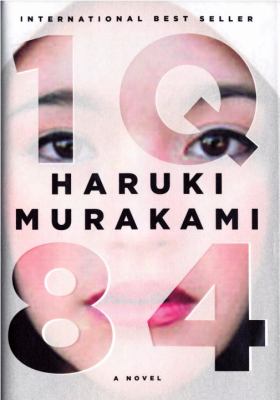
#24: 1Q84

1Q84, by Haruki Murakami, translated by Jay Rubin and Philip Gabriel (New York: Alfred A. Knopf, 2011)

Summary:
"The year is 1984 and the city is Tokyo.

"A young woman named Aomame follows a taxi driver's enigmatic suggestions and begins to notice puzzling discrepancies in the world around her. She has entered, she realizes, a parallel existence, which she calls 1Q84 -- 'Q' is for "question mark." A world that bears a question.' Meanwhile, an aspiring writer named Tengo takes on a suspect ghostwriting project. He becomes so wrapped up with the work and its unusual author that, soon, his previously placid life begins to come unraveled.

"As Aomame's and Tengo's narratives converge over the course of this single year, we learn of the profound and tangled connections that bind them ever closer: a beautiful, dyslexic teenage girl with a unique vision; a mysterious religious cult that instigated a shootout with the metropolitan police; a reclusive, wealthy dowager who runs a shelter for abused women; a hideously ugly private investigator; a mild-mannered yet ruthlessly efficient bodyguard; and a peculiarly insistent television-fee collector.

"A love story, a mystery, a fantasy, a novel of self-discovery, a dystopia to rival George Orwell's -- 1Q84 is Haruki Murakami's most ambitious undertaking yet: an instant bestseller in his native Japan, and a tremendous feat of imagination from one of our most revered contemporary writers."

Opening Line:
"The taxi's radio was tuned to a classical FM broadcast."

My Take:
Interesting in the way it combines a fantasy world/ parallel universe, a mystery/ suspense story, and even a little bit of a love story ... but it wasn't worth the almost 950 pages it took to get there (or else this just isn't my genre, or something was lost in translation, any of which are possible). The concept of a parallel world with 2 moons where everything's just slightly different was interesting, but the whole Air Chrysalis novella that Tengo is ghostwriting and the Little People who featured prominently therein just left me cold. I can appreciate the positive reviews the book got, but it didn't really speak to me personally.

Wednesday, November 16, 2011

#99: Heads You Lose

Heads You Lose, by Lisa Lutz and David Hayward (New York: G. P. Putnam's Sons, 2011)

Summary:
"From New York Times-bestselling author Lisa Lutz and David Hayward, a hilarious and original tag-team novel that reads like Weeds crossed with Adaptation.

"Meet Paul and Lacey Hansen: orphaned, pot-growing, twentysomething siblings eking out a living in rural Northern California. When a headless corpse appears on their property, they can't exactly dial 911, so they move the body and wait for the police to find it. Instead, the corpse reappears, a few days riper ... and an amateur sleuth is born. Make that two.

"But that's only half the story. When collaborators Lutz and Hayward -- former romantic partners -- start to disagree about how the story should unfold, the body count rises, victims and suspects alike develop surprising characteristics (meet Brandy Chester, the stripper with the Mensa IQ) and sibling rivalry reaches homicidal intensity. Will the authors solve the mystery without killing each other first?"

Opening Line:
"Dave, I just finished the first chapter of a new novel -- a real crime novel with a dead body and all -- and I thought of you."

My Take:
Maybe I've just fallen for the gimmick, but this was an OK (slightly muddled, as you'd expect) novel made much funnier and more interesting because of the meta-story. As noted above, the authors took turns writing alternating chapters -- without having agreed on a plot line or details in the beginning. Neither knew till they saw each chapter what his/ her cowriter would have done, and as you'd expect with exes, they don't always see eye to eye. They did establish a rule that neither could undo plot development established by the other, but they also have a good bit of fun seeing just how far they can push this rule. (Without spoiling too much, I had "He's really most sincerely dead" running through my head more than once.)

Other than that, the less said about the plot, the better ... but if it sounds funny, give it a read.

Thursday, October 13, 2011

#80: The White Devil

The White Devil, by Justin Evans (New York: Harper, 2011)

Summary:
"The Harrow School is home to privileged adolescents known as much for their distinctive dress and traditions as for their arrogance and schoolboy cruelty. Seventeen-year-old Andrew Taylor is enrolled in the esteemed British institution by his father, who hopes that the school's discipline will put some distance between his son and his troubled past in the States.

"But trouble -- and danger -- seem to follow Andrew. When one of his schoolmates and friends dies mysteriously of a severe pulmonary illness, Andrew is blamed and is soon an outcast, spurned by nearly all his peers. And there is the pale, strange boy who begins to visit him at night. Either Andrew is losing his mind, or the house legend about his dormitory being haunted is true.

"When the school's poet-in-residence, Piers Fawkes, is commissioned to write a play about Byron, one of Harrow's most famous alumni, he casts Andrew in the title role. Andrew begins to discover uncanny links between himself and the renowned poet. In his loneliness and isolation, Andrew becomes obsessed with Lord Byron's story and the poet's status not only as a literary genius and infamous seducer but as a student at the very different Harrow of two centuries prior -- a place rife with violence, squalor, incurable diseases, and tormented love affairs.

"When frightening and tragic events from that long-ago past start to recur in Harrow's present, and when the dark and deadly specter by whom Andrew's been haunted seems to be all too real, Andrew is forced to solve a two-hundred-year-old literary mystery that threatens the lives of his friends and his teachers -- and, most terrifyingly, his own."


Opening Lines:
"Outside a cool evening awaited. The perspiration on his back and neck turned icy."


My Take:

Halfway through and still trying to decide. Got off to a slow start -- Gothic fiction isn't usually my thing -- but I do like stories set in school settings and it is picking up a bit. TBA.

(Later)
Decent as those things go, but as I said, Gothic fiction isn't really my bag, and I don't know that this book was enough to win me over to the genre. Oh well; nothing wrong with expanding one's literary horizons.

As noted above, the book's opening is fairly unremarkable, with Andrew arriving at Harrow as a brand-new sixth-former (senior) feeling like he's stepped into a wholly alien world. The sole American at a British boarding school, and a rare transfer where most students begin as shells (seventh graders), Andrew does not make friends quickly -- not to mention that the rumors about his expulsion from his last school for drug use have crossed the pond with impressive speed. Only dorm-mate Theo Ryder is at all friendly or welcoming to Andrew, and within a few days, Theo is found dead. Contrary to the jacket blurb above, Andrew isn't blamed for Theo's death at this point, and the remaining residents of the Lot (Andrew's and formerly, Theo's house, or dorm) continue their studies, shaken but not really permanently changed.

Or so they think. What Andrew can't tell anyone at first, for fear of being deemed crazy and sent home, is that he not only found Theo's body ... he saw him die, strangled by a mysterious, white-haired boy who was there one moment and (without running away) simply gone the next. When the autopsy attributes Theo's death to a rare but non-contagious lung disease, he tries to put the vision from his mind. At the same time, Harrow's poet-in-residence and Lot's housemaster, Piers Fawkes, has been commissioned to write a play about Harrow's most famous alum, Lord Byron ... to whom Andrew bears an uncanny resemblance. Andrew is cast in the lead role, and begins to forge tentative, unlikely friendships with both Fawkes and the school's sole female student, headmaster's daughter Persephone Vine.

Unfortunately, the spectral white-haired boy doesn't give up that easily. Late one night, Andrew sees him a second time, when the boy leads him to a prefect's bathroom in the Harrow of yore, where a perplexed Andrew prevents him from being raped by a gang of older, larger students. Later, he recites a bizarre verse which Andrew learns (with the help of Fawkes and the school's archivist, Judith Kahn) comes from an obscure Jacobean tragedy performed at Harrow some 200 years earlier. This coincidence convinces the skeptical Fawkes that Andrew's ghost isn't just in his head, and the two become engrossed in discovering who he is and what he wants.

Until two more students fall ill, with symptoms similar to Theo's ... but which now, on closer examination, seem to indicate TB. This ratchets up the urgency and publicity of their search, especially as one of the students is Persephone.

From here on out, the book does get considerably more gripping and hard to put down. Though I'm not typically a fan of ghost stories, I did enjoy the climax and resolution of this one. If you like boarding school novels with a touch of the supernatural, give this one a try.

Thursday, May 5, 2011

#31: Ordinary Thunderstorms

Ordinary Thunderstorms, by William Boyd (New York: HarperCollins, 2010).

Summary:
"One May evening in London, Adam Kindred, a young climatologist in town for a job interview, is feeling good about the future as he sits down for a meal at a little Italian bistro. He strikes up a conversation with a solitary diner at the next table, who leaves soon afterward. With horrifying speed, this chance encounter leads to a series of malign accidents, through which Adam loses everything -- home, family, friends, job, reputation, passport, credit cards, cell phone -- never to get them back.

"The police are searching for him. There is a reward for his capture. A hired killer is stalking him. He is alone and anonymous in a huge, pitiless, modern city. Adam has nowhere to go but down -- underground. He decides to join that vast array of the disappeared and the missing who throng London's lowest levels as he tries to figure out what to do with his life and struggles to understand the forces that have made it unravel so spectacularly. Adam's quest will take him all along the river Thames, from affluent Chelsea to the gritty East End, and on the way he will encounter all manner of London's denizens -- aristocrats, prostitutes, evangelists, and policewomen -- and version after new version of himself.

"Ordinary Thunderstorms, William Boyd's electric follow-up to his award-winning Restless, is a profound and gripping novel about the fragility of social identity, the corruption at the heart of big business, and the secrets that lie hidden in the filthy underbelly of every city."


Opening Line:
"Let us start with the river -- all things begin with the river and we shall probably end there, no doubt -- but let's wait and see how we go."

My Take:
Wow! For some reason, I had a hard time getting around to starting this one, even though it's been on my reading list for nearly a year and on my library loaners shelf more than once before. Then yesterday I had a bad day (ah, the ups and downs of unemployment), polished it off in a few hours ... and man, Boyd really knocks this one out of the park.

As the jacket blurb above suggests, Ordinary Thunderstorms is most certainly a page turner. There's mystery, espionage, corporate malfeasance, a halfway-decent riches-to-rags story, and even a glimmer of a romance that manages to neither seem forced nor dominate the novel from the time it's introduced (both big peeves of mine, if that wasn't already obvious). Adam is compelling and makes you want to root for him largely because he's not perfect; he makes a few colossally stupid blunders early on in the novel (granted, if he hadn't, there wouldn't be much of a story here), and we learn that a spontaneous, unthinking fling with a grad student cost him both his last job and his marriage.

The supporting cast is likewise fun to watch and follow, even if it's more often than not in a can't look away, train wreck sort of way. With the exception of Rita, the marine police officer who unknowingly comes this close to Adam more than once before becoming obsessed with why the higher-ups suddenly released one of her highly-armed collars; and Philip Wang, the doctor/ pharmaceutical researcher whose murder Adam stumbles on in Chapter 1; they range from unsettling to sketchy to downright scary. There's Ingram, head of the company for which Wang had worked, who seems to have it made ... except for the growing realization that it's not he who's really calling the shots, and the suspicion that his mysterious ailments may be more than stress. There's Mhouse, the illiterate prostitute who laces her young son's meals with rum and Diazepam so he'll stay asleep when she goes out to work. Most ickily, there's Jonjo, the highly-trained ex-soldier who makes quite a comfortable living freelancing at what he does best, and whose sole redeeming quality seems to be that at least he loves his dog.

On top of being a darned good story, Ordinary Thunderstorms also has a lot going on between the lines. It's no accident that Adam is (or was) a climatologist by training: a man who made a living seeding clouds, demonstrating man's power to alter even the most elemental of forces. Throughout the novel, he goes from being someone who controls the weather (as his grad student, the aptly-named Fairfield Springer, observes just before their assignation, "It's like you're playing god,") to someone who struggles to control even the most basic aspects of his own life. The reader comes to realize, as the story unfolds, that the seemingly-random events that make Adam's life fall apart are, in fact, like the clouds he once seeded in his lab: the result of innumerable, interrelated human actions. Though hungry, penniless, and in fear for his life, Adam rejects the idea of turning himself into the police because he knows in doing so, he'd give up what little control he still has. Likewise, in their own ways, Ingram, Rita, Mhouse, and Jonjo all struggle (with varying degrees of success) to carve out patches of autonomy and dignity in a world where storms and uncertainties far beyond their control seem constantly at work.

Yeah, I guess I kinda liked this book -- that, and maybe I'm vicarously expounding on behalf of my daughter, who finished the ELA tests at school today. (Good thing no one's grading my blog, eh? I'd settle for someone reading it.)

Wednesday, October 27, 2010

#77 - Mr. Peanut

Mr. Peanut, by Adam Ross (New York: Alfred A. Knopf, 2010).

Summary: "David Pepin has loved his wife, Alice, since the moment they met in a university seminar on Alfred Hitchcock. After thirteen years of marriage he still can't imagine living without her -- yet he obsessively contemplates her demise. Soon she is dead, and he is both deeply distraught and the prime suspect.

"The detectives investigating Alice's suspicious death have plenty of personal experience with conjugal enigmas: Ward Hastroll was happily married until his wife inexplicably became voluntarily and militantly bedridden; and Sam Sheppard is especially sensitive to the intricacies of marital guilt and innocence, having decades before been convicted and then exonerated of the brutal murder of his wife.

"Still, these men are in the business of figuring things out, even as Pepin's role in Alice's death grows even more confounding when they link him to a highly unusual hit man called Mobius. Like the Escher drawings that inspire the computer games David designs for a living, these complex, interlocking dramas are structurally and emotionally intense, subtle, and intriguing; they brilliantly explore the warring impulses of affection and hatred, and pose a host of arresting questions. Is it possible to know anyone fully, completely? Are murder and marriage two sides of the same coin, each endlessly recycling into the other? And what, in the end, is the truth about love?

"Mesmerizing, exhilarating, and profoundly moving, Mr. Peanut is a police procedural of the soul, a poignant investigation of the relentlessly mysterious human heart -- and a first novel of the highest order."


Opening Line: "When David Pepin first dreamed of killing his wife, he didn't kill her himself."

My Take: Yeah, after a 500+-page tome on the horrors of war and a much-shorter book so filled with higher-level math as to seem like another language, I think it's time for something a little lighter ... like a story about a guy who may or may not have murdered his wife, say.

Well, that was disappointing. The reviewers were all over this one; Scott Turow, in the New York Times, calls it "daring [and] arresting ... an enormous success -- forceful and involving, often deeply stirring and always impressively original." The Wall Street Journal and The New Yorker, while not quite as laudatory, were nonetheless mostly positive. While I can't say I found it awful, I did end up wondering if these reviewers read the same book I did. Even Turow acknowledges that the novel's point of view is "overwhelmingly male." I don't object to this per se; heck, half the population is male. However, what all the reviewers seem to miss is that if you're offering a compelling meditation on marriage, it helps to have all your principals be at least reasonably sympathetic. In this area, Mr. Peanut falls far short of the mark. I usually avoid published reviews while I'm actually reading a book, lest they unduly influence my own experience, but here, I broke the rule about halfway through because I was desperate to see what others saw in the novel. Turow calls the three wives withholding, but that's not the half of it; both Alice and the voluntarily-bedridden Hannah Hastroll are so dramatic, manipulative, and uncommunicative that I just couldn't see why David and Ward didn't, to quote Dan Savage, DTMFA. A grown woman feels like she's become invisible to her husband, and just plain stops getting out of bed, letting her husband bring meals on a tray, for months on end? (How she washes or goes to the bathroom remain a mystery.) Another adult pitches constant temper tantrums, walking out on or refusing to speak to her partner for some perceived slight? I mean, really. For one character in a novel to behave like this could have been intriguing, an exploration of the complicated, sometimes dysfunctional pas de deux that evolves over time between long-married partners. For two unconnected characters to do it, and a third (Marilyn Sheppard) to take at least some steps in this direction, makes me wonder if Ross is working through some issues of his own here. (At least Marilyn, despite her unilateral decision to have a sexless marriage, is rendered with some sympathetic qualities; Alice has precious few, and Hannah none.)

This is really too bad, because the story otherwise raises some interesting issues. To what extent might both partners in a marriage be complicit in one partner's affair? How does infertility affect a couple's relationship? (Had Ross toned down Alice's histrionics, the part about her having a second-trimester miscarriage while on vacation would have been far more moving.) If you've ever imagined the death of someone you love, what kind of guilt do you carry if and when that person does die? Unfortunately, Mr. Peanut seems too busy scratching the surface of many different issues to really do any one of them justice.

Friday, September 24, 2010

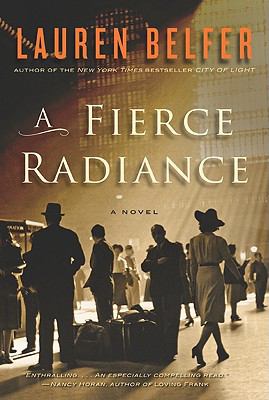
#69 - A Fierce Radiance

A Fierce Radiance, by Lauren Belfer (New York: Harper, 2010).

Jacket summary: "Claire Shipley is a single mother haunted by the death of her young daughter and by her divorce years ago. She is also an ambitious photojournalist, and in the anxious days after Pearl Harbor, the talented Life magazine reporter finds herself on top of one of the nation's most important stories. In the bustling labs of New York City's renowned Rockefeller Institute, some of the country's brightest doctors are racing to find a cure that will save the lives of thousands of wounded American soldiers and countless others -- a miraculous new drug they call penicillin. Little does Claire suspect how much the story will change her own life when the work leads to an intriguing romance.

"Though Claire has always managed to keep herself separate from the subjects she covers, this story touches her deeply, stirring memories of her daughter's sudden illness and death -- a loss that might have been prevented by this new 'miracle drug.' And there is James Stanton, the shy and brilliant physician who coordinates the institute's top secret research for the military. Drawn to this dedicated, attractive man and his work, Claire unexpectedly finds herself falling in love. But Claire isn't the only one interested in the secret development of this medicine. Her long-estranged father, Edward Rutherford, a self-made millionaire, understands just how profitable a new drug like penicillin could be. When a researcher at the institute dies under suspicious circumstances, the stakes become starkly clear: a murder has been committed to obtain these lucrative new drugs. With lives and a new love hanging in the balance, Claire will put herself at the center of danger to find a killer -- no matter what price she may have to pay."


Opening line: "Claire Shipley was no doctor, but even she could see that the man on the stretcher was dying."


My take: What do you say about a book that's part historical fiction, part mystery/ suspense, and part medical drama, with the obligatory bit of romance mixed in? Well, in the case of A Fierce Radiance, I'd say it's surprisingly good. You'd think, from the jacket flap, that the plot would either get impossibly complicated or implausibly cheesy, but it actually doesn't. A hard-core mystery or medical thriller it's not, but Belfer does an admirable job of blending the varied elements of the story without making the reader want to skip over one section or the other. No mean task, that.

It's not spoiling too much to say that yes, the man on the stretcher in Act I does, indeed, die. After a minor scrape on the tennis court gets infected, he arrives at the Rockefeller Institute in grave condition. Claire, a Life photojournalist who excels in blending into her surroundings to capture the story, has been sent to document penicillin's emergence as a miracle drug -- just in time to treat the countless injuries our soldiers will incur in World War II, which the U.S. has just entered the week the novel opens. With no other avenues left to treat Mr. Reese, his wife agrees to subject him to the first human penicillin trials. His recovery is nothing short of miraculous.

There's a catch, of course. While scientists have known about penicillin since the 1920s, its mass production continues to elude them. The Institute has only what they can grow in milk bottles and bedpans, and supplies are limited. Having never tried penicillin on humans before, dosage levels and frequency take some guesswork. A short few days later, Reese relapses, and dies before more penicillin is available.

His story and those of the researchers involved set the stage for the bulk of the novel. The military is sure to need as much penicillin as they can produce; civilians are bound to want it when word gets out; and yet there's no viable way to produce it on a large, commercial scale -- even though a Navy-led team of scientists from all the major pharmaceutical companies is throwing everything they have at the problem. Or are they? While the government's pre-emptively barred them from patenting anything to do with penicillin, there are sure to be other mold-based medicines out there, and all the drug companies have already realized that identifying and patenting them is where the real money lies. Needless to say, they're none too eager to share their progress in this area; patriotic duty, after all, only goes so far.

Furious when Life kills her penicillin story (Reese's death makes it too depressing for wartime), increasingly drawn to chief Rockefeller penicillin researcher James Stanton, and desperate not to be sent overseas on assignment, Claire pitches a new project to publisher Henry Luce: let her document the nascent penicillin production process, and don't publish it until the magazine and the country are ready. The formidable Luce agrees. Things get complicated in a hurry, however, when Claire is assigned a second job, working for the federal government: use the knowledge she gains to keep tabs on the pharmaceutical companies, and make sure they aren't holding anything back. A researcher who's just started to see promising results from a penicillin alternative ends up dead; was it suicide, accident, or murder? And Claire's father, the inventor/ tycoon she's just recently begun to know after a decades-long estrangement, has just bought a pharmaceutical company, and is turning up in the oddest places.

While A Fierce Radiance is certainly a page turner, it's the supporting details that really set it apart. Belfer succeeds brilliantly in capturing the texture of everyday Americans' lives in the early days of WWII: the constant fear that the nightly bombings of London would come to New York and Washington, the potentially devastating consequences of illness and injury in the pre-antibiotic age, the lingering aftermath of the Great Depression. While Claire herself has a bit of Mary Sue about her, the bulk of the characters are complex and believable; I especially appreciated how the author portrayed Rutherford, Claire's father, in this regard.

If anything, the romance is the weakest part of the story. It's not that I object to a love story that starts out with an intense physical attraction; heck, it happens all the time. But because it is so common, it's hard to write about it in a way that feels fresh or non-cliched. Fortunately, the somewhat-trite beginning is largely redeemed as the story progresses, Claire and Jamie are kept apart by their respective wartime assignments, and ... well, life happens.

All in all, an engaging read, and an interesting twist on the World War II novel. If you like historical fiction and/or medical thrillers, you'll probably like this one.

Tuesday, May 25, 2010

#41 - The Girl with the Dragon Tattoo

Decided after the poignant and literary but somewhat slow-paced Independence Day that I needed a book where something actually happened, darn it. Well, for anyone who's missed the hype around the books and/or the movie, Stieg Larsson's The Girl with the Dragon Tattoo (New York: Alfred A. Knopf, 2008) more than fit the bill.

Summary: "The disappearance forty years ago of Harriet Vanger, a young scion of one of the wealthiest families in Sweden, gnaws at her octogenarian uncle, Henrik Vanger. He is determined to know the truth about what he believes was her murder. He hires crusading journalist Mikael Blomkvist, recently at the wrong end of a libel case, to get to the bottom of Harriet's disappearance. Lisbeth Salander, a twenty-four-year-old, pierced, tattooed genius hacker, possessed of the hard-earned wisdom of someone twice her age -- and a terrifying capacity for ruthlesness -- assists Blomkvist with the investigation. This unlikely team discovers a vein of nearly unfathomable iniquity running through the Vanger family, an astonishing corruption at the highest echelon of Swedish industrialism -- and a surprising connection between themselves."

Opening lines: "It happened every year, was almost a ritual. And this was his eighty-second birthday."

My take: Hold on to your hat, folks. It's not often that a book surrounded by this much hype manages to impress and entertain me, but Dragon Tattoo certainly did. Lots of interesting characters, all worthy of varying levels of suspicion. There's the 82-year-old Henrik Vanger of the opening line; principals Blomkvist and Salander ... but also a host of supporting characters, ranging from Blomkvist's publisher and occasional lover, Erika Barger; Harriet's brother Martin, who took over as CEO of Vanger when Henrik retired; Henrik's seemingly devoted attorney; Salander's own boss; Harriet's inscrutably nasty mother; and many other curious members of the Vanger tribe. True to form, you wonder early on how all these threads -- Blomkvist's libel conviction; Harriet's disappearance and presumed murder; Salander's questionably-ethical sleuthing skills -- will tie together, and the answer mostly works. Without spoiling it, there is a particular romantic pairing I don't approve of -- and more importantly, that doesn't seem to add much to the story -- but otherwise, you can bet I'll be lining up for The Girl Who Played with Fire and The Girl Who Kicked the Hornet's Nest, stat.

Wednesday, April 28, 2010

#31 - When Will There Be Good News?

When Will There Be Good News, by Kate Atkinson (New York: Little, Brown, & Co., 2008) certainly wasn't perfect, but it definitely had more going for it than the last few books I've read.

Jacket summary: "On a hot summer day, Joanna Mason's family slowly wanders home along a country lane. A moment later, Joanna's life is changed forever. ... On a dark night thirty years later, ex-detective Jackson Brodie finds himself on a train that is both crowded and late. Lost in his thoughts, he suddenly hears a shocking sound. ... At the end of a long day, 16-year-old Reggie is looking forward to watching a little TV. Then a terrifying noise shatters her peaceful evening. Luckily, Reggie makes it a point to be prepared for an emergency. ... These three lives come together in unexpected and deeply thrilling ways in the latest novel from Kate Atkinson, the critically acclaimed author who Harlan Coben calls 'an absolute must-read.'"

My take: Interesting, likeable characters and an intriguing storyline make this book worth a read, though the plot occasionally crosses the line from mysterious to muddled and confusing. It's hard not to feel drawn to Joanna, the former child survivor of a horrendous crime, now grown into a successful, happily married doctor and mother in spite of it all, or to Reggie, her orphaned 16 year old mother's helper who's both a lost, innocent soul and wise beyond her years. Jackson Brodie, whose honest got-on-the-wrong train mistake is compounded exponentially by a freak accident, is a somewhat harder read, but perhaps he's supposed to be. The same, frankly, could be said for Louise, Jackson's "one that got away," who becomes entangled in all 3 of their lives when she volunteers to notify Joanna personally that her family's murderer has been released from prison. The resolution's a little neater than I usually like, but not nearly as bad as I've seen elsewhere, and certainly not veering off into "oh, come on, now" territory. Not one for the permanent shelves, but a good weekend read.

Thursday, March 18, 2010

#20 - House Rules

More pure entertainment here. Can you tell I needed some lighter diversionary stuff while I worked my way through Pygmy? House Rules is pretty much vintage Picoult, complete with twist ending (not quite up to her usual standards here; I had this one figured out about a quarter of the way through), plucky single mom, multiple narrators, and love interest who initially gets to know the family professionally.

Jacket summary: "The astonishing new novel from #1 New York Times bestselling author Jodi Picoult about a family torn apart by an accusation of murder. 'They tell me I'm lucky to have a son who's so verbal, who is blisteringly intelligent, who can take apart the broken microwave and have it working again an hour later. They think there is no greater hell than having a son who is locked in his own world, unaware that there's a wider one to explore. But try having a son who is locked in his own world, and still wants to make a connection. A son who tries to be like everyone else, but truly doesn't know how.' Jacob Hunt is a teenage boy with Asperger's syndrome. He's hopeless at reading social cues or expressing himself well to others, and like many kids with AS, Jacob has a special focus on one subject -- in his case, forensic analysis. He's always showing up at crime scenes, thanks to the police scanner he keeps in his room, and telling the cops what they need to do...and he's usually right. But then his town is rocked by a terrible murder and, for a change, the police come to Jacob with questions. All of the hallmark behaviors of Asperger's -- not looking someone in the eye, stimulatory tics and twitches, flat affect -- can look a lot like guilt to law enforcement personnel. Suddenly, Jacob and his family, who only want to fit in, feel the spotlight shining directly on them. For his mother, Emma, it's a brutal reminder of the intolerance and misunderstanding that always threaten her family. For his brother, Theo, it's another indication of why nothing is normal because of Jacob. And over this small family the soul-searing question looms: Did Jacob commit murder? Emotionally powerful from beginning to end, House Rules looks at what it means to be different in our society, how autism affects a family, and how our legal system works well for people who communicate a certain way -- and fails those who don't."

In short, not much was surprising about this book, but that was OK. Picoult's one of those authors I pick up not because I expect great literature, but because I want to be entertained for an evening or a weekend. She's got a solid formula for this, and it mostly works. If you like her other books, you'll probably like this one, though most reader reviews agree that it's not her best effort, and has more than a few plot holes. Narrators include the obvious (Jacob; his mother, Emma; neglected younger brother, Theo) and the usual secondaries (Oliver, the well-meaning but inexperienced attorney; Detective Matson, a good-guy detective who's convinced Jacob did the crime). Picoult offers several interesting metaphors about living with Asperger's, both first-hand and as a family member, though I do wish she hadn't harped so much on the whole caused-by-vaccines controversy, and her portrayal of the growing "Aspie" community was downright insulting. Worth a read, but probably not a hardcover (or even new paperback) purchase.

Monday, June 8, 2009

#49 - Gorky Park

On Friday night, while Mrhazel and Littlehazel were engrossed in original Star Trek reruns, I finished Martin Cruz Smith's Gorky Park (Ballantine, 1981). This one's been on my list since I read Child 44 a few months ago; eventually, I'll go back to The Gulag Archipelago and complete the Soviet-era political thriller troika.

The verdict? A decent read, engaging enough, but definitely a period piece. Set (mostly) in the Soviet Union in the early 1980s, it tells the story of Arkady Renko, a Moscow homicide investigator of average ambition and less-than-average Party loyalty who (we suspect) achieved his position only by dint of his father, a famous Stalinist-era general. The novel opens with the case that will change Arkady's life forever: the discovery of three frozen bodies, fingertips removed and faces mutilated to thwart identification, in Moscow's Gorky Park. He and his old nemesis, Major Pribluda of the KGB, respond at the same time, but after tromping around contaminating the crime scene, the KGB washes its hands of the case. Their lack of interest remains even when Arkady discovers one of the victims is an American. Given his history with Pribluda, something about this doesn't sit well with Arkady, and to distract himself from the collapse of his marriage, he immerses himself in an ill-advised investigation to find out who the Gorky Park victims are and who killed them.

For a suspense novel, I found the book a bit slow-paced. Smith's descriptions of Moscow are rich and vivid, and definitely succeeded in giving the reader a sense of place. Unfortunately, his descriptions of his characters are less so (yeah, I know I complain about this with almost every suspense novel I read ... you think I'd learn), and with so many of them to keep track of, this made the story line a bit confusing in places. Suffice it to say that there are elements of international intrigue and plain old ordinary greed at play here, and Arkady ultimately becomes unable to trust anyone. This would be more compelling if we'd gotten to know him well enough to be moved by his plight, but for me, this didn't happen.

All in all, Gorky Park is worth reading if you stumble across a copy and want something you don't need to think too much about (though maybe if I had, the characters and plot twists would have made a bit more sense) -- but not really something that, in our post-Cold War era, seems to have aged very well.