About Me

Ithaca, New York
MWF, now officially 42, loves long walks on the beach and laughing with friends ... oh, wait. By day, I'm a mid-level university administrator reluctant to be more specific on a public forum. Nights and weekends, though, I'm a homebody with strong nerdist leanings. I'm never happier than when I'm chatting around the fire, playing board games, cooking up some pasta, and/or road-tripping with my family and friends. I studied psychology and then labor economics in school, and I work in higher education. From time to time I get smug, obsessive, or just plain boring about some combination of these topics, especially when inequality, parenting, or consumer culture are involved. You have been warned.
Showing posts with label Asia. Show all posts

Wednesday, October 3, 2012

#82: The Reeducation of Cherry Truong

The Reeducation of Cherry Truong, by Aimee Phan
New York: St. Martin's Press, 2012
 Summary:
"Cherry Truong’s parents have exiled her wayward older brother from their Southern California home, sending him to Vietnam to live with distant relatives.  Determined to bring him back, twenty-one-year-old Cherry travels to their homeland and finds herself on a journey to uncover her family’s decades-old secrets—hidden loves, desperate choices, and lives ripped apart by the march of war and currents of history.

"The Reeducation of Cherry Truong tells the story of two fierce and unforgettable families, the Truongs and the Vos: their harrowing escape from Vietnam after the war, the betrayal that divided them, and the stubborn memories that continue to bind them years later, even as they come to terms with their hidden sacrifices and bitter mistakes. Kim-Ly, Cherry’s grandmother, once wealthy and powerful in Vietnam, now struggles to survive in Little Saigon, California without English or a driver’s license. Cherry’s other grandmother Hoa, whose domineering husband has developed dementia, discovers a cache of letters from a woman she thought had been left behind. As Cherry pieces their stories together, she uncovers the burden of her family’s love and the consequences of their choices.

"Set in Vietnam, France, and the United States, Aimee Phan’s sweeping debut novel reveals a family still yearning for reconciliation, redemption, and a place to call home."

Opening Line:
"Cherry releases the grip around her brother, steadying her trembling feet onto the hot, bright concrete."

My Take:
A decent immigrant saga and family story, but would have been better if the title character hadn't been so much of a cipher. All we know is that she's a good student and curious about her family history, but we don't ever get much insight into what she's thinking and feeling as the events of the book unfold (or as she discovers what and how events unfolded in the past).

Tuesday, August 7, 2012

#68: The Piano Teacher

The Piano Teacher, by Janice Y. K. Lee
(New York: Penguin Books, 2009)
 Summary:
"In the sweeping tradition of The English Patient, Janice Y.K. Lee's debut novel is a tale of love and betrayal set in war-torn Hong Kong. In 1942, Englishman Will Truesdale falls headlong into a passionate relationship with Trudy Liang, a beautiful Eurasian socialite. But their affair is soon threatened by the invasion of the Japanese as World War II overwhelms their part of the world. Ten years later, Claire Pendleton comes to Hong Kong to work as a piano teacher and also begins a fateful affair. As the threads of this spellbinding novel intertwine, impossible choices emerge-between love and safety, courage and survival, the present, and above all, the past"

Opening Lines:
"It started as an accident. The small Herend rabbit had fallen into Claire’s purse."

My Take:
This was another of those novels that I expected and really wanted to like more than I did. On paper the plot has promise: What will become of the rarefied world Will and Trudy inhabit (though neither really fully belong) as the war comes ever closer? What's happened to Will between the earlier, 1942-43 story line and the 1953 one featuring Claire that keeps him in Hong Kong, now as the Chens' remarkably underutilized chauffeur?

Trouble is, at least from my vantage point, it doesn't quite deliver. We learn what happens to all these people, of course, and naturally, this being a war story, some of the answers aren't pretty. But it didn't feel like we learned enough about what made the principal characters tick to really picture them in these harrowing settings and make us see the events through their eyes. Claire's pilfering habit (not a spoiler, as you learn about it somewhere around the first chapter) is interesting, but Lee barely scratches the surface of why she starts or what the purloined objects mean to her. We're told that her marriage to husband Martin is safe, conventional, and, well, not very exciting, but we don't see enough of Claire to understand exactly what she wants beyond that. Likewise, Will is a promising character I never really felt like I understood. As a prisoner of war, he shows not quite heroism, but a quiet, understated integrity and strength ... which doesn't quite jibe with how passive he seems in his relationship with Trudy.

Perhaps there's some meta-commentary here, but I found myself feeling like I imagine Lee's two chief European characters felt in Hong Kong: like a fish out of water, with things not quite fitting together as you'd expect. Not awful, and maybe I'm just not getting it, but the book didn't really resonate with me, either.

Saturday, March 24, 2012

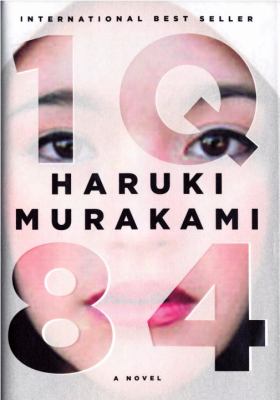
#24: 1Q84

1Q84, by Haruki Murakami, translated by Jay Rubin and Philip Gabriel (New York: Alfred A. Knopf, 2011)

Summary:
"The year is 1984 and the city is Tokyo.

"A young woman named Aomame follows a taxi driver's enigmatic suggestions and begins to notice puzzling discrepancies in the world around her. She has entered, she realizes, a parallel existence, which she calls 1Q84 -- 'Q' is for "question mark." A world that bears a question.' Meanwhile, an aspiring writer named Tengo takes on a suspect ghostwriting project. He becomes so wrapped up with the work and its unusual author that, soon, his previously placid life begins to come unraveled.

"As Aomame's and Tengo's narratives converge over the course of this single year, we learn of the profound and tangled connections that bind them ever closer: a beautiful, dyslexic teenage girl with a unique vision; a mysterious religious cult that instigated a shootout with the metropolitan police; a reclusive, wealthy dowager who runs a shelter for abused women; a hideously ugly private investigator; a mild-mannered yet ruthlessly efficient bodyguard; and a peculiarly insistent television-fee collector.

"A love story, a mystery, a fantasy, a novel of self-discovery, a dystopia to rival George Orwell's -- 1Q84 is Haruki Murakami's most ambitious undertaking yet: an instant bestseller in his native Japan, and a tremendous feat of imagination from one of our most revered contemporary writers."

Opening Line:
"The taxi's radio was tuned to a classical FM broadcast."

My Take:
Interesting in the way it combines a fantasy world/ parallel universe, a mystery/ suspense story, and even a little bit of a love story ... but it wasn't worth the almost 950 pages it took to get there (or else this just isn't my genre, or something was lost in translation, any of which are possible). The concept of a parallel world with 2 moons where everything's just slightly different was interesting, but the whole Air Chrysalis novella that Tengo is ghostwriting and the Little People who featured prominently therein just left me cold. I can appreciate the positive reviews the book got, but it didn't really speak to me personally.

Wednesday, January 25, 2012

#2: Chang and Eng

Chang and Eng, by Darin Strauss (New York: Dutton, 2000)

Summary:
"In this stunning debut novel, Darin Strauss combines fiction with astonishing facts to tell the story of history's most famous twins. Born in Siam in 1811 -- on a squalid houseboat in the Mekong River -- Chang and Eng Bunker were international celebrities before the age of twenty. Touring the world's stages as a circus act, they settled in the American South just prior to the Civil War. They eventually married two sisters from North Carolina, fathering twenty-one children between them, and lived for more than six decades never more than seven inches apart, attached at the chest by a small band of skin and cartilage. Woven from the fabric of fact, myth, and imagination, Strauss's narrative gives poignant, articulate voice to these legendary brothers and humanizes the freakish legend that grew up around them. Sweeping from the Far East and the court of the king of Siam to the shared intimacy of their lives in America, Chang and Eng rescues one of the nineteenth century's most fabled human oddities from the sideshow of history, drawing from their extraordinary lives a novel of exceptional power and beauty."

Opening Lines:
"'Chang-Eng,' the children chanted. 'Mutant, mutant.'"


My Take:
This one was an excellent read -- novel setting (pardon the pun) with characters familiar yet new. Wish we'd heard from the perspective of both twins and not just from Eng, but still really enjoyed the book.

Friday, April 29, 2011

#30: The Good Son

The Good Son, by Michael Gruber (New York: Henry Holt and Co., 2010).

Summary:
"Special Operations soldier Theo Bailey is right to be concerned when his mother, a controversial Muslim writer, announces that she will be traveling to Pakistan to attend a symposium on peace. His worst fears are realized when the conference participants are taken hostage by a group of terrorists who resolve to execute the captives one at a time for every new Muslim war casualty. Fortunately, Sonia Bailey Laghari is prepared with a few tricks of her own: an astounding facility with languages, the mysterious insights of Jungian psychotherapy, and an unshakeable, at times brutal, sense of faith. While Theo masterminds a high-stakes military operation to save the hostages, his mother discovers in her gift for dream interpretation a psychological tool of great power and subtlety. For her fellow prisoners -- including an eccentric American billionaire, a Jesuit priest, and a married Quaker activist couple -- Sonia's uncanny influence over the captors is their only hope of survival. But life is not all that's at stake: the mounting tumult of their terrifying adventure leads Sonia and Theo ultimately to face the far-reaching questions of culture, morality, religion, and family."

Opening Line:
"The phone rang at a little before one in the morning and I knew it was my mother."


My Take:
Interesting that it was this book, set largely in Pakistan and full of admittedly fictional insights on the differences between the US and the Muslim world, that I was reading when Osama bin Laden was killed. It was a decent read anyhow, but that coincidence made it seem that much more relevant and real.

That aside, it's nice after my last few efforts to actually read something with characters who are sufficiently complex that I was able to care about what they did and what became of them. The Good Son has its flaws, of course -- who and what doesn't? -- but all in all was an enjoyable, intriguing combination of a political thriller and a meaty family saga. In addition to Theo, the self-described "half-breed" offspring of a U.S.-educated Pakistani lawyer and a Polish-American cum good Muslim wife who seems to care far more for soldiering than for which side he's fighting on, and Sonia, his infinitely resourceful chameleon of a mother, the book also spends a good chunk of time with Cynthia Lam, the ambitious NSA language expert who feels bound to call shenanigans on the intelligence that suggests Islamic jihadists have gotten hold of The Bomb even though she doesn't know whether doing so will send her career skyrocketing or just crashing down in flames. (Hint: It's not the former.) As the novel unfolds, so do the secrets of all three characters' pasts, and the often-circuitous routes that led them up to the present day.

While it seems an odd thing to complain about, I couldn't help noticing that Sonia was almost too strong a character. It's established very early on that she's the novel's moral center, which isn't a bad thing -- but she eventually goes from complex and likable to seeming almost too perfect and unflappable. This may be deliberate on Gruber's part, but her role relative to Theo's is almost like Reese Witherspoon's to Joaquin Phoenix's in Walk the Line: he'd be a perfectly solid if not especially memorable leading man, had she not stolen the show out from under him.

I've gotten pretty picky about endings lately, and this one is better than most. I'm not 100% thrilled about how Sonia's piece of the story wraps up -- I won't spoil it for you, but it just seemed a bit too perfect (Jean Auel's Ayla, anyone) for my tastes. While I didn't love what became of Theo or Cynthia, either, I have to admit that both resolutions make sense given what we'd learned of the characters up until that point. Long story short, The Good Son was certainly one of my favorites of the month, if not the year to date, and was strong enough to make me want to check out other books by Michael Gruber when I have the chance.