About Me

Ithaca, New York
MWF, now officially 42, loves long walks on the beach and laughing with friends ... oh, wait. By day, I'm a mid-level university administrator reluctant to be more specific on a public forum. Nights and weekends, though, I'm a homebody with strong nerdist leanings. I'm never happier than when I'm chatting around the fire, playing board games, cooking up some pasta, and/or road-tripping with my family and friends. I studied psychology and then labor economics in school, and I work in higher education. From time to time I get smug, obsessive, or just plain boring about some combination of these topics, especially when inequality, parenting, or consumer culture are involved. You have been warned.
Showing posts with label authors. Show all posts

Saturday, March 24, 2012

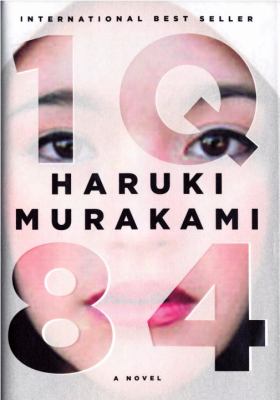
#24: 1Q84

1Q84, by Haruki Murakami, translated by Jay Rubin and Philip Gabriel (New York: Alfred A. Knopf, 2011)

Summary:
"The year is 1984 and the city is Tokyo.

"A young woman named Aomame follows a taxi driver's enigmatic suggestions and begins to notice puzzling discrepancies in the world around her. She has entered, she realizes, a parallel existence, which she calls 1Q84 -- 'Q' is for "question mark." A world that bears a question.' Meanwhile, an aspiring writer named Tengo takes on a suspect ghostwriting project. He becomes so wrapped up with the work and its unusual author that, soon, his previously placid life begins to come unraveled.

"As Aomame's and Tengo's narratives converge over the course of this single year, we learn of the profound and tangled connections that bind them ever closer: a beautiful, dyslexic teenage girl with a unique vision; a mysterious religious cult that instigated a shootout with the metropolitan police; a reclusive, wealthy dowager who runs a shelter for abused women; a hideously ugly private investigator; a mild-mannered yet ruthlessly efficient bodyguard; and a peculiarly insistent television-fee collector.

"A love story, a mystery, a fantasy, a novel of self-discovery, a dystopia to rival George Orwell's -- 1Q84 is Haruki Murakami's most ambitious undertaking yet: an instant bestseller in his native Japan, and a tremendous feat of imagination from one of our most revered contemporary writers."

Opening Line:
"The taxi's radio was tuned to a classical FM broadcast."

My Take:
Interesting in the way it combines a fantasy world/ parallel universe, a mystery/ suspense story, and even a little bit of a love story ... but it wasn't worth the almost 950 pages it took to get there (or else this just isn't my genre, or something was lost in translation, any of which are possible). The concept of a parallel world with 2 moons where everything's just slightly different was interesting, but the whole Air Chrysalis novella that Tengo is ghostwriting and the Little People who featured prominently therein just left me cold. I can appreciate the positive reviews the book got, but it didn't really speak to me personally.

Wednesday, November 16, 2011

#99: Heads You Lose

Heads You Lose, by Lisa Lutz and David Hayward (New York: G. P. Putnam's Sons, 2011)

Summary:
"From New York Times-bestselling author Lisa Lutz and David Hayward, a hilarious and original tag-team novel that reads like Weeds crossed with Adaptation.

"Meet Paul and Lacey Hansen: orphaned, pot-growing, twentysomething siblings eking out a living in rural Northern California. When a headless corpse appears on their property, they can't exactly dial 911, so they move the body and wait for the police to find it. Instead, the corpse reappears, a few days riper ... and an amateur sleuth is born. Make that two.

"But that's only half the story. When collaborators Lutz and Hayward -- former romantic partners -- start to disagree about how the story should unfold, the body count rises, victims and suspects alike develop surprising characteristics (meet Brandy Chester, the stripper with the Mensa IQ) and sibling rivalry reaches homicidal intensity. Will the authors solve the mystery without killing each other first?"

Opening Line:
"Dave, I just finished the first chapter of a new novel -- a real crime novel with a dead body and all -- and I thought of you."

My Take:
Maybe I've just fallen for the gimmick, but this was an OK (slightly muddled, as you'd expect) novel made much funnier and more interesting because of the meta-story. As noted above, the authors took turns writing alternating chapters -- without having agreed on a plot line or details in the beginning. Neither knew till they saw each chapter what his/ her cowriter would have done, and as you'd expect with exes, they don't always see eye to eye. They did establish a rule that neither could undo plot development established by the other, but they also have a good bit of fun seeing just how far they can push this rule. (Without spoiling too much, I had "He's really most sincerely dead" running through my head more than once.)

Other than that, the less said about the plot, the better ... but if it sounds funny, give it a read.

Wednesday, March 10, 2010

#16 - All the Sad Young Literary Men

This one was better. Not perfect, but better. All the Sad Young Literary Men, by Keith Gessen (New York, 2008).

Summary: "A charming yet scathing portrait of young adulthood at the opening of the twenty-first century, All the Sad Young Literary Men charts the lives of Sam, Mark, and Keith as they overthink their college years, underthink their love lives, and struggle through the encouragement of the women who love and despise them to find a semblance of maturity, responsibility, and even literary fame. Heartbroken in his university town, Mark tries to focus his attention on his graduate work on the Russian Revolution, only to be lured again and again to the free pornography on the library computers. Sam binds himself to the task of crafting 'the first great Zionist epic' even though he speaks no Hebrew, has never visited Israel, and is not a practicing Jew. Keith, more earnest and easily upset than the other two, is haunted by catastrophes both public and private -- and his inability to tell the difference. At every turn, at each character's misstep, All the Sad Young Literary Men radiates with comedic warmth and biting honesty and signals the arrival of a brave and trenchant new writer."

My take (really, a pretty quick one this time): Annoying characters, but I still mostly liked it -- chiefly because I think Gessen knows they're annoying, and wants us to laugh and roll our eyes at them. (Actually, Keith, from what we see of him, is fairly sympathetic; Sam and Mark, not so much.) Beautiful downtown Syracuse, NY makes a less-than-flattering cameo, as Mark's temporary Elba for most of his graduate hears (he's in a doctoral program at SU), and while it's not my favorite city, either, I initially got my feathers riled about yet another Downstater thinking there's nothing north of Westchester save depressed downtowns and toothless rednecks ... but, um, Gessen was a student at Syracuse himself at one point, so I guess he's got cred.

Anyway, digression aside, it was sometimes hard to keep Mark's and Sam's plot lines (and occasionally, love interests) separate, but again ... I'm going to assume that was deliberate. I don't know that it's a great book, or that it'll be worth reading in 10 or 20 years, but if you're familiar with the "obscure humanities scholar" type or even academic/ intellectual pretensions in general, you'll probably get a few chuckles out of AtSYLM. Best to read it once you're well past, and not still in the thick of, your angst-ridden early 20s, though.

Thursday, October 29, 2009

#112 - Home Safe

I love Elizabeth Berg. She's pretty prolific, and I haven't read all her books -- but I've read a few (I'm looking at the "Also By" listing now, and The Art of Mending, Open House, and Range of Motion are all familiar), and they're just what I want in a fun read: short chapters, not too taxing, but plausible and non-formulaic enough that I don't feel like I'm reading utter trash (yeah, I have weird Issues with this, I know).

So when I saw Home Safe (Random House, 2009) on the library's new acquisitions shelf, well, it just jumped right onto the stack in my arms. Uh huh. And I wasn't disappointed. It's certainly not haunting the way Columbine or even a particularly intense novel would be, but then again, that's not always what I'm looking for. If a cigar is sometimes just a cigar, well, sometimes a good story is just a good story.

And Home Safe is a good story. The protagonist is the recently-widowed Helen Ames, a middle-aged Midwestern author who's been unmoored since her late husband Dan succumbed to a heart attack at the breakfast table. As she muses in the first chapter,
"She believes the last thing Dan felt was surprise, and to her way of thinking, it wasn't a bad way to go. The bad part is he left her here without him, ignorant of ... everything.

"People used to accuse her of being overly dependent on Dan, and it was true. 'You give away your power,' one friend told Helen. 'You infantilize yourself.' On that occasion, Helen looked down at her salad plate as though acknowledging culpability and feeling bad about it, but what she was thinking was, Oh, shut up. It feels good to infantilize myself. You ought to try it. Might take an edge off. ...

"In addition to her greatest love, Helen has lost the person who handled the practical side of their life together. All this time later, Helen is still shaky on managing the simplest aspects of her finances, despite the fact that she has an accountant to ask questions of. She trusted Dan to take care of his own income and hers; she didn't want to know anything about what he was doing."
For the moment, aside from annoying her daughter Tessa with requests for mechanical repairs, this isn't a problem. "Financially, she is fine: she and Dan created for themselves a nice nest egg. It is in other ways that she is not." Most poignant of these "other ways" is a paralyzing writer's block:
"[S]he can no longer write. Bad enough that writing was the way she made her living; it was also her anchor, her lens, her abiding consolation. Next to Dan, it was her greatest love. Without her husband or the practice of laying out words on a page, she feels that she spends her days rattling around inside herself; that whereas she used to be a whole and happy woman, now she is many pieces of battered self, slung together in a sack of skin. ...

"These days Helen looks around the places she goes to, and nothing seems worth noting, or even quite there. These days, she comes into her study, sits at the desk, starts up the computer, and drinks coffee while she tries to avoid looking at the blinking cursor, that electronic tapping foot. Sometimes she moves to her little white sofa to read from volumes of poetry she used to find inspiring, and sometimes she reads from her own previously published novels. Irrespective of what she reads, though, when she goes back to sit before the computer, there is the same stubborn emptiness, the same locked door. So she shuts the computer down and leaves the room, pulling the door firmly closed behind her."
Good thing, then, that the money's not a problem. Or so Helen thinks, until (after weeks of unreturned phone calls) her accountant finally sits her down and gives her the news: instead of nearly a million dollars, she has only $50,000 of her nest egg left.

No, this is neither a reaction to the recent financial meltdown or another story in which the absent husband turns out to have had another family and another life all along. It turns out that unbeknownst to her, Dan was building Helen's dream house in San Francisco, intending for them both to retire there. Convinced by architect Tom Ellis (himself a 9/11 almost-widower), she flies to the west coast to visit, and the house is indeed breathtaking ... but how on earth can Helen imagine living there without Dan? For that matter, how can she leave Illinois? And what about Tessa?

The unexpected depletion of her savings, however, forces Helen to let the house question take a back seat to more pressing matters: earning a living. After a whimsical attempt to get a job at Anthropologie ends in disaster, she accepts a gig she dreads: teaching a creative writing class. To make matters worse, the class is so popular that a second section is added, and Helen's nemesis, Saundra Weller, is invited to teach that one. "But Saundra Weller! Helen can't stand her, with her endless self-promotion and her snotty attitude toward ... well, toward Helen, for one thing. They were on a panel together at a book festival, and Saundra made no secret of the fact that she found Helen to be a vastly inferior writer."

As you might expect (OK, the book's not really formulaic), the writing class turns out to be a fascinating exercise, both for Helen and her students. Never mind that Saundra's star pupil, Margot Langley, recently wrote Helen an anti-fan letter, proclaiming her writing mawkish, clumsy, and insipid -- Helen's, er, unusual cast of students surprise her with their insights and their enthusiasm. Foremost among these is the inscrutable Claudia, a painfully introverted young woman whose shyness conceals the talent of a real artist.

Another theme which runs throughout the story is the tension between Helen and the 27-year-old Tessa. Helen seems to know she's leaning too heavily on her daughter, yet can't seem to help herself, whether it's dropping off leftovers or buying expressly unwanted clothes or attempting clumsy fix-ups with an eligible young man from her writing class. Tessa is kind but firm with her mother, and begins to think she herself might just want to move to the house in San Francisco.

None of the characters or story lines are exceptionally memorable, but Home Safe is nonetheless an absorbing and believable story of grief, loss, family, and the writing process. (I can't help wondering how much of Helen's character is autobiographical, but then again, how Helen describes her inspiration makes me wonder: Does it matter? Isn't all writing based on our own experience to some degree?) The weaving together of the plot lines is realistic and well-done, and concludes with just the right balance of resolution and uncertainty. (I don't like sloppy, unduly tangled plots, but I'm not a fan of overly tidy endings, either.) Not one I'd necessarily buy for myself, but well worth the read if it's a loaner or secondhand.