About Me

Ithaca, New York
MWF, now officially 42, loves long walks on the beach and laughing with friends ... oh, wait. By day, I'm a mid-level university administrator reluctant to be more specific on a public forum. Nights and weekends, though, I'm a homebody with strong nerdist leanings. I'm never happier than when I'm chatting around the fire, playing board games, cooking up some pasta, and/or road-tripping with my family and friends. I studied psychology and then labor economics in school, and I work in higher education. From time to time I get smug, obsessive, or just plain boring about some combination of these topics, especially when inequality, parenting, or consumer culture are involved. You have been warned.

Wednesday, January 12, 2011

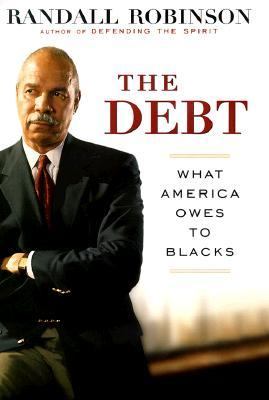
#6 - The Debt

The Debt: What America Owes to Blacks, by Randall Robinson (New York: Dutton, 2000).

Summary: "In Randall Robinson's view, racial problems can't be solved until America is willing to face up to the devastating effects of slavery and educate all Americans, black and white, about the history of Africa and its people. In his recent book, the highly successful Defending the Spirit: A Black Life in America, Robinson makes a stirring call to form the next legion of African-American leadership. Now, in The Debt, he argues that reclaiming the lost history of Africa and African-Americans will help provide a much-needed springboard for solving many of today's problems -- from finding new leadership within the black community to developing meaningful educational programs to helping black people empower themselves economically. Robinson also argues that the United States must be prepared to make restitution to African-Americans for 246 years of slavery, and the century of de jure racial discrimination that followed, via major educational programs and economic development. Robinson offers a solution-oriented approach to controversial issues of social justice in a style that is both personal and informative."

Table of Contents:
  1. Reclaiming Our Ancient Self
  2. Taking Account of the Long-Term Psychic Damage
  3. Race to Class to Race
  4. Self-Hatred
  5. Demanding Respect
  6. Race, Money, and Foreign Policy: The Cuba Example
  7. The Cost of Ignoring the Race Problem in America ...
  8. ... and in the Black World
  9. Thoughts about Restitution
  10. Toward the Black Renaissance
My Take: If you haven't guessed, I'm focusing on the theme of race and culture this month. It's interesting to be finishing and reviewing this book, with its discussion of the lasting impact of a 350-year history of slavery and racial discrimination, and simultaneously starting Some Sing, Some Cry, which begins just after emancipation as a former slave whose three children were all fathered by her white master prepares to leave the Low Country plantation on which she's lived her entire life.

This is a hard, hard book for me to review. As with so many other subjects, I'm both eager to learn more, and not sure I know enough to offer any intelligent criticism. The fact that it's a book about race and racism in the U.S., and on paper I'm as white-and-privileged as it gets, makes this post all the more challenging. Bottom line, though, is that I'm glad I read The Debt, and have just added its successor, The Reckoning, to my book list. While I'm not sure I agree with Robinson's call for reparations to the descendants of former slaves, or how on earth a reparations program might work in practice, the book made me think about much of America's history and culture in a new light. That's a valuable outcome, just by itself.

To be brief, Robinson's argument is that the 250-year practice of American slavery and the hundred-plus years of racism and de jure discrimination that followed it were, no question, the greatest crime against humanity the world's ever seen. There's no way to eliminate the socioeconomic gap between African-Americans and whites, he says, until we not only acknowledge the magnitude of this wrong, but truly commit to righting it.

The book's middle chapters were for me the most persuasive and compelling. Here, Robinson argues that the Middle Passage and the slave trade, by kidnapping and killing so many young, strong, and able people; separating countless children from their parents and extended families; and doing so on such a broad scale over so many generations, virtually annihilated many of Africa's ancient, highly sophisticated civilizations. The impact of this crime was compounded by a U.S. and Europe that consistently overlook both the role of African people in history and the racism of our own esteemed leaders. We know, if we give it much thought, that Jesus, born in the Middle East to a Jewish woman, was unlikely to have been blond and blue-eyed; that Cleopatra probably didn't look like Elizabeth Taylor; and that George Washington owned slaves. At this point, we've even heard something or other about Thomas Jefferson's affair with Sally Hemmings. But Robinson makes us think about what we don't hear: that Haiti owes its independence to those slaves who revolted against Napoleon's soldiers in 1791; that Jefferson's relationship with Hemmings likely began when she was in her mid-teens and he thirty years older; that even Abraham Lincoln considered shipping all American blacks back to Africa after emancipation; that Charles Lindbergh was "a self-described racist [who] had written in Reader' Digest in 1939 that aviation was 'a gift from heaven ... a tool specially shaped for Western hands ... one of those priceless possessions which permit the white race to live at all in a pressing sea of yellow, black, and brown" and urged the U.S. to enter World War II on the German side. Nor is Robinson inclined to let any of these popular heroes off easily, on account of their living in different times with different standards:
"It is often argued in Jefferson's defense that it is unfair to hold his behavior with regard to race to modern standards, that after all he was 'a man of his time.' But who isn't? ... What about Genghis Khan? ... As the first ruler of united Mongolia, he is thought of by Mongolians much the same way as most Americans think of George Washington. In the West, of course, he is remembered as a ruthless scourge. But he was every bit as much a man of his time as Jefferson was of his.

"For that matter, the same specious excuse can be offered for Ataturk or Franco or Lenin or Mao or Hitler. All of them committed great wrongs within permissive if not supportive environments. But this cannot be allowed to render their heinous wrongs any less reprehensible."
Robinson notes that Thomas Paine, a man of the same time as Washington and Jefferson, called the slave trade "lamentable," "wicked," "inhuman," and "barbarous." He also asks the reader to consider why Washington, D.C. boasts a Holocaust museum but not a slavery or African-American museum:
"For wasn't the practice of slavery at least as serious a system of human rights wrongs as the Nazi holocaust? Did not the holocaust of slavery last longer -- indeed, 234 years longer? Did it not claim at least twice as many lives, in the Middle Passage alone? Did it not savagely eviscerate the emotional core of a whole race of people on three continents?"
Understand that Robinson is not seeking here to blame the Jews for American racism, or minimize their own experience of discrimination and human rights crimes; in fact, on several occasions, he cites the Jewish community's call for post-Holocaust reparations and the German government's relative generosity in paying them as positive examples to be emulated. Rather, he argues that the utter absence of black or African faces in the American story as generally told tells African-Americans that they and their contributions are valueless.
"Since this nation's inception, taxpayers -- white, black, brown -- have spent billions on museums, monuments, memorials, parks, centers for the performing arts, festivals, and commemorative occasions. Billions more have been spent on the publication of history texts, arts texts, magazines, newspapers, and history journals. Formulaic television and large-screen historical fiction treatments virtually defy count. Almost none of this spending, building, unveiling, and publishing has been addressed to the needs of Americans who are not white. ... And, indeed, needs are what we are talking about here. ... Ancestor worship is not alone the exotic preoccupation of quaint people mired in superstition in some remote corner of the world. Larger-than-life evidence of its industrialized-world variants can be seen in virtually every public park in America. ...

"Trouble is, George Washington is not my ancestor, private or public. He owned my ancestors, abused them as chattel and willed them to his wife, Martha, upon his death. I and mine need to know about George and Martha but, assuredly, we do not need to revere them. Indeed, psychically we cannot afford to revere them. ... Blacks need to remember who we are, not remember with others who they are."

I'm not sure this distinction is as black and white as Robinson suggests here; the U.S. is, after all, a nation of immigrants and mutts, and I suspect many of us see Washington and Jefferson not strictly as ancestors or owners, but as both -- or neither. Even if his argument is oversimplified, though, his broader point is at least worthy of consideration.
"In every competitive society, instruction in history and the humanities is a valuable instrument with which the dominant group, consciously or unconsciously, attempts to sustain its primacy, ill-gotten or not. In America, whites control virtually every mainstream purveyor of instruction, academic and ephemeral. And in America, whites have caused all Americans to read, see, hear, learn, and select from a diet of their own ideas, with few others placed to make suggestions, not to mention decisions. ... State and federal budgets, to which Asians, Hispanics, and African Americans contribute, are uniformly controlled by whites who seem to uniformly believe that the only ancestor worship worth funding is theirs."
The end products of this whitewashed history, asserts the book, are a persistent self-hatred within the black community and pervasive low expectations that extend beyond it.
"[A] static, unarticulated, insidious racial conditioning, to which all Americans are subject, lifts the high-expectation meritless (Dan Quayle comes to mind here) and, more often than not, locks down in a permament class hell the natively talented but low-expectation black. The gap mocks the efforts of the best of us, black and white, like some ageless yawning crevasse that separates the perennially privileged on their gilded higher ground from those who learn from birth to expect and therefore to reach for little."
Or, from a later chapter:
"[I]t is the very normalcy of our self-denial, our self-ignorance, that is so troubling. It all leads me to wonder whether any group of people in the world has been more resolutely, if unconsciously, committed to notions of self-abnegation than blacks. Well-trained, quiet-flowing, oblivious, uncritical, near total cultural self-abnegation. It is akin to driving in heavy night fog. Little can be seen of where we're going, less still of where we've been. The thickness of the blanket pitch steals our confidence. We conclude that the only hope is to follow the broken white line that snakes in the darkness."

Self-hatred, says Robinson, is evident in the performance of many black comedians, but is not limited to African-American images and experience; Native Americans are marginalized in much the same way. This is a tough argument to make convincingly (here's the danger of reviewing this book while I'm in the middle of reading The Race Card), as it's easily trivialized by those who think the struggle for civil rights and equality is so over already, but an extended thought experiment offered here at least makes you think twice about how insidious and offensive the cultural mainstream can be:
"On occasion, between [televised sports] plays, I have allowed myself to imagine certain franchise transmutations. I would change the team's name and logo, and then try to gauge public reaction.

"The Washington Redskins would become the Washington Blackskins. The logo on the helmet would look like the old caricatured Aunt Jemima. That Sunday, the Blackskins would be playing in Atlanta against Ted Turner's renamed football team, the Atlanta Mafia, who were coached by an Irishman named Maloney but known to all America variously as the Don and the Assassin. On the side of their helmets was a likeness of Al Capone. Before the game, toy machine guns had been handed to the Turner Field faithful, who screamed throughout on cue from Miss Fonda: Rat tat tat. Thatsa deada Blackskin. Thatsa deada Blackskin.

"That same Sunday, the New York Jews had a bye and did not play. One nationally syndicated sports columnist had written that the Jews did not play because they had a 'buy.' No one seemed to notice. After all, it was all in good fun.

"Across town at George Armstrong Custer Stadium, the New York Genocidists were wrapping up a four-game World Series sweep of the Massachusetts Pilgrim Feeders. The Indians had lost the first three games by large margins. The Genocidists, who wore blue and yellow uniforms reminiscent of the old U.S. horse cavalry, were led by a coach who called himself the General. The team's logo was a half-tone of a slightly inebriated Ulysses S. Grant. That evening, when the eleven-to-one score was announced on the evening news, the New York announcer said, 'The Genocidists have slaughtered the Pilgrim Feeders once again.' ...

"As inclined as blacks understandably are by painful experience to believe the contrary, racism is not black-specific. It is like the Hydra, the lethal many-headed mythological snake whose heads regenerated as fast as they were severed. Racism is a social disease that exempts no race from either of its two rosters: victims and victimizers."

Robinson also acknowledges the complex interplay between race and class. A long anecdote about a poor, black girl growing up in Boston who's got the deck stacked against her suggests that this interaction is most apparent in education. Many middle- and upper-income people of color are doing so as we speak; likewise, many white people, especially those who are poor, are not. The key difference, however, is that one can be poor and white without people assuming you're poor because you're white; poverty isn't thought to be intrinsically linked with being white in America. By contrast, if you're poor and black, it's just assumed that you're poor because you're black. We believe poor students can succeed, and we believe black students can succeed -- but consciously or otherwise, teachers often expect students who are poor and black to fail. While I don't agree 100% with everything Robinson says in this book, I find him most persuasive when he's arguing for the vital role education must play in combating inequality and injustice:
"Give a black or white child the tools (nurture, nutrition, material necessities, a home/school milieu of intellectual stimulation, high expectation, pride of self) that a child needs to learn and the child will learn. Race, at least in this regard, is irrelevant. ... It is obvious that in any effort to balance America's racial scales, education, defined in the broadest sense, must be assigned the very highest priority."
Where The Debt loses me is in its final two chapters, where Robinson actually makes the call for reparations that he's been working up to all along. I started the book knowing very little about the particulars of the reparations discussion, but skeptical about the overall concept. By the time I reached Chapter 9, though, Robinson's claims had hit their mark; I was sufficiently moved by his discussion of the suppression and denial of the African and African-American role in US history and culture that I was at least willing to be persuaded. Perplexingly, though, the last two chapters don't even begin to do so. Having spent the bulk of the text convincing the reader that a grave injustice was done to black Americans, orders of magnitude greater than other now widely-acknowledged crimes against humanity, Robinson's last two chapters are curiously vague: long on well-written oratory about how something material is owed, but short on specifics as to what, how, and to/ from whom. And personally, that's exactly what I wanted to hear at this point: How, exactly, might reparations for slavery be funded? Who would reap the benefits? Again, look at the racial, ethnic, and class makeup of our country; not everyone fits neatly into a "former slave" or "former master" box. Some of us may be both; some neither; still others may have no way of knowing. Sure, a comprehensive answer to these questions is about as easy as a hard-and-fast definition of race, but given the book's title, I at least expected Robinson to take a more substantive stab at it.

Tuesday, January 11, 2011

#5: The Black Girl Next Door

The Black Girl Next Door: A Memoir, by Jennifer Baszile (New York: Simon & Schuster, 2009).

Jacket Summary: "A powerful, beautifully-written memoir about coming of age as a black girl in an exclusive white suburb in 'integrated,' post-Civil Rights California in the 1970s and 1980s. At six years of age, after winning a foot race against a white classmate, Jennifer Baszile was humiliated to hear her classmate explain that black people 'have something in their feet to make them run faster than white people.' When she asked her teacher about it, it was confirmed as true. The next morning, Jennifer's father accompanied her to school, careful to 'assert himself as an informed and concerned parent and not simply a big, black, dangerous man in a first-grade classroom.' This was the first of many skirmishes in Jennifer's childhood-long struggle to define herself as 'the black girl next door' while living out her parents' dreams. Success for her was being the smartest and achieving the most, with the consequence that much of her girlhood did not seem like her own but more like the 'family project.' But integration took a toll on everyone in the family when strain in her parents' marriage emerged in her teenage years, and the struggle to be the perfect black family became an unbearable burden. A deeply personal view of a significant period of American history, The Black Girl Next Door deftly balances childhood experiences with adult observations, creating an illuminating and poignant look at a unique time in our country's history."

Opening Line: "On an early autumn morning in 1975, as fog rolled off the Pacific Ocean and covered the Vista Grande School playground, my first-grade girlfriends and I decided to squeeze in a quick foot race before school began."


My Take: Liked this one a lot. As I've tried to articulate why, I couldn't help but remember a poem by Pat Parker that I came across about a gazillion years ago, entitled "For the white person who wants to know how to be my friend." It begins,
"the first thing you do is to forget that i'm Black.
Second, you must never forget that i'm Black."
Sounds contradictory, of course, but after reading Baszile's memoir, I think I understand better what Parker meant. On one hand, The Black Girl Next Door has wide appeal; it tells the story of the author's childhood, from age six through the end of high school, through a series of vignettes. Many of these will resonate with anyone who grew up in the 1970s and '80s, particularly in a well-off suburb like Palos Verdes Estates: the pains our mothers took to make us presentable for picture day; the unscripted summer evenings playing Kick the Can until the streetlights came on; the excruciating self-consciousness of attending your first middle school dance; the endless pre-DVD-era road trips to spend holidays in a house crammed with relatives you barely knew.

On the other hand, for every forty-something who smiles knowingly and nods at these memories, the experience was just a little bit different. In Baszile's case, that difference often hinged upon being the only black family in her neighborhood, and close to it at school. For a well-intentioned white liberal like me, this makes her book a kaleidoscope, at once familiar and new. Baszile's second-grade picture captures a disheveled braid and a torn shirt, courtesy of the young thugs-in-training who insisted on fighting the [racial epithet] on the playground. One night of street games takes an unexpected and disturbing turn when the kids go inside, get into some old clothes in the attic, and Jennifer finds herself mimicking a poor, rural, Southern black woman she claims is her grandmother. And the middle school dance marks a fork in the road for Baszile and her (until then) similarly gangly and gawky best friend Amy. Before the dance, the girls hit the mall for makeovers, but only Amy is transformed; Jennifer, who slowly remembers that her own mother always needs to go out of town for makeup, comes away looking more like a kabuki dancer. Perhaps the most poignant illustration, though, comes with the Christmas visit to Mr. Baszile's tiny, rural home town of Elton, Louisiana. From their arrival, when Grandmother compliments (?) Jennifer and her sister by pronouncing them "perfect little white girls," the Louisiana Basziles seem both wonderfully exotic and alien:
"For all of the Christmas cheer, Dad was sullen and again stayed outside on the porch. He talked to everyone, but his nerves seemed flimsy like tinsel. Whenever he saw one of his cousins, he called Natalie and me outside to meet them. He held us up like shields to these people and put us on display. I knew Dad was proud of us, but it felt to me like a distraction even more than pride. When I wasn't being paraded out to meet people, I mostly sat on the edge of the bed where I had slept, out of the way; I didn't want to met anyone else. I didn't want another kiss on the cheek, another stranger's hug, or another person's comment about my 'funny' California speech."
Later, when an argument between Jen's father and his brother Sunny gets a bit heated, she observes:
"No one cheered for Dad, even though we were related to nearly everyone there and he was right to defend me. I couldn't figure out why. ... Suddenly I felt the way I often did in California, like it was the four of us against everyone else. I didn't expect to feel such a thing among all these relatives. ... I stayed on the porch, afraid of what I wanted to do to them. The magic had disappeared for me. This had been a strange and terrible Christmas, maybe the worst one ever. I wanted to go to bed and then back to California."
If this makes it sound like The Black Girl Next Door is one complaint after another about how racism traumatized Baszile, it's not. Like anyone's childhood, Baszile's had its ups and downs; some of these were related to her ethnicity, but some weren't. Readers of all hues can cheer Jennifer on when she makes lemons out of lemonade at the dance. When Amy abandons her to dance with a boy, she remembers her mother telling her that she went there to dance, not to get a boyfriend -- and asks one male wallflower after another to join her on the dance floor until someone accepts. What young woman hasn't had a welcome-to-the-club trip to the beauty parlor that didn't quite go as she'd expected (even if she decided in the end that it looked pretty good anyway)? And I'm sure I'm not alone in cringing and wanting to shut my eyes when Jen and her dad have their climactic fight towards the book's end.

One criticism Dwight Garner raises in his New York Times review is that Baszile's memoir lacks "adult wit and complexity," and that her decision "to write almost entirely from the necessarily blinkered perspective of herself as a girl" proves detrimental to the narrative. I can see his point -- I, too, would have liked to know more about where Mr. Baszile went on Friday nights and why Mrs. Baszile seemed so cut off from her family in Detroit -- but saw this as a reasonable choice on Baszile's part. There are memoirs aplenty on the shelves whose authors retell their stories from an older, wiser adult's perspective; I found it a refreshing change to read one that felt more like I was there beside the 6-, 9-, and 12-year-old Baszile, without a grown-up narrator looking over our shoulders.

The author's own web site indicates that her next book will pick up her story at Columbia, just after this one leaves off. I, for one, will be eagerly waiting.

Monday, January 10, 2011

#4: Cum Laude

Cum Laude, by Cecily von Ziegesar (New York: Hyperion, 2010).

Jacket Summary: "Dexter College is a small liberal arts college in the quiet town of Home, Maine. But it won't stay quiet for long with this group of freshmen. There's Shipley -- blonde and beautiful, the object of envy and more than a little lust. Determined to assert herself and to shed her good-girl image, she buys cigarettes and condoms, because that's what every self-respecting college girl does. Her edgy roommate, Eliza, came to Dexter to get noticed, and she has the attitude and the mouth to prove it. There's Tom. Handsome, privileged, used to getting his own way, he's a jock-turned-artist who thinks his paintings will change the world. Sensitive Nick, Tom's wake-and-bake pot-smoking roommate, wants to follow in the footsteps of his boarding-school hero. And then there's brother and sister Adam and Tragedy Gatz. The freckle-faced farm boy lives at home with his parents and his little sister, who does all she can to stop him from being a wuss.

"As Shipley, Eliza, Tom, Nick, and Adam find out, that first year of college is more than credits and cramming. Between the lust and the love, the secrecy and the scandal, they'll all receive an unexpected education. It's a time of shifting alliances, unrequited crushes, and coming of age. Find Yourself is Dexter's motto. And they are determined to do just that."

Opening Lines: "College is for lovers. At least, this one was."

My Take:
Not great literature by any means, yet better than it had any right to be.

When a serious relationship ends, conventional wisdom tells us it's better to be alone for a while than to jump right into another one. And when I return from a week's vacation, treating myself to restaurant-sized portions and/or the guilty pleasures of someone else's home cooking, I somehow just want to eat oatmeal and veggies for a while.

In the same vein, sometimes when I've just finished a Really Good Book, I want some white space around it. As I'd hoped, Cum Laude delivers. While the characters themselves aren't particularly deep or compelling, they're just offbeat enough that this isn't a fatal flaw. Likewise, von Ziegesar's eye for the minute, often ridiculous, but nonetheless realistic details that comprise the freshman experience make the story both familiar and entertaining (in that quasi-awkward, "wow, I'm glad that part of my life's over" sort of way). Some examples: Eliza taking a work-study job as a nude art model, and milking every minute of it. Patrick, the homeless, Dumpster-diving Dexter dropout, floating around the edges of the main characters' consciousness. Every straight man in town developing a sudden, simultaneous obsession with the "It" girl du jour (in this case, Shipley). Tom deciding on a whim to be an art major, and going off on week-long, X-fueled painting binges. Shipley, who loses her virginity to Tom their first night on campus, staying with him mostly because he looks like good boyfriend material, even though she really has the hots for loner townie Adam.

Not surprisingly, other parts of the story line strain credibility. It may be that the characters' family relationships are supposed to be over the top, but still -- only Tom's and Eliza's parents seem remotely realistic or sympathetic (and we never actually see Eliza's on screen, anyway). Likewise, it's hard to imagine that even a relatively sheltered, still-lives-at-home freshman like Adam would opt to spend most of his free time with his 15- or 16-year-old sister (though I will say, for the squeamish among you, that von Ziegesar does resist the urge to add an incest plot line to the novel). I also don't buy the Dexter administration's blithely allowing Nick to construct a yurt on campus, or Eliza's blithe willingness to let Shipley's mom foot the bill (albeit unwillingly) for her new clothes.

Still kept me entertained for an evening, though.

Sunday, January 9, 2011

#3: Fat! So?

Fat! So? Because You Don't Have to Apologize for Your Size, by Marilyn Wann (Berkeley, CA: Ten Speed Press, 1998)

Jacket Summary: "Life is too short for self-hatred and celery sticks!

"Whether you're a size 2 or 2X, Fat! So? will make your 'weight problem' disappear. Based on the popular underground zine of the same name, Fat! So? tackles the last American taboo -- fat -- with sassy quotes, eye-opening essays, true stories, and attitude. Plus it's tons of fun, with a fab flipbook, nifty trading cards, glam paper dolls, and much more. Along the way, zine publisher and fat rebel Marilyn Wann shows you how to reclaim your body, live healthy at any size, and remember why they call it a belly laugh!"


Table of Contents (partial):
Introduction
  • What Are You So Afraid Of?
  • Quiz: Are You a Fatso?
Anatomy Lesson #1: The Butt
  • What Do You Like About Being Fat?
  • Love in the Time of Size 18
  • Little Lost Pound o'Fat Sees the World
  • The Fat! So? Manifesto
  • Talk Radio & You
  • She Likes It!
  • But What About Your Health?
  • What's In a Word?
  • Fat Kills
  • 300,000
  • Another Number
  • Anatomy is Destiny
  • The Little Black Dress
  • A Letter to Fat! So?
  • The Cutoff Point
  • Oh, Yeah?
  • Celebrity Wasting Syndrome
  • My Personal Trainer Can Beat Up Your Personal Trainer
  • Cinder Says ...
  • Break the Connection
  • What Being Fat Has Taught Me
  • A Talk Show By Any Other Name
My Take: OK, perhaps an odd choice for someone who's lost ~30 pounds in the last 9 months and is desperately trying to get back on the wagon after Christmas to check out right about now, but it's been on my list for a while and it practically jumped off the library shelf into my arms this afternoon. What's a gal to do?

Mildly interesting and entertaining, but I think it leaves some key pieces out of the puzzle. Do I agree that fat may be the last great American taboo, and that even if rising obesity rates are a legitimate public health concern (which Wann would dispute), it's blamed for far too many not really related things? Yep. I also agree that the number on the scale and the size of your clothes probably mean much less for your overall health than your blood pressure, cholesterol level, and overall level of activity. And many of the suggested comebacks to rude, ignorant comments are pretty darned funny.

That said, I don't want to make this all about me ... but again, I think there's a lot to this issue that Wann's just plain avoiding. Yes, genetics influence our body's size and shape, but they're not the whole story ... if they were, how would we explain the huge uptick in the percentage of people who are overweight over the last generation or 2? Granted, the book's more than 10 years old, and at the time it was published, there wasn't yet much conversation about how culture and advertising influence how we eat ... but there is now, and (pardon the pun) addressing the issue of size acceptance without addressing the cultural component is like ignoring an elephant in the living room.

My other chief gripe here is Wann's oversimplistic implication that if fat people can be happy and healthy regardless of their size (OK, with you there), thin or average-sized people are automatically unhappy and must be constantly denying themselves pleasure. Eh, not so much. Heck, I've been in the trenches of this war for almost a year (and that's just this latest deployment). Sure, in a struggle to achieve or maintain a healthy weight, many people find themselves sometimes passing up a treat that might seem appealing ... but does that necessarily mean you're denying yourself pleasure, and/or must be an unhappy, withholding person? I don't think so. I'd think part of overall health and wellness means making decisions not just based on what might feel or taste good right now, but what's going to make you feel best over the long haul. Sure, that third glass of wine might taste good right now if I let myself indulge, but you can bet I'll be paying for it later. Ergo, I'll say "no, thank you" -- to me, the short-lived pleasure of sipping the wine and perhaps getting a slight (responsible, of course) buzz isn't worth feeling sick or hung over later. Same deal with certain foods. Yeah, I like pizza, and if it's particularly tasty, a third slice might initially seem like a good idea ... but if I know that eating it will leave me feeling stuffed and uncomfortable, I'm going to pass it up. This isn't because I want so much to be a Size 00 and weigh 110 pounds that I'm willing to live on celery sticks and cottage cheese; it's that I've learned -- yes, while actively pursuing a weight-loss program -- that I feel way better, have more energy, am happier, etc. -- if I limit my intake of certain foods.

If the subject matter interests you, read it, but it's probably not worth an actual purchase. Entertaining, even thought-provoking in places ... but not, I don't think, terribly memorable.

Tuesday, January 4, 2011

#2 - The Lacuna

The Lacuna, by Barbara Kingsolver (New York: Harper, 2009)

Jacket Summary: "Born in the United States, reared in a series of provisional households in Mexico -- from a coastal island jungle to 1930s Mexico City -- Harrison Shepherd finds precarious shelter but no sense of home on his thrilling odyssey. Life is whatever he learns from housekeepers who put him to work in the kitchen, errands he runs in the streets, and one fateful day, by mixing plaster for famed Mexican muralist Diego Rivera. He discovers a passion for Aztec history and meets the exotic, imperious artist Frida Kahlo, who will become his lifelong friend. When he goes to work for Leo Trotsky, an exiled political leader fighting for his life, Shepherd inadvertently casts his lot with art and revolution, newspaper headlines and howling gossip, and a risk of terrible violence.

"Meanwhile, to the north, the United States will soon be caught up in the internationalist goodwill of World War II. There in the land of his birth, Shepherd believes he might remake himself in America's hopeful image and claim a voice of his own. He finds support from an unlikely kindred soul, his stenographer, Mrs. Brown, who will be far more valuable to her employer than he could ever know. Through darkening years, political winds continue to toss him between north and south in a plot that turns many times on the unspeakable breach -- the lacuna -- between truth and public presumption."

Opening Lines: "In the beginning were the howlers. They always commenced their bellowing in the first hour of dawn, just as the hem of the sky began to whiten."

My Take: Kingsolver's definitely near the top of my favorite authors list. I read the first few chapters last night and don't yet know what I think. On one hand, I'm not yet chomping at the bit to find out what happens next (and truth be told, I'm more than a little confused about some of what's going on) ... but on the other, I initially had the same reaction to The Poisonwood Bible and ended up being very glad I stuck it out. Stay tuned.

Well, as with Poisonwood Bible, it took some time to get into the swing of this one, but when I did -- wow. This is not a book you can read while multitasking, one eye on its pages while watching TV or offering minimal responses to a young child's enthusiastic if somewhat incomprehensible patter. The Lacuna demands most of your attention, and offers handsome rewards in return.

Most of the story is told through Shepherd's diaries and letters, with pertinent news articles scattered through the text here and there. Born to a Mexican mother and U.S. father who split up long before the novel begins, he receives little formal schooling, yet aches to write almost from birth. He grows to young adulthood in quarters maintained by one, then another of his mother's boyfriends. His earliest memories are of the remote Isla Pixol, where Shepherd and his mother first encounter the howlers mentioned on the first page. It is here that his overly dramatic mother, Salome, tells him, "You had better write all this in your notebook ... the story of what happened to us in Mexico. So when nothing is left of us but bones, someone will know where we went." Shepherd takes her advice to heart, and thus is laid the foundation for the novel's principal themes: the role of art and the howlers, in their many guises, in shaping history -- what and how they record as events unfold, and which pieces are lost.

Shepherd's pivotal first brush with history comes about by accident. Having learned years earlier to prepare the European breads his mother's paramour preferred, he proves a natural at mixing plaster for the Much-Discussed Painter, Diego Rivera. This first job ends not long after, when Salome packs Shepherd off on a train to Washington, D.C. to live with his father and Rivera departs on a separate, unrelated trip to the States ... but eventually, both return to Mexico City and Shepherd returns to work for Rivera. He is quickly promoted from plaster-mixer to cook, and thus finds himself in the midst of the interesting-times whirlwind that is the Riveras' home. The already considerable excitement that comes from living with Diego's flamboyant jewel of a wife, painter Frida Kahlo, and cooking in the tiny kitchen of the boxy, Functional, divided, his-and-hers house is magnified a thousand-fold when two VIP guests come to stay for the duration: Lev Davidovich, nee Leon Trotsky, and his wife Natalya, who've exiled themselves to Mexico in a desperate hope of escaping Stalin's murderous purges.

It is here that he first observes the uncanny likeness of the news media to the howler monkeys that once plagued him and his mother. As Shepherd later muses in his diary, long after Lev has been assassinated and he's made a new home for himself in Asheville, North Carolina, "anyone who rises, any greatness, attracts those who would cut it down at the root. Any fool knows that also." Several years later, Harry Truman's surprising, newspaper-defying re-election offers a brief flicker of hope that the howlers' power is not absolute (says Shepherd's stenographer, Violet Brown, "it's a day to remember. Those news men could not make a thing true just by saying so. It's only living makes life.") The howlers regroup, of course, with their terrifying noise reaching its apogee during the red scares of the late 1940s and early '50s. Ultimately, after being repeatedly punished and humiliated over his years-earlier association with Rivera and Trotsky, Shepherd offers his journal a biting "Universal declaration of rights of the howlers:
"Article 1. All human beings are endowed with the god-given right to make firewood from the fallen tree. Article 2. Any tree will do. If it is tall, it should be cut down. The quality of wood is no matter, the tree asked for it by growing tall. A decent public will cheer to see it toppled. Article 3. Rules of normal kindness do not extend to the celebrated person. Article 4. All persons may hope to become celebrated. Article 5. It is more important to speak than to think. The only danger is silence. Article 6. A howler must choose one course or the other: lie routinely, or do so only on important occasions, to be more convincing."
For a man like Shepherd, who's always held that "Dios habla por el que se calle" (God speaks for those who keep quiet), this corruption and pillorying of the words he's so conflicted about sharing with the world is devastating. As he'd mused years earlier, in a letter to Frida on the eve of his first novel's publication,
"A terrifying miracle. These words were all written in dark, quiet rooms. How can they face the bright, noisy world? You must know. You open your skin and pour yourself on a canvas. And then let the curators drape your intestines all around the halls, for the ruckus of society gossips. Can it be survived?"
He has persisted in his writing, despite the excruciating vulnerability it brings, because he is driven to it, perhaps not realizing until he must stop how painful it is not to write. As he tells the Committee on Un-American Activities in a climactic, almost cinematic speech,
"The purpose of art is to elevate the spirit, or pay a surgeon's bill. Or both, really. It can help a person remember, or forget. If your house doesn't have many windows in it, you can hang up a painting and have a view. Of a whole different country, if you want. If your spouse is homely, you can gaze at a lovely face and not get in trouble for it. ... It can be painted on a public wall or locked in a mansion. ... Art is one thing I do know about. A book has all the same uses I mentioned, especially for the house without enough windows. Art by itself is nothing, until it comes into that house. People here wanted Mrs. Kahlo's art, and I carried it.

"You asked me why I've stayed here so long. I can try to say. People have a lot of color and songs in Mexico, more art than they have hopes, it often seemed to me. Here, I found people bursting with hope but not many songs. They didn't sing, they turned on the radio. They wanted stories, like anything. So I decided to try my hand at making art for the hopeful. Because I wasn't any good at the other thing, manufacturing hopes for the artful. America was the most hopeful place I'd ever imagined. My neighbors were giving over their hairpins and door hinges to melt down for building the good ship America. I wanted to give her things too. So I stayed here."
This speech notwithstanding, neither the Committee members nor the howlers who make him larger than life in their papers nor his fickle readers ever fully understand Shepherd. Frida and Violet Brown come closest, with lawyer Artie Gold not far behind, perhaps, but as he himself has acknowledged for years,
"[Y]ou can't really know the person standing before you, because always there is some missing piece: the birthday like an invisible pinata hanging great and silent over his head, as he stands in slippers boiling the water for coffee. The scarred, shrunken leg hidden under a green silk dress. A wife and son back in France. Something you never knew. That is the heart of the story."
I could write much more about this complex and lovely book, but to do so would almost spoil the joy of reading a novel whose title means "blank space or missing part." Please read it, without delay, and fill in the missing parts for yourself.

#1 - My Sister's Keeper

Gotta love road trips. When else would I make a dent in the paperbacks I seem to accumulate till they're triple-stacked in my bookcase, but then never read because my library books are due back soon?

So, my less-than-auspicious first book of 2011 was My Sister's Keeper, by the prolific, popular, and predictable Jodi Picoult (New York: Atria, 2004).

Jacket Summary: "Can a parent love too much? Or is too much never enough?

"Anna is not sick, but she might as well be. By age thirteen, she has undergone countless surgeries, transfusions, and shots so that her older sister, Kate, can somehow fight the leukemia that has plagued her since childhood. The product of preimplementation genetic diagnosis, Anna was conceived as a bone marrow match for Kate -- a life and a role that she has never challenged ... until now. Like most teenagers, Anna is beginning to question who she truly is. But unlike most teenagers, she has always been defined in terms of her sister -- and so Anna makes a decision that for most would be unthinkable, a decision that will tear her family apart and have perhaps fatal consequences for the sister she loves. A provocative novel that raises some important ethical issues, My Sister's Keeper is the story of one family's struggle for survival at all human costs and a stunning moral parable for all time."


Opening Line: "When I was little, the great mystery to me wasn't how babies were made, but why."

My Take: I'm not usually a big fan of chain restaurants, but I'll grant that they have their place. Back when the Sapling was still just a wee shoot, many road trips were saved by a well-situated McDonald's Playplace. There's a sad little mall in Oneonta with a Subway that's just the thing on the not-quite-brief-enough-to-do-in-one-shot drive to Aunt & Uncle Thyme's house. And hey -- I may not have a minivan, but sometimes, when Sapling & I are running from errand to activity to friend's house on Saturdays, a quick swing by Panera is ... well, a mom's gotta do what a mom's gotta do. Pretentious foodie that I am, even I'll allow that sometimes, the ideal has to defer to the practical. The chains are quick, cheap, and reliable; you probably won't be transported when your lunch arrives, but nor will you be disappointed or disgusted.

And so it is with Jodi Picoult's books. They're incredibly formulaic, right down to the muted jewel tones on the covers: Take a hot contemporary legal/ ethical issue (bonus points if there's a medical component, though that's not strictly required), invent a family and associated professionals to go with it, choose different fonts to represent the perspectives of 5-7 different players in the story ... and eventually, cap it all off with a twist ending and at least one dead child. Even knowing all this, though -- I don't read 'em every day, any more than I eat at McD's or Subway on a regular basis -- sometimes, that's precisely what I want to read. Like here, when I was looking for something I a) owned in paperback, so as to conserve space and weight in my suitcase, and b) would find both compelling enough to overcome vacation inertia, but not so demanding that I couldn't concentrate despite the bustle and blaring TV in my parents' house. I had 2 yet-unread Picoults on the shelf, and this one won out over The Pact. I started it New Year's Eve and turned the last page before heading home on New Year's Day; I liked some of the characters more than others; I wished I'd stopped before reading the last few twist-ending chapters. In short, I got what I paid for and can't really complain.

Interestingly, the 6 characters Picoult chooses to tell the story don't include Kate -- at least not until the very end. Anna's voice, of course, comes first. Alternating chapters are narrated by Sara, the lawyer-turned-SAH mom who opts to represent herself and her husband in Anna's lawsuit against them; Brian, her firefighter husband and the kids' father, who harbors his own doubts about his kids' medical circumstances and lets Anna move into the fire house with him temporarily; Jesse, the Fitzgeralds' oldest child and only son, who's moved into the family's garage and been so utterly ignored over the years that he's turned to arson in hopes of finally attracting his parents' attention; Campbell Alexander, the attorney Anna convinces to represent her pro bono for reasons that aren't entirely clear; and Julia Romano, the court-appointed guardian at litem charged with getting to know the family and determining what's really in Anna's best interest (who, by the way, has a complicated romantic history with Campbell going way back). As you might surmise from my character summaries, some parts of the story are more interesting than others. The Campbell-Julia history and sexual tension didn't really do much for me, but perhaps that's just because I forgot to include "romantic sub-plot" in my required elements of Picoult blockbusters. On the other hand, I'd have liked to have heard more of Jesse's story -- which sheds considerable light on Anna's plight, and ended up being resolved far too quickly and smoothly for an author who seems to pride herself on capturing many shades of gray.

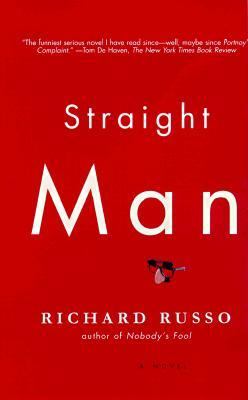
#94 - Straight Man

Yes, I know I'm not actually posting this till 2011, but my 94th & final book of 2010 was Straight Man, by Richard Russo (New York: Vintage Books, 1997).

Jacket Summary: "In this uproarious new novel, Richard Russo performs his characteristic high-wire walk between hilarity and heartbreak. Russo's protagonist is William Henry Devereaux, Jr., the reluctant chairman of the English department of a badly underfunded college in the Pennsylvania rust belt. Devereaux's reluctance is partly rooted in his character -- he is a born anarchist -- and partly in the fact that his department is more savagely divided than the Balkans. In the course of a single week, Devereaux will have his nose mangled by an angry colleague, imagine his wife is having an affair with his dean, wonder if a curvaceous adjunct is trying to seduce him with peach pits, and threaten to execute a goose on local television. All this while coming to terms with his philandering father, the dereliction of his youthful promise, and the ominous failure of certain vital body functions. In short, Straight Man is classic Russo -- side-splitting and true-to-life, witty, compassionate, and impossible to put down."

Opening Line: "When my nose finally stops bleeding and I've disposed of the bloody paper towels, Teddy Barnes insists on driving me home in his ancient Honda Civic, a car that refuses to die and that Teddy, cheap as he is, refuses to trade in."

My Take: I always enjoy Russo's books and this one didn't disappoint. Straight Man does for second-tier liberal arts colleges what Jane Smiley's Moo did for the gargantuan public universities of the Midwest. Obviously, most back-cover blurbs tend toward the hyperbolic, but here I have to agree: this is either the saddest comic novel or the funniest sad novel I've read in quite a while. The above summary notwithstanding, it's not quite the laugh-a-minute riot you might expect. Rather, the humor here comes in Hank Devereax's, the supporting characters', and the town of Railton's unvarnished warts-and-all humanity.

I've often said that even when a novel's primarily a character study or portrait of a place, I need at least some plot to hold my interest. In Straight Man, Russo's kind enough to oblige me in this regard. The frame story -- Russo's colleagues' efforts to oust him as chair, while at the same time his dean and old friend is trying desperately to throw him a life jacket -- is serviceable, if not particularly meaty in itself. What holds the reader's attention, though, is wanting to know how all the secondary story lines and characters turn out. Will Hank give in and sleep with his alcoholic colleague's lovely adjunct daughter, the peach-eating Meg? Will his daughter Julie ever grow up and turn responsible? Will his wife, Lily, accept a plum out-of-town job -- and what would that mean for his comfortable, if uninspired, small-town academic life?

Probably one of the most interesting and, to me, appealing aspects of the story and Hank's character is his complete refusal to take anything seriously. I've worked with people like this (hell, I've probably been a person like this), and frankly, usually find them as exasperating as Hank's colleagues and family seem to find him. Here, though, I also saw the pathos and loneliness just beneath the surface -- a testament to Russo's subtlety and skill at capturing the nuances of personality.

Entertaining enough to pass muster as a vacation read, but serious enough not to leave you feeling like you've just eaten a bag of M&Ms. If you're looking for an interesting, moving character story, and can accept its somewhat slow pace as part of its charm, I recommend it highly.