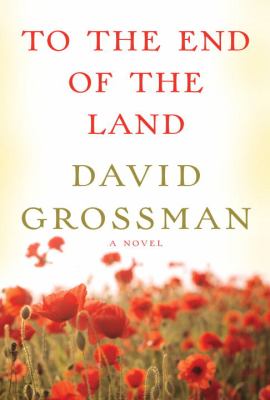
 To the End of the Land, by David Grossman (translated by Jessica Cohen) (New York: Alfred A. Knopf, 2010)
Summary:
"From one of Israel's most acclaimed writers comes a novel of extraordinary power about family life -- the greatest human drama -- and the cost of war.
"Ora, a middle-aged Israeli mother, is on the verge of celebrating her son Ofer's release from army service when he returns to the front for a major offensive. In a fit of preemptive grief and magical thinking, she sets out for a hike in the Galilee, leaving no forwarding information for the 'notifiers' who might darken her doorstep with the worst possible news. Recently estranged from her husband, Ilan, she drags along an unlikely companion: their former best friend and her former lover Avram, once a brilliant artistic spirit. Avram served in the army alongside Ilan when they were young, but their lives were forever changed one weekend when the two jokingly had Ora draw lots to see which of them would get the few days' leave being offered by their commander -- a chance act that sent Avram into Egypt and the Yom Kippur War, where he was brutally tortured as a POW. In the aftermath, a virtual hermit, he refused to keep in touch with the family and has never met the boy. Now, as Ora and Avram sleep out in the hills, ford rivers, and cross valleys, avoiding all news from the front, she gives him the gift of Ofer, word by word: she supplies the whole story of her motherhood, a retelling that keeps Ofer very much alive for Ora and for the reader, and opens Avram to human bonds undreamed of in his broken world. Their walk has a 'war and peace' rhythm, as their conversation places the most hideous trials of war next to the joys and anguish of raising children. Never have we seen so clearly the reality and surreality of daily life in Israel, the currents of ambivalence about war within one household, and the burdens that fall on each generation anew.
"Grossman's rich imagining of a family in love and crisis makes for one of the great antiwar novels of our time."
Opening Lines:
"Hey, girl, quiet!
"Who is that?
"Be quiet! You woke everyone up!
"But I was holding her
"Who?
"On the rock, we were sitting together
"What rock are you talking about? Let us sleep
"Then she just fell
"All this shouting and singing
"But I was asleep
"And you were shouting!
"She just let go of my hand and fell
"Stop it, go to sleep
"Turn on a light
"Are you crazy? They'll kill us if we do that"
My Take:
Still a bit confused, which usually means cranky about not understanding exactly what's going on -- but I'm hanging in there, hoping there's some meta-intentionality to this on Grossman's part and that all will be revealed in time. The opening sequence above is an extreme example, though it does go on for four pages ... hard to figure out, but as it's a conversation whispered in the dark between 2 fever-stricken patients/ prisoners in an Israeli military hospital/ prison, circa 1967, its disorienting nature can be forgiven.
I'm almost 200 pages into the book now, though, and while subsequent parts are a bit more lucid, there's still a lot I don't know. I do know some of what's been explained on the dust jacket: Ora's still reeling from the collapse of her marriage and the defection of her older son, Adam, so Ofer's being recalled to the army at the eleventh hour really is the last straw. Avram was the victim of horrific torture at Egyptian hands some 33 years earlier, and has lived a marginal, hermit's existence since. It's not fully clear how Ora ended up marrying Ilan rather than Avram, whether this happened before or after Avram was sent to war, and whether Avram is indeed Ofer's father. I guess I'll find out eventually, or discover that it doesn't really matter.
(Later, Thurs., 5/19). Just finished. Yes, you do find out pretty much everything you need to know if you stick with it. I just described the story to Mr. Hazelthyme and from the back story, it sounds rather soap operatic ("You see, Ora, Ilan, and Avram all met as teenagers, and were inseparable. Both of the men were in love with Ora and she with them, though in slightly different ways, and she actually dated both at the same time for a while ... but then by chance, ended up marrying one will the other ended up a POW on the wrong side of the Six Day War and survived, but came back Different.") It's not, though. Mostly, the book follows Ora and Avram on their long hike through the Galilee, during which the two fill each other in on all that's happened in their lives these past 20 years. The pacing is much like many long hikes I've been on -- slow-going at once, but ultimately rewarding for the effort. The short afterward from the author is eerily devastating, as well. If you're interested in an Israeli anti-war voice and in literary fiction, check this one out.


