About Me

Ithaca, New York
MWF, now officially 42, loves long walks on the beach and laughing with friends ... oh, wait. By day, I'm a mid-level university administrator reluctant to be more specific on a public forum. Nights and weekends, though, I'm a homebody with strong nerdist leanings. I'm never happier than when I'm chatting around the fire, playing board games, cooking up some pasta, and/or road-tripping with my family and friends. I studied psychology and then labor economics in school, and I work in higher education. From time to time I get smug, obsessive, or just plain boring about some combination of these topics, especially when inequality, parenting, or consumer culture are involved. You have been warned.
Showing posts with label women. Show all posts

Wednesday, October 17, 2012

#88: The Quickening

The Quickening, by Michelle Hoover
(New York: Other Press, 2010)
Summary:
"Enidina Current and Mary Morrow live on neighboring farms in the flat, hard country of the upper Midwest during the early 1900s. This hardscrabble life comes easily to some, like Eddie, who has never wanted more than the land she works and the animals she raises on it with her husband, Frank. But for the deeply religious Mary, farming is an awkward living and at odds with her more cosmopolitan inclinations. Still, Mary creates a clean and orderly home life for her stormy husband, Jack, and her sons, while she adapts to the isolation of a rural town through the inspiration of a local preacher. She is the first to befriend Eddie in a relationship that will prove as rugged as the ground they walk on. Despite having little in common, Eddie and Mary need one another for survival and companionship. But as the Great Depression threatens, the delicate balance of their reliance on one another tips, pitting neighbor against neighbor, exposing the dark secrets they hide from one another, and triggering a series of disquieting events that threaten to unravel not only their friendship but their families as well."

Opening Line:
"My boy, you might think an old woman hasn't much to say about the living, but your grandmother knows when a person does right by her and when they don't."

My Take:
Lovely, lyrical language, but I felt like I missed something here. Maybe it's just that the characters and plot, like the setting and Hoover's writing, is spare -- so much so that it was hard to get much of a sense of Mary or of how the relationship between the two women evolved over time (though Eddie did feel authentic and likeable, at least where I was concerned). I've read books like this before, where we need to draw our own conclusions about characters' relationships based on a handful of events with many years in between, but here it just felt like there wasn't enough to go on to let me connect the dots. Eddie's eagerness to reconnect with her departed daughter and never-seen grandchild is compelling, but not given quite enough airtime (unless it was just too subtle and understated for me to appreciate) to fully draw me in. Might be better on a second reading, or with a group, but for now -- just OK.

Thursday, August 16, 2012

#73: One True Thing

One True Thing, by Anna Quindlen
(New York:  Dell, 1995)
Summary:
"Ellen Gulden is in jail, accused of the mercy killing of her mother. She says she didn't do it; she thinks she knows who did.

"When Ellen learns of her mother Kate's cancer, the disease is already far advanced. Her father insists that Ellen quit her job and come home to take care of her, and as Ellen begins to spend her days with Kate, she learns many surprising things, about herself, her mother, and the life choices they both made. But as Kate's illness progresses, and her pain increases, so do the dosages of morphine. And so does Ellen's belief that her mother's suffering is unendurable....

"Widely admired for her intelligence, humor and insight, and for the depth of her perceptions about the public and private lives of ordinary people, Quindlen writes masterfully, and with great sophistication and grace about love and death, sexuality and betrayal, the triangles within a family, identity, growth, and change. Exploring the ambiguities that make up marriage, character, family, and fate, One True Thing takes each of us to the mysteries at the heart of the person we think we are, of who and what we know."

Opening Line:
"Jail is not as bad as you might imagine."

My Take:
This one is beautiful, heartbreaking, powerful. Not in a very wordy mood for once, but really loved it. 

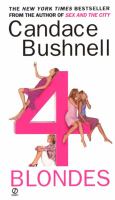
#72: Four Blondes

Four Blondes, by Candace Bushnell
(New York: Signet/ Grove Press, 2002, c2000)
Summary:
"Sex and the City author Candace Bushnell returns to the playgrounds of Manhattan's powerful and beautiful with her sizzling sensation Four Blondes, which gives an insider's look at the romantic intrigues, liaisons, and betrayals among the elite. She chronicles the lives of four beautiful women -- a model, a columnist, a socialite, and a writer -- as they face turning points at which each must choose among her passions.
"Studded with Bushnell's trademark wit and stiletto-heel-sharp insights, Four Blondes serves up the zeitgeist and mores of our era with gossipy, scandalous verve."

Opening Line:
"Janey Wilcox spent every summer for the last ten years in the Hamptons, and she'd never once rented a house or paid for anything, save for an occasional Jitney ticket."

My Take:
Ugh. Everything annoying and shallow and makes-you-want-to-claw-your-eyes-out about Sex and the City (the TV show; never read the book and may not bother after this) with none of the redeeming qualities (friendship, characters with at least some depth, etc.). Not a likeable person in the whole book. Also seemed remarkably dated for the early '00s, as if a story line from the 1980s somehow turned up behind the old washing machine. If I hadn't been up way too early for a flight and too tired and sad to focus on anything else, I wouldn't have bothered to finish it.

Friday, August 10, 2012

#71: The Cookbook Collector

The Cookbook Collector, by Allegra Goodman
(New York: The Dial Press, 2010)
Summary:
"Heralded as 'a modern-day Jane Austen' by USA Today, National Book Award finalist and New York Times bestselling author Allegra Goodman has compelled and delighted hundreds of thousands of readers. Now, in her most ambitious work yet, Goodman weaves together the worlds of Silicon Valley and rare book collecting in a delicious novel about appetite, temptation, and fulfullment.

"Emily and Jessamine Bach are opposited in every way: Twenty-eight-year-old Emily is the CEO of Veritech, twenty-three-year-old Jess is an environmental activist and graduate student in philosophy. Pragmatic Emily is making a fortune in Silicon Valley, romantic Jess works in an antiquarian bookstore. Emily is rational and driven, while Jess is dreamy and whimsical. Emily's boyfriend, Jonathan, is fantastically successful. Jess's boyfriends, not so much -- as her employer George points out in what he hopes is a completely disinterested way.

"Passionate, surprising, rich in ideas and characters, The Cookbook Collector is a novel about getting and spending, and about the substitutions we make when we can't find what we're looking for: reading cookbooks instead of cooking, speculating instead of creating, collecting instead of living. But above all it is about holding onto what is real in a virtual world: love that stays."

Opening Lines:
"Rain at last. Much-needed rain, the weathermen called it."


My Take:
A good read -- perfect blend of being interesting enough to keep me turning pages, but substantial enough for me to care about the characters. Not big on weighty matters while I was home last week, or, for that matter, since I've come back to work (and soul-sucking travel) this week. 

Friday, July 20, 2012

#61: Rebels in White Gloves

Rebels in White Gloves: Coming of Age 
with Hillary's Class -- Wellesley '69, by Mirian Horn 
New York: Times Books/ Random House, 1999
 Summary:
"'Freak out, Suzy Creamcheese. Drop out of school before your brain rots,' urged Frank Zappa. 'Protest boxy suits! Protest big ugly shoes!' exhorted the Wellesley News. 'Get your ring before spring,' cooed the women's magazines. Reject 'inauthentic reality' in favor of 'a more penetrating existence,' advised Hillary Rodham to her fellow graduates. Whipsawed by these conflicting mandates, the Wellesley Class of '69 were women on the cusp, feeling out the new rules. Rebels in White Gloves is their story.
"When these women entered Wellesley's ivory tower, they were initiated into a rarefied world where the infamous 'marriage lecture' and white gloves at afternoon tea were musts. Many were daughters of privilege; many were going for their 'MRS.' Four years later, by the time they graduated, they found a world turned upside down by the Pill, Betty Friedan's The Feminine Mystique, Roe v. Wade, the Vietnam War, student protests, the National Organization for Women, and the battle for the Equal Rights Amendment. 'Coming of age at a rare moment in history and with the equally rare privilege of an elite college education,' writes Miriam Horn, 'the women who graduated from Wellesley in 1969 were destined to be the monkeys in the space capsule, the first to test in their own lives the consequences of the great transformations wrought by the second wave of feminism.'

"For the thirtieth anniversary of the Class of '69 -- 'Hillary's class' -- Horn has created trenchant, remarkably nuanced portraits of these women, chronicling their experiments with sex, work, family, politics, and spirituality. Horn follows them as they joined SDS, tumbled into free-love communities, prosecuted pot growers, ministered to Micronesian natives, fled trust-fund security, forged and surrendered marriages, plumbed the challenges of motherhood, and coped with the uncertainties of growing older. As Horn writes, 'The women of '69 have come out as debutantes. They have also come out as lesbians, as victims of domestic abuse, as alcoholics.' In all their guises, these are wise, well-spoken women who look back on the last thirty years with great eloquence and humor, and whose coming of age mirrors all women's struggles to define themselves.

"On Commencement Day at Wellesley thirty years ago, Hillary Rodham told her classmates, 'We are, all of us, exploring a world that none of us understands and attempting to create within that an uncertainty. The only tool we have ultimately to use is our lives.' In Rebels in White Gloves, Miriam Horn has created raw and intimate portraits of women on the verge. Their tumultuous life paths -- wild, funny, heartbreaking, unforgettable -- are a primer in women's history of the past fifty years and a timely attempt to make sense of the increasingly blurred line between the personal and the political."

Table of Contents:
  1. The Wellesley Years
  2. Mothers and Daughters
  3. Rebellions and New Solidarities
  4. Reinventing Womanhood
  5. Breaking the Barriers
  6. Balancing Work and Family
  7. Full-Time Moms
  8. On Their Own
  9. Spiritual Journeys
  10. In Search of Self
  11. Life's Afternoon
My Take:
Not surprisingly, I really enjoyed this one -- not least because it didn't purport to offer any neat, tidy answers. An intriguing read for anyone interested in latter twentieth century history, women's history, or how our paths are shaped by and diverge after our college experiences (I can check all of those boxes). Thankfully, less navel-gazing than some accounts I've read that try with less skill to extrapolate some greater significance from a small, non-representative sample of individuals' experiences.

Saturday, July 14, 2012

#53: The Interruption of Everything

The Interruption of Everything, by Terry McMillan  
(New York: Viking, 2005)
Summary:
Since Terry McMillan’s breakout novel Waiting to Exhale surged onto the bestseller lists, critics and readers alike have been captivated by her irreverent, hilarious, pitch-perfect tales of women’s lives and contemporary issues. With The Interruption of Everything, her sixth novel, McMillan takes on the fault lines of midlife and family life, reminds us once again of the redeeming power of friendship, and turns her eye toward the dilemma of how a woman starts to put her own needs higher on the to-do list while not shortchanging everyone else.

"Marilyn Grimes, wife and mother of three, has made a career of deferring her dreams to build a suburban California home and lifestyle with her husband, Leon. She troubleshoots for her grown kids, cares for her live-in mother-in-law, Arthurine (and elderly poodle, Snuffy); keeps tabs on her girlfriends Paulette and Bunny and her own aging mother and foster sister—all the while holding down a part-time job. But at forty-four, Marilyn’s got too much on her plate and nothing to feed her passion. She feels like she’s about ready to jump. She’s just not sure where.

Highly entertaining, deeply human, a page-turner full of heart and soul, The Interruption of Everything is vintage Terry McMillan—and a triumphant testament to the fact that the detour is the path, and living life 'by the numbers' never quite adds up."

Opening Line:
"The only reason I'm sitting on a toilet seat in the handicapped stall of the ladies' room is because I'm hiding."

My Take:
One of my more expensive finds from the May booksale at the Boston Public Library (think I paid a dollar for it), and a highly entertaining read. Things do tend to wrap up a bit too neatly and quickly at the end, which is often a peeve of mine, but it wasn't necessarily a bad ending -- just one that might have benefited from a loose end or 2.
 

Monday, July 9, 2012

#51: Julia's Child

Julia's Child, by Sarah Pinneo (New York: Plume, 2012)

Summary:
"A delectable comedy for every woman who has ever wondered if buying that $6 box of organic crackers makes her a hero or a sucker.

 "Julia Bailey is a mompreneur with too many principles and too little time. Her fledgling company, Julia’s Child, makes organic toddler meals with names like Gentle Lentil and Give Peas a Chance. But before she realizes her dream of seeing them on the shelves of Whole Foods, she will have to make peace between her professional aspirations and her toughest food critics: the two little boys waiting at home. Is it possible to save the world while turning a profit?

Julia's Child is a warmhearted, laugh-out-loud story about motherhood’s choices: organic vs. local, paper vs. plastic, staying at home vs. risking it all."

Opening Line:
"Though I wasn't familiar with the neighborhood, St. Agatha's was easily found in the middle of a leafy Brooklyn street."

My Take:
Funny little book -- really does, as Publisher's Weekly put it, "[Skewer] the cult of the child with an insider’s eye." Unfortunately, as this was the third or fourth BookLite in a row I read a few weeks back, the moment has passed and it seems hardly worth it to go back and remember enough detail to illustrate what I liked about it. If the summary sounds like it might be funny, you might enjoy it.

Thursday, July 5, 2012

#43: My Name Is Mary Sutter

My Name Is Mary Sutter, by Robin Oliveira (New York:  Viking, 2010)

Summary:
"In this stunning historical novel, Mary Sutter is a brilliant, headstrong midwife from Albany, New York, who dreams of becoming a surgeon. Determined to overcome the prejudices against women in medicine -- and eager to run away from her recent heartbreak -- Mary leaves home and travels to Washington, D.C. to help tend the legions of Civil War wounded. Under the guidance of William Stipp and James Blevens -- two surgeons who fall unwittingly in love with Mary's courage, will, and stubbornness in the face of suffering -- and resisting her mother's pleas to return home to help with the birth of her twin sister's baby, Mary pursues her medical career in the desperately overwhelmed hospitals of the capital.
Like Charles Frazier's Cold Mountain and Robert Hicks's The Widow of the South, My Name Is Mary Sutter powerfully evokes the atmosphere of the period. Rich with historical detail (including marvelous depictions of Lincoln, Dorothea Dix, General McClellan, and John Hay among others), and full of the tragedies and challenges of wartime, My Name Is Mary Sutter is an exceptional novel. And, in Mary herself, Robin Oliveira has created a truly unforgettable heroine whose unwavering determination and vulnerability will resonate with readers everywhere.


Opening Lines:
"'Are you Mary Sutter?' Hours had passed since James Blevens had called for the midwife."

My Take:
Here's where the reviews get pretty terse and cursory. As I said, before I came to Boston, I spent a few weeks in Ohio. What I hadn't yet mentioned was that I almost got sent to Memphis for a few months. When that looked like a possibility, I began looking into what there was to keep myself busy after work and on weekends, and began making grand plans to indulge my interest in both Civil War and Civil Rights history. The trip didn't happen but a number of historical novels set during the Civil War did, and I'm still slogging my way through James M. McPherson's master single-volume work on the subject, Battle Cry of Freedom

Anyway, I enjoyed Mary Sutter. If you enjoy Civil War stories and want one with a slightly different focus than you're used to, like books about iconoclastic women ahead of their time (as opposed to reviews by redundantly verbose readers!), or enjoy fiction that touches on the historical practice of medicine, give this one a try.

Monday, April 30, 2012

#39: French Women Don't Get Fat

French Women Don't Get Fat: The Secret of Eating for Pleasure, by Mireille Guiliano (New York: Alfred A. Knopf, 2005)


Summary:
"Stylish, convincing, wise, funny -- and just in time: the ultimate non-diet book, which could radically change the way you think and live.


"French women don't get fat, but they do enjoy bread and pastry, wine, and regular three-course meals. Unlocking the simple secrets of this 'French paradox' -- how they enjoy food while staying slim and healthy -- Mireille Guiliano gives us a charming, empowering take on health and eating for our times.


"As a French teenager, Mireille (Meer-ray) went to America as an exchange student and came back fat. Fortunately, her kindly family physician, 'Dr. Miracle,' came to the rescue. Reintroducing her to classic principles of French gastronomy plus time-honored tricks of the local women, he helped restore her shape with a fresh understanding of food, drink, and living. The key? Not guilt or deprivation but learning how to get the most from the things you enjoy. Mireille has ever since relished a life of indulgence without bulge, satisfying yen without yo-yo on three meals a day.


"Now, in simple but potent strategies and dozens of recipes you'd swear were fattening, she revelas the ingredients for a lifetime of weight control -- from the emergency weekend remedy of Magical Leek Soup to everyday tricks like fooling yourself into contentment. Emphasizing freshness, variety, balance, and always pleasure, Mireille shows how virtually anyone can learn to eat, drink, and move like a French woman.


"A natural raconteur, she illustrates her philosophy in cherished personal stories: her first taste of Champagne (at age six), hunts for mushrooms and berries, and a near-spiritual rendezvous with oysters, to name but a few. She also shows us other women discovering the wonders of 'French in action,' eating smarter and more joyfully.


"For anyone who has slipped out of her Zone, missed the flight to South Beach, or accidentally let a carb pass her lips, here is a buoyant, positive way to stay trim, a culture's most precious secrets recast for the twenty-firest century. A life of wine, bread -- even chocolate -- without girth or guilt? Porquoi pas?"

Table of Contents:
  • 1. Vive l'Amerique:  The Beginning . . . I Am Overweight
  • 2. La Fille Prodigue:  Return of the Prodigal Daughter
  • 3. Short-term Recasting:  The First Three Months
  • 4. The Tales of the Three Cs
  • Entr'acte:  Stabilization and Eating for Life
  • 5. Il Faut des Rites
  • 6. The Seasons and the Seasonings
  • 7. More Recipes That Will Fool You
  • 8. Liquid Assets
  • 9. Bread and Chocolate
  • 10. Moving Like a French Woman
  • 11. States of Desire
  • 12. Life Stages
  • 12 bis. The Plan for Life
My Take:
Not surprisingly, some good ideas but if everything Guiliano recommends were as easy to say as to do, or as compatible with U.S. culture as with that of France, then American women wouldn't get fat, either. I do like the "eat real food and enjoy it, rather than diet foods," and "enjoy the food you love proudly, rather than gobbling it in secret" advice, though.

(A few books behind and heading out of town tonight for a week, so that's all I have time for.)

Monday, April 23, 2012

#33: Summer House

Summer House, by Nancy Thayer (New York: Ballantine Books, 2009)


Summary:
"After years of wandering from whim to whim, thirty-year-old Charlotte Wheelwright seems to have at last found her niche. The free spirit enjoys running an organic gardening business on the island of Nantucket, thanks in large part to her spry grandmother Nona, who donated a portion of land on the family's seaside compound to get Charlotte started. Though Charlotte's skill with plants is bringing her success, cultivating something deeper with people -- particularly her handsome neighbor Coop -- might be more of a challenge.


"Nona's generosity to Charlotte, secretly her favorite grandchild, doesn't sit well with the rest of the Wheelwright clan, however, as they worry that Charlotte may be positioning herself to inherit the entire estate. With summer upon them, everyone is making their annual pilgrimage to the homestead -- some with hopes of thwarting Charlotte's dreams, others in anticipation of Nona's latest pronouncements at the annual family meeting, and still others with surprising news of their own. Charlotte's mother, Helen, a Wheelwright by marriage, brings a heavy heart. She once set aside her own ambitions to fit in with the Wheelwrights, but now she must confront a betrayal that threatens her sense of place and her sense of self.


"As summer progresses, these three women -- Charlotte, Nona, and Helen -- come to terms with the decisions they have made. Revisiting the lives and loves that have crossed their paths and the possibilities of the roads not taken, they may just discover that what they've always sought was right in front of them all along."

Opening Line:
"Charlotte had already picked the lettuces and set them, along with the bundles of asparagus tied with twine and the mason jars of fresh-faced pansies, out on the table in a shaded spot at the end of the drive."

My Take:
Better and more engaging than The Last Time I Saw You, if perhaps not quite as much so as Maine ... but to be honest, these stories are starting to run together a bit. Maybe it's about time to switch from the love-and-friendship chick lit genre to something else for a while. After I finish my current library backlog, that is.

Wednesday, April 18, 2012

#30: A Grown-Up Kind of Pretty

A Grown-Up Kind of Pretty, by Joshilyn Jackson New York: Grand Central Publishing, 2012)

Summary:
"Every fifteen years, trouble comes after the three Slocumb women. Now, as the youngest turns fifteen, she's desperate to know who used their yard as a makeshift cemetery, and why. The unlikely matriarch, forty-five-year-old Ginny, doesn't know the truth -- she only knows she must do everything in her power to keep it hidden. Between them is Liza, silenced by a stroke, haunted by the choices she made as a teenager, with the answers trapped inside her. To survive Liza's secrets and Mosey's insistent adventures, Ginny must learn to trust the love that braids the strands of their past -- and stop at nothing to defend their future.

"With riveting plot twists and off-kilter characters, A Grown-Up Kind of Pretty introduces three generations of Slocumbs: a child on the cusp of womanhood searching for her true family; a woman whose fight to protect her daughter will toss her headlong into a second chance at first love; and a lost soul rediscovering her voice. New York Times bestselling author Joshilyn Jackson takes us on a wild ride from desperate mystery to a place of firm hope, providing once more that 'she knows how to grab a reader -- and not let go' (USA Today)."

Opening Line:
"My daughter, Liza, put her heart in a silver box and buried it under the willow tree in our backyard."

My Take:
Two chapters in, and weirdness aplenty has been established. Thirty years earlier, Ginny got pregnant at fourteen by a popular high school athlete who plied her with zombie punch, and used the hush money from his family to get away from the shameful gazes in her parents' small town and raise her daughter, Liza, on her own. Fifteen years later, Liza repeats her mother's mistake, disappears a few weeks after her still-unnamed daughter's birth, and returns two years later with a skinny toddler named Mosey who looks oddly unlike her mother and grandmother. Since Mosey's own fourteenth year, both Ginny and Liza have been a wreck, although Ginny desperately hopes that Liza's stroke will be all the bad luck the family's due for another fifteen years.

Then Ginny hires a local yokel to cut down Liza's beloved willow tree so she can put in a swimming pool, in hopes that this will aid Liza's recovery. He finds a silver box containing what Ginny can't help but recognize as the infant Mosey's clothing and toys, along with a tiny infant jawbone. The discovery sends Liza into an anguished rage, screaming words only Ginny and Mosey can decipher: "Umbay! Umbay! Geem, gee!" My baby! My baby! Give me, give!

I, for one, am intrigued.

(Next day) Well, I wasn't disappointed, and can't wait to track down some of Jackson's other novels if this one is any indication. It's not too much of a spoiler to say that both Mosey and Ginny (a/k/a Big) realize early on that the baby beneath the willow is probably Liza's child, in which case ... who the heck is Mosey? Neither knows that the other knows, and Mosey is by turns angry and terrified that Big won't want a thing to do with her once she learns she's not a blood relation. Did Liza steal someone else's baby? If so, does anyone know, and will they come to take Mosey back? And just who was the carney who allegedly fathered Liza's baby, anyway? a different kind of mystery than I'm used to -- less legal and police procedural, more family and relationship stuff -- but plenty of twists and intrigue to keep things interesting.

#28: Maine

Maine, by J. Courtney Sullivan (New York: Alfred A. Knopf, 2011)

Summary:
"For the Kellehers, Maine is a place where children run in packs, showers are taken outdoors, and old Irish songs are sung around a piano at night. Their beachfront property, won on a barroom bet after the war, sits on three acres of sand and pine needles nestled between stretches of rocky coast, with one tree bearing the initials 'A.H.' At the cottage, built by Kelleher hands, cocktail hour follows morning mass, nosy grandchildren snoop in drawers, and decades-old grudges simmer beneath the surface.

"As three generations of Kelleher women descend upon the property one summer, each brings her own hopes and fears. Maggie is thirty-two and pregnant, waiting for the perfect moment to tell her imperfect boyfriend the news; Ann Marie, a Kelleher by marriage, is channeling her domestic frustration into a dollhouse obsession and an ill-advised crush; Kathleen, the black sheep, never wanted to set foot in the cottage again; and Alice, the matriarch at the center of it all, would trade every floorboard for a chance to undo the events of one night, long ago.

"By turns wickedly funny and achingly sad, Maine unveils the sibling rivalry, alcoholism, social climbing, and Catholic guilt at the center of one family, along with the abiding, often irrational love that keeps them coming back, every summer, to Maine and to each other."

Opening Lines:
"Alice decided to take a break from packing. She lit a cigarette, leaning back in one of the wicker chairs that were always slightly damp from the sea breeze."

My Take:
If there were a prize for most-improved sophomore effort, I think J. Courtney Sullivan would win. Commencement was a decent enough read, but not really a serious one. While Maine is probably still closer to Oprah's book club than Pulitzer territory, it puts Sullivan in a category with Alice McDermott of poignant, nuanced, and highly accurate portraits of the Irish-American family. More details are available in Lily King's New York Times review, but I enjoyed this one, too.

Wednesday, January 25, 2012

#112: Then Came You

Then Came You, by Jennifer Weiner (New York: Atria Books, 2011)

Summary:
"The lives of four very different women intertwine in unexpected ways in this new novel ... Each woman has a problem: Princeton senior Jules Wildgren needs money to help her dad cure his addiction; Pennsylvania housewife Annie Barrow is gasping to stay financially afloat; India Bishop yearns to have a child, an urge that her stepdaughter Bettina can only regard with deep skepticism until she finds herself in a most unexpected situation. Interlocking dramas designed to ensnare; bound to be a bestseller. ...

"Weiner has a knack for amazing dialogue and descriptions that ring true and her humor is a constant presence. There isn't a fake, forced or phony tone in any of her writing. In Then Came You, Weiner explores the sensitive issues of infertility, egg donation, and surrogacy, while also delving into the more universal issues surrounding marriage, family relationships, alcoholism, regret, and love. Each chapter is told from the point of view of a different character and as the story unfolds, the role that each woman will play in the life of another is revealed. Annie, a stay-at-home mom, married her high school sweetheart and is now raising her two boys. She decides to become a surrogate to help her family out of their current financial problems. Jules, a recent Princeton graduate, decides to donate her eggs to a fertility clinic hoping that the money she gets can go towards helping her sick father. India is a trophy wife. She recently married a wealthy older man and decides to have a baby. When she can't conceive naturally, she turns to surrogacy. Each individual story is woven together when Bettina, India's stepdaughter, decides to investigate India's past."


Opening Line:
"The man in the suit was watching me again."


My Take:
Hella fun vacation read. (Yeah, I'm way behind in blogging so this is all the reviewing I can do for now. Sorry.)

Friday, December 16, 2011

#110: Summer Rental

Summer Rental, by Mary Kay Andrews (New York: St. Martin's Press, 2011)

Summary:
"Ellis, Julia, and Dorie. Best friends since Catholic grade school, they now find themselves in their mid-thirties, at the crossroads of life and love. Ellis, recently fired from a job she gave everything to, is beginning to question the choices she's made over the past decade of her life. Julia -- whose caustic wit covers up her wounds -- has a man who loves her and is offering her the world, but she can't hide how deeply insecure she feels about her looks, her brains, and her life. And Dorie has just been shockingly betrayed by the man she loved and trusted most in the world ... though this is just the tip of the iceberg of her problems and secrets. A month in North Carolina's Outer Banks is just what each of them needs.

"Ty Bazemore is their landlord, though he's hanging on to the rambling old beach house by a thin thread. After an inauspicious first meeting with Ellis, the two find themselves disturbingly attracted to each other, even as Ty is about to lose everything he's ever cared about.

"Maryn Shackleford is a stranger, and a woman on the run. Maryn just needs a few things in life: no questions, a good hiding place, and a new identity. Ellis, Julia, and Dorie can provide what Maryn wants, but can they also provide what she needs?

"Five people questioning everything they ever thought they knew about life. Five people on a journey that will uncover their secrets and point them on the path to forgiveness. Five people who need a sea change, and one month in a summer rental that might just give it to them."

Opening Line:
"It was not an auspicious beginning for a vacation, let alone for a new life."

My Take:
Halfway entertaining, but forgettable.


Thursday, December 8, 2011

#106: Call Me Irresistible

Call Me Irresistible, by Susan Elizabeth Phillips (New York: William Morrow, 2011)

Summary:
"Lucy Jorik is the daughter of a former president of the United States.

"Meg Koranda is the offspring of legends.

"One of them is about to marry Mr. Irresistible -- Ted Beaudine -- the favorite son of Wynette, Texas. The other is not happy about it and is determined to save her friend from a mess of heartache.

"But even though Meg knows that breaking up her best friend's wedding is the right thing to do, no one else seems to agree. Faster than Lucy can say "I don't," Meg becomes the most hated woman in town -- a town she's stuck in with a dead car, an empty wallet, and a very angry bridegroom. Broke, stranded, and without her famous parents at her back, Meg is sure she can survive on her own wits. What's the worst that can happen? Lose her heart to the one and only Mr. Irresistible? Not likely. Not likely at all.

"Call Me Irresistible is the book Susan Elizabeth Phillips's readers have long awaited. Ted, better known as 'little Teddy,' the nine-year-old heartbreak kid from Phillips's first bestseller, Fancy Pants, and as 'young Teddy,' the hunky new college graduate in Lady Be Good, is all grown up now -- along with Lucy from First Lady and Meg from What I Did for Love. They're ready to take center stage in a saucy, funny, and highly addictive tale fans will love."


Opening Line:
"More than a few residents of Wynette, Texas, thought Ted Beaudine was marrying beneath himself."

My Take:

Maybe long-time faithful fans of the author would love and anticipate this book, but I'm not among them. My cardinal rule of sequels, or any books set in a universe the author's previously established, is that they need to work just as well as stand-alones for those who haven't read the others in the series. This one fails. Lots of stock, two-dimensional cardboard characters and ridiculous plot contrivances. Perhaps I've just read one chick lit book too many of late, but I feel a little like I just ate a full not-quite-half-gallon carton of ice cream by myself. The kind with rich but heavy little mix-ins in it.

#105: Wife-in-Law

Wife-in-Law, by Haywood Smith (New York: St. Martin's Press, 2011)

Summary:
"Neighbors Betsy Callison and Kat Ellis were oil and water when they met thirty-five years ago. Betsy was a prim, neat-freak, Republican wife, and Kat was a wild, irreverent hippie liberal. But they soon discovered common ground that created a bond that has lasted for decades. Until Betsy's husband, Greg, leaves her for his secretary, then comes back sniffing around two years later and convinces newly widowed Kat to marry him!

"Not that Betsy wants him back, but it's hard to move on when the newlyweds are flaunting their love right across the street. But there's trouble brewing in paradise, and no one knows philandering Greg better than his ex-wife, Betsy. Can Betsy get involved in her best friend's marriage -- even if it means helping her wife-in-law figure out the same man she shared a bed with for thirty years?"


Opening Line:
"Somebody once asked me how I pick my friends, and I just laughed, because God usually does the picking for me, and believe me, He has a wicked sense of humor."

My Take:
Fluffy, corn-battered and Southern-fried fun, if not especially literary or memorable.

#104: Joy for Beginners

Joy for Beginners, by Erica Bauermeister (New York: G.P. Putnam's Sons, 2011)

Summary:
"At
an intimate, festive dinner party in Seattle, six women gather to celebrate their friend Kate's recovery from cancer. Wineglass in hand, Kate strikes a bargain with them: to celebrate her new lease on life, she'll do the one thing that's always terrified her: whitewater rafting down the Grand Canyon. But if she goes, each of them must promise to do one thing in the next year that is new, or difficult, or scary -- and Kate gets to choose their challenges.

"Shimmering with warmth, wit, and insight, Joy for Beginners is a celebration of life: unexpected, lyrical, and deeply satisfying."

Opening Line:

"Life came back slowly, Kate realized."


My Take:
Decent but not awesome. Not really enough time to get to know the characters well, or to understand the challenges Kate chose for them: best friend Ava's training for a three-day cancer walk (her own mother's death when she was ten left her absolutely paralyzed around death, to the extent of not being able to be around Kate during her illness) makes sense, but why demand that free spirited potter Dalia learn to bake bread?

Well written, though not quite to the extent oversold by the jacket blurb. What else is new?

Thursday, October 20, 2011

#84: Hedge Fund Wives

Hedge Fund Wives, by Tatiana Boncompagni (New York: Avon, 2009)

Summary:
"When her husband, John, is recruited to be a big-time hedge fund manager, Marcy Emerson gives up her job, uproots her life, and moves from Chicago to New York City. But try as she might, March is never going to fit into one of the supposed seven categories of Hedge Fund Wives -- the Accidental, the Westminster, the Stephanie Seymour, the Former Secretary, the Socialite, the Workaholic, or the Breeder -- especially when behind every smile may lurk a stab in the back.

"In a perfect world John would have been there to help her navigate the waters, but in this volatile financial market, relationships have a way of nosediving faster than the Dow, and March quickly finds herself tossed aside for a thinner, blonder model. But while living out of suitcases and drowning her sorrows in cocktails, Marcy realizes it's time to get back up on her own two feet again ... and fight for those things in life that are far more important than money."


Opening Line:
"When I first opened the invitation to Caroline Reinhardt's baby shower, I thought I'd received it by mistake."

My Take:
Polished this off in half a day, and I feel as though I just had a big bowl of popcorn for supper. It's fun and tasty in the short term, partly because you feel like you're getting away with something, but doesn't do much to nourish or sustain you over the long haul.

The back-of-the-jacket blurb pretty much sums up the story line. Marcy, our heroine and narrator, is established as a fish out of water from the get-go, starting with the first-chapter sequence in which her pink parka stands out like a sore thumb amid a coat closet full of furs, and Caroline Reinhardt decides she's not worth talking to because she doesn't hire an interior decorator. At John's insistence, she'd given up her own banking career in anticipation of one day staying at home with their children, but after a recent miscarriage and the move to Manhattan, she's still reeling. It doesn't help that the other hedge fund wives, whether employed in their own right or not, seem interested primarily in extreme competitive shopping.

She does meet the glamorous but warm, if a little high-strung, Jill at the aforementioned baby shower, and through her, eventually meets Gigi, a caterer and cookbook author who (despite her marriage to yet another Wall St. VIP) becomes her closest friend and confidante. She and John also begin to socialize with Ainsley and Peter, despite that couple's precarious finances. As is telegraphed early on, this is where the trouble begins; Ainsley, panicked at Peter's fortune and aware of John's rising-star status, decides to trade up, and when Marcy spontaneously flies to Miami to visit John at a conference, she catches the pair in flagrante. With the help of a tough divorce lawyer Gina recommends, Marcy resists John's early settlement offers and ultimately walks away with a cool $15 million ... just in time to see Ainsley's pregnancy in the society pages, and realize how long her affair with John had been going on.

Marcy eventually comes out on top, and John does get a comeuppance of sorts, but this is no First Wives Club. It's far shorter on humor, and rather excessive in the descriptions of conspicuous consumption. (The excess is the point, I know, but it still makes for tedious reading after yet another over-the-top baby shower or dinner party.) All in all, an OK read, but I'd have liked a bit less of the bling, and more exploration of the edge-of-recession era in which the story is set.

Thursday, October 6, 2011

#76: Kindred Spirits

Kindred Spirits, by Sarah Strohmeyer (New York: Penguin Group, 2011)

Summary:
"When
life gives you lemons, call your best girlfriends and whip up some lemon martinis. Such is the mantra for the Ladies Society for the Conservation of Martinis, which was established after one fateful PTA meeting when four young mothers -- Lynne, Mary Kay, Beth, and Carol -- discovered they had more in common than they ever thought possible.

"Meeting once a month, the women would share laughs and secrets and toast to their blossoming friendship with a clink of their sacred martini glasses. The Society was their salvation, their refuge, a place where they could vent about kids, work, and husbands and celebrate their mutual appreciation for a good cocktail. But when life-shattering circumstances force the group to dissolve, their friendship is never quite the same ... until two years later, when a tragic event puts the Society back in session.

"When Lynne passes away suddenly, she leaves behind one simple request: that her old friends sort through her belongings. Reluctantly, the women reunite to rummage through her closets. There's nothing remarkable -- no kinky sex toys, no embarrassing diary. But buried deep within Lynne's lingerie drawer is an envelope addressed to the Society. In it, they find a letter than reveals a stunning personal secret and a final wish that will send the woman on a life-changing journey where they will discover unexpected truths about themselves, each other, and the meaning of friendship."


Opening Line:
"A martini is the world's most sophisticated cocktail, a classic of beauty and simplicity that derives its intoxicating allure from the melding of four strikingly different sensations."


My Take:

As I suspected, Kindred Spirits was no Dreams of Joy. While it wasn't quite as formulaic as Legacy, it was certainly closer to that end of the continuum. Even as a heartwarming story about female friendship, others have done far better at capturing the complex bonds among group members and making us care what happens to the characters.

Maybe it's because there's no real tension here.
All we know is that the four principals met and bonded at a PTA meeting several years ago, after which they started getting together once a month for girl talk and martinis. Eventually, Lynne battles cancer, and Carol has a mad-as-hell-and-not-going-to-take-it-anymore moment that leads her, inexplicably, to leave her husband and kids and start a new life as a career gal in NYC ... which causes the Society to drift apart until Lynne's death two years later. During the course of the novel, the three survivors sort through Lynne's belongings and find a top-secret letter asking them to find the baby girl she'd given up for adoption 30 years earlier. Along the way, Carol begins to wonder whether she'd been a bit too hasty in leaving her marriage, Mary Kay agonizes after how to tell fiance Drake that she can't have children, and Beth worries that the life she and her husband had always dreamed of is passing them by. Any or all this could make for a halfway decent story, except the characters and their feelings aren't really presented with enough depth or description to hook us in. They never seem to argue, and we see little of their friendship -- dialogue, memories, etc. -- to understand why they became close in the first place, what made the others stop seeing each other after Carol left, etc.

All in all, not a horrible way to spend an afternoon, but not especially memorable, either.

Tuesday, October 4, 2011

#72: Emily, Alone

Emily, Alone, by Stewart O'Nan (New York: Viking, 2011).

Summary:
"A sequel to the bestselling, much-beloved Wish You Were Here, Stewart O'Nan's intimate new novel follows Emily Maxwell, a widow whose grown children have long moved away. She dreams of visits by her grandchildren while mourning the turnover of her quiet Pittsburgh neighborhood, but when her sole companion and sister-in-law Arlene faints at their favorite breakfast buffet, Emily's days change. As she grapples with her new independence, she discovers a hidden strength and realizes that life always offers new possibilities. Like most older women, Emily is a familiar yet invisible figure, one rarely portrayed so honestly. Her mingled feelings -- of pride and regret, joy and sorrow -- are gracefully rendered in wholly unexpected ways. Once again making the ordinary and overlooked not merely visible but vital to understanding our own lives, Emily, Alone confirms O'Nan as an American master."

My Take:
It was hard to sit down and start this one -- I was on a rereading crap, don't-tax-the-brain spree last week -- but once I did, wow. What a lovely, gentle, sweet book. Read the author's Songs for the Missing some time ago and enjoyed that well enough, but this one was something different altogether. First book I've ever read about aging that didn't make me absolutely dread the eventual sunset years of my own life.