About Me

Ithaca, New York
MWF, now officially 42, loves long walks on the beach and laughing with friends ... oh, wait. By day, I'm a mid-level university administrator reluctant to be more specific on a public forum. Nights and weekends, though, I'm a homebody with strong nerdist leanings. I'm never happier than when I'm chatting around the fire, playing board games, cooking up some pasta, and/or road-tripping with my family and friends. I studied psychology and then labor economics in school, and I work in higher education. From time to time I get smug, obsessive, or just plain boring about some combination of these topics, especially when inequality, parenting, or consumer culture are involved. You have been warned.
Showing posts with label World War II. Show all posts

Thursday, August 16, 2012

#74: The Reader

The Reader, by Bernhard Schlink
translated by Carol Brown Janeway
(New York: Vintage International, 2008, c1997)
 Summary:
"When young Michael Berg falls ill on his way home from school, he is rescued by Hanna, a woman twice his age. In time she becomes his lover, enthralling him with her passion, but puzzling him with her odd silences. Then she disappears.
"Michael next sees Hanna when she is on trial for a hideous crime, refusing to defend herself. As he watches, he begins to realize that Hanna may be guarding a secret she considers more shameful than murder."

Opening Line:
"When I was fifteen, I got hepatitis."


My Take:
Liked the earlier segment of the story, in which Michael and Hanna become unlikely but passionate lovers despite Hanna clearly having some skeletons in her closet (and frankly, if she's a 36 year old woman having a clandestine affair with a 15 year old boy, doesn't this almost go without saying?) rather more than the later, in which Michael is a grown man studying law and Hanna on trial for war crimes. Maybe that's because I'd figured out Hanna's secret fairly early on, so the big reveal didn't have the punch it might. Maybe it's because I've read rather a lot of World War II novels (which would be screamingly obvious to my readers if I actually had any), and while the events of which Hanna is accused are certainly horrific, neither the Nazi atrocities nor the legal drama was the most compelling example of their genres that I've ever read. To be fair, both might read better a) in the original German, and b) to someone more intimately familiar with German culture and how WWII has affected subsequent generations. A well-written book with interesting imagery, even in translation, but not quite all I'd hoped for.

Tuesday, August 7, 2012

#68: The Piano Teacher

The Piano Teacher, by Janice Y. K. Lee
(New York: Penguin Books, 2009)
 Summary:
"In the sweeping tradition of The English Patient, Janice Y.K. Lee's debut novel is a tale of love and betrayal set in war-torn Hong Kong. In 1942, Englishman Will Truesdale falls headlong into a passionate relationship with Trudy Liang, a beautiful Eurasian socialite. But their affair is soon threatened by the invasion of the Japanese as World War II overwhelms their part of the world. Ten years later, Claire Pendleton comes to Hong Kong to work as a piano teacher and also begins a fateful affair. As the threads of this spellbinding novel intertwine, impossible choices emerge-between love and safety, courage and survival, the present, and above all, the past"

Opening Lines:
"It started as an accident. The small Herend rabbit had fallen into Claire’s purse."

My Take:
This was another of those novels that I expected and really wanted to like more than I did. On paper the plot has promise: What will become of the rarefied world Will and Trudy inhabit (though neither really fully belong) as the war comes ever closer? What's happened to Will between the earlier, 1942-43 story line and the 1953 one featuring Claire that keeps him in Hong Kong, now as the Chens' remarkably underutilized chauffeur?

Trouble is, at least from my vantage point, it doesn't quite deliver. We learn what happens to all these people, of course, and naturally, this being a war story, some of the answers aren't pretty. But it didn't feel like we learned enough about what made the principal characters tick to really picture them in these harrowing settings and make us see the events through their eyes. Claire's pilfering habit (not a spoiler, as you learn about it somewhere around the first chapter) is interesting, but Lee barely scratches the surface of why she starts or what the purloined objects mean to her. We're told that her marriage to husband Martin is safe, conventional, and, well, not very exciting, but we don't see enough of Claire to understand exactly what she wants beyond that. Likewise, Will is a promising character I never really felt like I understood. As a prisoner of war, he shows not quite heroism, but a quiet, understated integrity and strength ... which doesn't quite jibe with how passive he seems in his relationship with Trudy.

Perhaps there's some meta-commentary here, but I found myself feeling like I imagine Lee's two chief European characters felt in Hong Kong: like a fish out of water, with things not quite fitting together as you'd expect. Not awful, and maybe I'm just not getting it, but the book didn't really resonate with me, either.

Monday, February 13, 2012

#9: Nanjing Requiem

Nanjing Requiem, by Ha Jin (New York: Pantheon Books, 2011)

Summary:
"The award-winning author of Waiting and War Trash returns to his homeland in a searing new novel that unfurls during one of the darkest moments of the twentieth century: the Rape of Nanjing.

"In 1937, with the Japanese posed to invade Nanjing, Minnie Vautrin -- an American missionary and the dean of Jinling Women's College -- decides to remain at the school, convinced that her American citizenship will help her safeguard the welfare of the Chinese men and women who work there. She is painfully mistaken. In the aftermath of the invasion, the school becomes a refugee camp for more than ten thousand homeless women and children, and Vautrin must struggle, day after day, to intercede on behalf of the hapless victims. Even when order and civility are eventually restored, Vautrin remains deeply embattled, and she is haunted by the lives she could not save.

"With extraordinarily evocative precision, Ha Jin recreates the terror, the harrowing deprivations, and the menace of unexpected violence that defined life in Nanjing during the occupation. In Minnie Vautrin he has given us an indelible portrait of a woman whose convictions and bravery prove, in the end, to be no match for the maelstrom of history."


Opening Lines:
"Finally Ban began to talk. For a whole evening we sat in the dining room listening to the boy."

My Take:
Had high hopes for this one. Sadly, it didn't deliver. Ha Jin's writing style, at least here, was just too detached and clinical for the book to be effective. Certainly the Rape of Nanjing was horrific -- heck, it makes That History Place's online list of the worst genocides of the twentieth century -- but Nanjing Requiem reads more like a chronicle of atrocities than a portrait of the human beings involved. Neither Minnie nor the narrator, Anling, really come to life in any meaningful way here. I have to agree with Marie Arana's Washington Post review, which calls the novel "unnervingly flat" and says it "doesn't quite pack the voltage it deserves. ... The action can read like a textbook, with intermittent spatters of gore."

Thursday, May 5, 2011

#32: City of Thieves

City of Thieves, by David Benioff (New York: Penguin Group, 2008)

Summary:
"Stumped by a magazine assignment to write about his own uneventful life, a man visits his retired grandparents in Florida to document their experience during the infamous siege of Leningrad. Reluctantly, his grandfather commences a story that will take him almost a week to tell: an odyssey of two young men determined to survive, against desperate odds, a mission in which cold, hunger, and the Russian authorities prove as dangerous as the invading Wehrmacht.

"Two young men meeting for the first time in a jail cell await summary execution for crimes of dubious legitimacy. At seventeen, Lev Beniov considers himself 'built for deprivation.' Small, smart, insecure about his virginity, he's terrified about the sentence that awaits him and his cellmate, the charismatic and grandiose Kolya, a handsome young soldier charged with desertion. However, instead of a bullet in the back of the head, the pair is given an outrageous assignment: In a besieged city cut off from all supplies, secure a dozen eggs for a powerful colonel to use in his daughter's wedding cake. Lev and Kolya embark on a hunt to find the impossible in five days' time, a quest that propels the from the lawless streets of Leningrad to the devastated countryside behind German lines. As they encounter murderous city dwellers, guerrilla partisans, and finally the German army itself, an unlikely bond forms between this earnest teenager and his unpredictable companion, a lothario whose maddening, and endearing, bravura will either advance their cause or get them killed.

"Hailed for his brilliantly drawn characters and incisive ability to capture the pulse of urban life, David Benioff rises to new heights in this portrait of two unforgettable young men and Soviet Russia under siege. By turns insightful and funny, thrilling and terrifying, City of Thieves takes us on a breathtaking journey into the twentieth century's darkest hour even as it celebrates the power of friendship to transform a life."


Opening Line:
"My grandfather, the knife fighter, killed two Germans before he was eighteen."

My Take:
Don't think there are many authors out there who can successfully combine a buddy movie and the seige of Leningrad between two covers, but somehow, Benioff manages. City of Thieves is an engrossing, entertaining book that manages to capture some of the humor and absurdity of war without trivializing it.

The main story opens in the Crosses, as Lev, an achingly young seventeen-year-old whose mom and sister fled the city long ago, awaits an unknown but dire fate in the dark, forebidding prison that's long been the stuff of every Leningrad child's nightmares. Enter Kolya, a handsome-and-knows-it Cossack deserter who claims he can write in the pitch dark and quotes from a great Russian novel that Lev (son of a famed poet) has never heard of. Kolya is arrogant but kind, Lev is impressed but annoyed, and whether or not they admit it, both are terrified. Not usually the stuff of lifelong friendships ... that is, until the next day, when the local colonel offers to redeem their lives if they can bring back a dozen eggs for his daughter's wedding cake within a week's time. Yes, in a city whose very name still defines the word siege.

Since both young men value their lives, they have no choice but to try. Their search begins in Leningrad proper, where they assume someone, somewhere must have eggs, and they need only the money, barter, and/or guile to get them. They crash with an old friend-with-benefits of Kolya's, narrowly escape a tribe of cannibals who do indeed have food to sell, and learn the truth behind the rumors of a crazy but armed old man who still keeps a flock of chickens on a rooftop somewhere ... but alas, no luck, and no eggs. They make a daring escape from the city, thinking the Germans must have left a farm or 2 intact somewhere, if only for their own provisions. Their instincts are correct, though it's not only the soldiers' culinary appetites the lovely young residents are satisfying -- a fact which incenses Kolya until his hosts describe, in harrowing detail, what the alternative would be and exactly how they know. Together, the young men and their hosts hatch a plan to catch the Germans with their pants down ... which is interrupted by the arrival of a band of pro-Allied guerrillas who have had some success plaguing both the German soldiers and the not-so-popular-around-here Soviet army. The guerrillas are led by Vika, a crack sniper barely Lev's age who seems to have a secret up his sleeve (among other places).

As you might expect, the young ex-cons join forces with the partisans, additional hair-raising adventures ensue, and not everyone survives till the last chapter ... though you know all along that Lev will, as he's still alive and now a grandfather in the frame story. A bit formulaic, I suppose, if I'm being honest -- but captivating and (har, har) novel enough that I didn't mind. Recommended if you enjoy World War II stories and/or tales of young men's adventures.

Tuesday, January 4, 2011

#2 - The Lacuna

The Lacuna, by Barbara Kingsolver (New York: Harper, 2009)

Jacket Summary: "Born in the United States, reared in a series of provisional households in Mexico -- from a coastal island jungle to 1930s Mexico City -- Harrison Shepherd finds precarious shelter but no sense of home on his thrilling odyssey. Life is whatever he learns from housekeepers who put him to work in the kitchen, errands he runs in the streets, and one fateful day, by mixing plaster for famed Mexican muralist Diego Rivera. He discovers a passion for Aztec history and meets the exotic, imperious artist Frida Kahlo, who will become his lifelong friend. When he goes to work for Leo Trotsky, an exiled political leader fighting for his life, Shepherd inadvertently casts his lot with art and revolution, newspaper headlines and howling gossip, and a risk of terrible violence.

"Meanwhile, to the north, the United States will soon be caught up in the internationalist goodwill of World War II. There in the land of his birth, Shepherd believes he might remake himself in America's hopeful image and claim a voice of his own. He finds support from an unlikely kindred soul, his stenographer, Mrs. Brown, who will be far more valuable to her employer than he could ever know. Through darkening years, political winds continue to toss him between north and south in a plot that turns many times on the unspeakable breach -- the lacuna -- between truth and public presumption."

Opening Lines: "In the beginning were the howlers. They always commenced their bellowing in the first hour of dawn, just as the hem of the sky began to whiten."

My Take: Kingsolver's definitely near the top of my favorite authors list. I read the first few chapters last night and don't yet know what I think. On one hand, I'm not yet chomping at the bit to find out what happens next (and truth be told, I'm more than a little confused about some of what's going on) ... but on the other, I initially had the same reaction to The Poisonwood Bible and ended up being very glad I stuck it out. Stay tuned.

Well, as with Poisonwood Bible, it took some time to get into the swing of this one, but when I did -- wow. This is not a book you can read while multitasking, one eye on its pages while watching TV or offering minimal responses to a young child's enthusiastic if somewhat incomprehensible patter. The Lacuna demands most of your attention, and offers handsome rewards in return.

Most of the story is told through Shepherd's diaries and letters, with pertinent news articles scattered through the text here and there. Born to a Mexican mother and U.S. father who split up long before the novel begins, he receives little formal schooling, yet aches to write almost from birth. He grows to young adulthood in quarters maintained by one, then another of his mother's boyfriends. His earliest memories are of the remote Isla Pixol, where Shepherd and his mother first encounter the howlers mentioned on the first page. It is here that his overly dramatic mother, Salome, tells him, "You had better write all this in your notebook ... the story of what happened to us in Mexico. So when nothing is left of us but bones, someone will know where we went." Shepherd takes her advice to heart, and thus is laid the foundation for the novel's principal themes: the role of art and the howlers, in their many guises, in shaping history -- what and how they record as events unfold, and which pieces are lost.

Shepherd's pivotal first brush with history comes about by accident. Having learned years earlier to prepare the European breads his mother's paramour preferred, he proves a natural at mixing plaster for the Much-Discussed Painter, Diego Rivera. This first job ends not long after, when Salome packs Shepherd off on a train to Washington, D.C. to live with his father and Rivera departs on a separate, unrelated trip to the States ... but eventually, both return to Mexico City and Shepherd returns to work for Rivera. He is quickly promoted from plaster-mixer to cook, and thus finds himself in the midst of the interesting-times whirlwind that is the Riveras' home. The already considerable excitement that comes from living with Diego's flamboyant jewel of a wife, painter Frida Kahlo, and cooking in the tiny kitchen of the boxy, Functional, divided, his-and-hers house is magnified a thousand-fold when two VIP guests come to stay for the duration: Lev Davidovich, nee Leon Trotsky, and his wife Natalya, who've exiled themselves to Mexico in a desperate hope of escaping Stalin's murderous purges.

It is here that he first observes the uncanny likeness of the news media to the howler monkeys that once plagued him and his mother. As Shepherd later muses in his diary, long after Lev has been assassinated and he's made a new home for himself in Asheville, North Carolina, "anyone who rises, any greatness, attracts those who would cut it down at the root. Any fool knows that also." Several years later, Harry Truman's surprising, newspaper-defying re-election offers a brief flicker of hope that the howlers' power is not absolute (says Shepherd's stenographer, Violet Brown, "it's a day to remember. Those news men could not make a thing true just by saying so. It's only living makes life.") The howlers regroup, of course, with their terrifying noise reaching its apogee during the red scares of the late 1940s and early '50s. Ultimately, after being repeatedly punished and humiliated over his years-earlier association with Rivera and Trotsky, Shepherd offers his journal a biting "Universal declaration of rights of the howlers:
"Article 1. All human beings are endowed with the god-given right to make firewood from the fallen tree. Article 2. Any tree will do. If it is tall, it should be cut down. The quality of wood is no matter, the tree asked for it by growing tall. A decent public will cheer to see it toppled. Article 3. Rules of normal kindness do not extend to the celebrated person. Article 4. All persons may hope to become celebrated. Article 5. It is more important to speak than to think. The only danger is silence. Article 6. A howler must choose one course or the other: lie routinely, or do so only on important occasions, to be more convincing."
For a man like Shepherd, who's always held that "Dios habla por el que se calle" (God speaks for those who keep quiet), this corruption and pillorying of the words he's so conflicted about sharing with the world is devastating. As he'd mused years earlier, in a letter to Frida on the eve of his first novel's publication,
"A terrifying miracle. These words were all written in dark, quiet rooms. How can they face the bright, noisy world? You must know. You open your skin and pour yourself on a canvas. And then let the curators drape your intestines all around the halls, for the ruckus of society gossips. Can it be survived?"
He has persisted in his writing, despite the excruciating vulnerability it brings, because he is driven to it, perhaps not realizing until he must stop how painful it is not to write. As he tells the Committee on Un-American Activities in a climactic, almost cinematic speech,
"The purpose of art is to elevate the spirit, or pay a surgeon's bill. Or both, really. It can help a person remember, or forget. If your house doesn't have many windows in it, you can hang up a painting and have a view. Of a whole different country, if you want. If your spouse is homely, you can gaze at a lovely face and not get in trouble for it. ... It can be painted on a public wall or locked in a mansion. ... Art is one thing I do know about. A book has all the same uses I mentioned, especially for the house without enough windows. Art by itself is nothing, until it comes into that house. People here wanted Mrs. Kahlo's art, and I carried it.

"You asked me why I've stayed here so long. I can try to say. People have a lot of color and songs in Mexico, more art than they have hopes, it often seemed to me. Here, I found people bursting with hope but not many songs. They didn't sing, they turned on the radio. They wanted stories, like anything. So I decided to try my hand at making art for the hopeful. Because I wasn't any good at the other thing, manufacturing hopes for the artful. America was the most hopeful place I'd ever imagined. My neighbors were giving over their hairpins and door hinges to melt down for building the good ship America. I wanted to give her things too. So I stayed here."
This speech notwithstanding, neither the Committee members nor the howlers who make him larger than life in their papers nor his fickle readers ever fully understand Shepherd. Frida and Violet Brown come closest, with lawyer Artie Gold not far behind, perhaps, but as he himself has acknowledged for years,
"[Y]ou can't really know the person standing before you, because always there is some missing piece: the birthday like an invisible pinata hanging great and silent over his head, as he stands in slippers boiling the water for coffee. The scarred, shrunken leg hidden under a green silk dress. A wife and son back in France. Something you never knew. That is the heart of the story."
I could write much more about this complex and lovely book, but to do so would almost spoil the joy of reading a novel whose title means "blank space or missing part." Please read it, without delay, and fill in the missing parts for yourself.

Monday, December 27, 2010

#92 - Skeletons at the Feast

Skeletons at the Feast, by Chris Bohjalian (New York: Shaye Areheart Books, 2008).

Jacket Summary: "In January 1945, in the waning months of World War II, a small group of people begin the longest journey of their lives: an attempt to cross the remnants of the Third Reich, from the Russian front to the Rhine if necessary, to reach the British and American lines.

"Among the group is eighteen-year-old Anna Emmerich, the daughter of Prussian aristocrats. There is her lover, Callum Finella, a twenty-year-old Scottish prisoner of war who was brought from the stalag to her family's farm as forced labor. And there is a twenty-six-year old Wehrmacht corporal, who the pair know as Manfred -- who is, in reality, Uri Singer, a Jew from Germany who managed to escape a train bound for Auschwitz.

"As they work their way west, they encounter a countryside ravaged by war. Their flight will test both Anna's and Callum's love, as well as their friendship with Manfred -- assuming any of them even survive."


Opening Line: "The girl -- a young woman, really, eighteen, hair the color of corn silk -- had been hearing the murmur of artillery fire for two days now."

My Take: Among World War II novels, Skeletons at the Feast is no The Invisible Bridge. Among Bohjalian's work, it's not quite Midwives. That said, it's not as disappointing as The Law of Similars, either, and remains a solid, intriguing take on the World War II novel.

I've said here before that I both enjoy stories set during World War II and have become a bit picky about them. Perhaps that's inevitable; read enough of a particular sub-genre, and it becomes difficult to find characters and plot elements you don't feel like you've seen dozens of times before. Skeletons is reasonably successful in this regard; it's set on the Russian front, in a swath of Poland and Germany just south of Danzig and the Baltic Sea. When the novel opens, its main characters are still relatively untouched by the war. Although the Emmerichs' estate, on the banks of the Vistula River, is technically part of Poland, the family themselves are Prussian. They've always felt more German than Slavic anyway, and from their perspective, the Third Reich takeover of Poland just undid the wrong that happened when their home was deemed to be part of Poland and not East Prussia. Anna's mother, Mutti, even has a portrait of Hitler displayed proudly in their home, and speaks of the fuhrer with something that's half religious reference, half schoolgirl crush (although her husband admits privately that he's not all that sure the Nazis have the right idea). Besides, aristocrats or not, they're basically just a farm family. The rumors they've heard about the concentration camps can't possibly true, and are chalked up to BBC propaganda -- particularly as the stories of Russian atrocities in nearby East Prussian villages are closer to home and far more plausible.

And so their exodus begins. Anna, convinced her parents and brothers know nothing of her affair with Callum, is initially surprised that her father brings the POW with them. Just across the Vistula, though, this makes sense; her father Rolf and twin brother Helmut leave the family to help defend their homeland from the barbaric Russians, and the large red-headed Scot offers some measure of protection for the two women and ten-year-old Theo. (It's also possible that Rolf is more knowing than he seems; he knows the Reich is done for, and hopes that when his family meet the Allies, Callum's presence will convince them that the Emmerichs aren't just your ordinary run-of-the-mill Nazis.)

Their story is intercut, initially, with two others. The first of these is Manfred's (nee Uri's). Having been separated from his family just before their deportation to Auschwitz, he is driven by two things: his mother's injunction to survive and tell the world what the Nazis have done to the Jews, and his drive to find out what happened to his sister Rebekah. It's the former that prompts a cinematic leap from a moving Auschwitz-bound train, and kick-starts his determination to do whatever it takes to survive (including posing as a series of German officers, and killing any stray Nazi soldiers that happen across his path). Eventually, he meets the Emmerich party as they struggle to mend a broken wagon, and joins them despite considerable suspicions as to the depths of their Nazi sympathies (though he doesn't reveal his true identity until much later).

The third and, to me, less compelling story follows Cecile, a French Jewish prisoner on a forced march to an unspecified work camp (probably Auschwitz). Here's where I found my pickiness about WWII stories kicking in. Yes, the camps were brutal beyond imagining, and including at least a taste of their atrocities seems de rigeur for the genre. Unfortunately, it also makes it darned hard for a given author to bring much new to the genre. On this point, Bohjalian doesn't quite seem up to the task. The story is mostly the Emmerichs' and Uri/ Manfred's, and we just don't see enough of Cecile to understand how her narrative fits in with the primary one. The threads do cross eventually, but not until near the end of the book, and not in a way that significantly alters any of the characters' trajectories. I suppose the point is to convince Anna and Mutti that yes, the rumors they'd heard about the camps were true ... but it's not well-executed here, and seems a bit forced.

My other gripe is with the book's epilogue. Sure, it's nice to see that those characters who survive have a mostly-happy outcome in the end, but it almost seemed a bit too pat and perfect. The story would have been stronger, in my opinion, had it ended in 1945, rather than giving us a quick glimpse of the principals' lives three years later. Some ambiguity is a good thing, and we could still have imagined a happy outcome if we so desired ... but the last, brief chapter had a tacked-on, Hollywood-style feel to it that didn't quite mesh with the bulk of the story.

Saturday, October 2, 2010

#71 - The Invisible Bridge

The Invisible Bridge, by Julie Orringer (New York: Alfred A. Knopf, 2010).

Jacket Summary: "Julie Orringer's astonishing first novel, eagerly awaited since the publication of her heralded best-selling short story collection, How to Breathe Underwater, is a grand love story set against the backdrop of Budapest and Paris, an epic tale of three brothers whose lives are ravaged by war, and the chronicle of one family's struggle against the forces that threaten to annihilate it.

"Paris, 1936. Andras Levi, a Hungarian-Jewish architecture student, arrives from Budapest with a scholarship, a single suitcase, and a mysterious letter he has promised to deliver to C. Morgenstern on the rue de Sevigne. As he falls into a complicated relationship with the letter's recipient, he becomes privy to a secret history that will alter the course of his own life. Meanwhile, as his elder brother takes up medical studies in Modena and their younger brother leaves school for the stage, Europe's unfolding tragedy sends each of their lives into terrifying uncertainty. At the end of Andras's second summer in Paris, all of Europe erupts in a cataclysm of war.

"From the small Hungarian town of Konyar to the grand opera houses of Budapest and Paris, from the lonely chill of Andras's room on the rue des Ecoles to the deep and enduring connection he discovers on the rue de Sevigne, from the despair of Carpathian winter to an unimaginable life in forced labor camps and beyond, The Invisible Bridge tells the story of a love tested by disaster, of brothers whose bonds cannot be broken, of a family shattered and remade in history's darkest hour, and of the dangerous power of art in a time of war."


Opening Line: "Later he would tell her that their story began at the Royal Hungarian Opera House, the night before he left for Paris on the Western Europe Express."

My Take: Just when I thought I'd been there and done that where World War II novels were concerned, along comes a brace of books to remind me that when an event is truly cataclysmic in nature, the stories woven into its fabric are nearly infinite. The former, you may recall, was A Fierce Radiance. Now comes The Invisible Bridge, which ... well, not since Gone to Soldiers has a novel made both the familiar and the bleak facets of WWII seem newly personal and compelling.

In fact, one theme that makes The Invisible Bridge so intriguing is one it shares with Marge Piercy's GtS: the effects of an unsurpassed global drama writ small on one young person's emerging adult identity. (Yeah, I guess I'll always be a student of psychology first and history second; sue me.) Here, the story opens with Andras embarking on a journey that's in many respects timeless: leaving his home and family to attend university. At the same time, his course is influenced by where and when he lives; barred by Jewish quotas from attending college in Hungary, he accepts a scholarship to a Parisian school of architecture. There, the very factors that at first seem most damning -- his poverty, his Judaism, and his scant knowledge of French -- shape his experience in unexpected ways. When his scholarship falls through, he secures a job at a theater run by Novak, a man he'd met on the train from Budapest to Paris. On campus, he quickly bonds with three other Jewish students: radical, hot-tempered Rosen; easygoing Casanova type Ben-Yakov; and talented, openly gay Polaner. And he finds a mentor in Vago, a Hungarian Catholic professor who tutors him in French and encourages his architectural studies.

Most important, perhaps, is a chance meeting in Budapest on the eve of his departure with a wealthy matron, Mrs. Hasz. She asks him to carry a package to her own son, Joszef, who is also studying in Paris; when he comes to her house to collect it, her mother-in-law gives him a mysterious letter addressed to a C. Morgenstern, which she asks him to post once he's safely in France. Later, when a colleague at the theater encourages him to call on a Hungarian Jewish family of her acquaintances, he recognizes Morgenstern's address, and is too curious not to comply. The hope is that Andras will court the teenaged Elisabet, but it's quickly made clear that this ain't gonna happen; Elisabet, born and raised in Paris, has no use for any reminders of her Hungarian roots, and will scarcely speak to him. He is, however, oddly drawn to her mother Claire, a 31-year-old ballet teacher who he instantly recognizes as the daughter of the elder Mrs. Hasz.

In another time and place, this beginning might lead all too predictably to a number of familiar places: a Jane-Austen-meets-Eastern-Europe comedy of manners, an unconventional-flirting-with-Gothic romance, a poor-country-kid-comes-of-age-and-makes-good-in-the-big-city tale, or [insert-your-own-overuse-of-hyphens-here]. Therein lies the suspense in Part I; we know, even if Andras and his comrades don't, that war will indeed come to both France and Hungary, and that before they can complete their studies, Paris will become a very different place.

I'll be a bit vague about what happens when it does, because much of this story's intricate appeal lies in watching it unfold without knowing exactly what comes next. Aided by Vago's connections, Andras' beloved elder brother Tibor wins a scholarship to study medicine in Italy, and takes a train ride to Paris that will change his life. Back in Hungary, younger brother Matyas, furious at being left singly responsible for their parents, gives up his own studies to become an entertainer. Slowly, the secrets behind Claire's (nee Klara's) exile from Hungary and the identity of Elisabet's late father are revealed. While anti-Semitism spreads insidiously throughout Europe, and the Hungarian government walks a fine line between maintaining its autonomy and keeping its German allies happy, Andras finds himself detained in Budapest at a most inconvenient time -- eventually realizing, as news of France's fall trickles in, that not only his university but his Paris are lost forever. As Hungary is drawn deeper into the escalating war, he is called up repeatedly for service in the munkaszolgálat, where he illustrates underground newspapers to maintain his sanity, waits desperately for news of his family, and wavers between a fragile hope that Hungary's Jews will continue to be spared and a growing dread that they too will perish, either in concentration camps or in graves they dig themselves.

As usual, when I've wrapped up the plot summary and try to move on to explaining why I enjoyed the book, I find myself at a loss. An engaging novel is such an holistic experience that it's hard to deconstruct; it doesn't help that as I said earlier, I'm (or was) a student of psychology, not literary criticism. I've said before that I'm always drawn to books that offer a different take on a familiar story, and to some extent, that's the case here. I've read plenty of WWII books, but most are set either in the concentration camps (which makes for an intense, dramatic story, but also a somewhat familiar one) or on the U.S. home front (less intense, but still familiar in a different way). The Invisible Bridge is neither; it takes place primarily in prewar Paris and then wartime Hungary, which has the effect of shifting the kaleidoscope a quarter-turn or so.

I also enjoy coming-of-age stories, and Invisible Bridge doesn't disappoint on that score, either. Andras, his classmates, the dilettante artiste Joszef Hasz, and the condescending adolescent Elisabet are both recognizable and believable, as are the ways in which they change and grow throughout the book.
If you've ever set foot on a college campus, you'll remember a Jozsef or 2 of your own acquaintance, and will find yourself nodding at the recurring tension between angry young man Rosen's insistence on fighting for his rights, Ben-Yakov's "boys just wanna have fun" carelessness, and Polaner's quiet determination to keep his head down and get his degree. (You'll probably also be familiar with Polaner's paradox: Pretty much everyone at school knows he's gay, but when an occasional lover and his anti-Semitic French nationalist pals beat him within an inch of his life, he resists the hospital and forbids his friends from informing his parents lest they find out.) And the complex blend of love and obligation Andras, Tibor, and Matyas share (right down to the inevitable two-on-one triangle) will be familiar to anyone who has siblings.

I'm always compelled to find some fault with what I read; here, it's certain aspects of the Morgenstern ladies that come up short. Again, I don't want to give too much away, but at some point, the conflicts and complications that plague Andras and Klara's relationship at the start seem to vanish without a trace. Likewise, Klara's relationship with Elisabet is transformed from one of dancing-on-eggshells teenage rebellion to one of mature, mutual respect as suddenly as if someone had flipped a switch. In my own experience as daughter, mother, wife, and lifelong friend, real world relationships seldom work like this. Both changes seem a bit too convenient, as if Orringer decided it was time to tie up the interpersonal storylines and focus on the war.


This minor quibble aside, though, The Invisible Bridge is a keeper. I'll recommend it to friends (hint, hint), and may even put it on my "want to own" list for this weekend's book sale. (Watch for changes to Hazel's Bookshelf soon!)

Friday, September 24, 2010

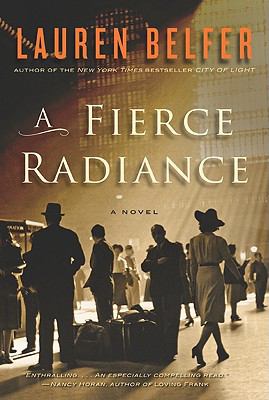
#69 - A Fierce Radiance

A Fierce Radiance, by Lauren Belfer (New York: Harper, 2010).

Jacket summary: "Claire Shipley is a single mother haunted by the death of her young daughter and by her divorce years ago. She is also an ambitious photojournalist, and in the anxious days after Pearl Harbor, the talented Life magazine reporter finds herself on top of one of the nation's most important stories. In the bustling labs of New York City's renowned Rockefeller Institute, some of the country's brightest doctors are racing to find a cure that will save the lives of thousands of wounded American soldiers and countless others -- a miraculous new drug they call penicillin. Little does Claire suspect how much the story will change her own life when the work leads to an intriguing romance.

"Though Claire has always managed to keep herself separate from the subjects she covers, this story touches her deeply, stirring memories of her daughter's sudden illness and death -- a loss that might have been prevented by this new 'miracle drug.' And there is James Stanton, the shy and brilliant physician who coordinates the institute's top secret research for the military. Drawn to this dedicated, attractive man and his work, Claire unexpectedly finds herself falling in love. But Claire isn't the only one interested in the secret development of this medicine. Her long-estranged father, Edward Rutherford, a self-made millionaire, understands just how profitable a new drug like penicillin could be. When a researcher at the institute dies under suspicious circumstances, the stakes become starkly clear: a murder has been committed to obtain these lucrative new drugs. With lives and a new love hanging in the balance, Claire will put herself at the center of danger to find a killer -- no matter what price she may have to pay."


Opening line: "Claire Shipley was no doctor, but even she could see that the man on the stretcher was dying."


My take: What do you say about a book that's part historical fiction, part mystery/ suspense, and part medical drama, with the obligatory bit of romance mixed in? Well, in the case of A Fierce Radiance, I'd say it's surprisingly good. You'd think, from the jacket flap, that the plot would either get impossibly complicated or implausibly cheesy, but it actually doesn't. A hard-core mystery or medical thriller it's not, but Belfer does an admirable job of blending the varied elements of the story without making the reader want to skip over one section or the other. No mean task, that.

It's not spoiling too much to say that yes, the man on the stretcher in Act I does, indeed, die. After a minor scrape on the tennis court gets infected, he arrives at the Rockefeller Institute in grave condition. Claire, a Life photojournalist who excels in blending into her surroundings to capture the story, has been sent to document penicillin's emergence as a miracle drug -- just in time to treat the countless injuries our soldiers will incur in World War II, which the U.S. has just entered the week the novel opens. With no other avenues left to treat Mr. Reese, his wife agrees to subject him to the first human penicillin trials. His recovery is nothing short of miraculous.

There's a catch, of course. While scientists have known about penicillin since the 1920s, its mass production continues to elude them. The Institute has only what they can grow in milk bottles and bedpans, and supplies are limited. Having never tried penicillin on humans before, dosage levels and frequency take some guesswork. A short few days later, Reese relapses, and dies before more penicillin is available.

His story and those of the researchers involved set the stage for the bulk of the novel. The military is sure to need as much penicillin as they can produce; civilians are bound to want it when word gets out; and yet there's no viable way to produce it on a large, commercial scale -- even though a Navy-led team of scientists from all the major pharmaceutical companies is throwing everything they have at the problem. Or are they? While the government's pre-emptively barred them from patenting anything to do with penicillin, there are sure to be other mold-based medicines out there, and all the drug companies have already realized that identifying and patenting them is where the real money lies. Needless to say, they're none too eager to share their progress in this area; patriotic duty, after all, only goes so far.

Furious when Life kills her penicillin story (Reese's death makes it too depressing for wartime), increasingly drawn to chief Rockefeller penicillin researcher James Stanton, and desperate not to be sent overseas on assignment, Claire pitches a new project to publisher Henry Luce: let her document the nascent penicillin production process, and don't publish it until the magazine and the country are ready. The formidable Luce agrees. Things get complicated in a hurry, however, when Claire is assigned a second job, working for the federal government: use the knowledge she gains to keep tabs on the pharmaceutical companies, and make sure they aren't holding anything back. A researcher who's just started to see promising results from a penicillin alternative ends up dead; was it suicide, accident, or murder? And Claire's father, the inventor/ tycoon she's just recently begun to know after a decades-long estrangement, has just bought a pharmaceutical company, and is turning up in the oddest places.

While A Fierce Radiance is certainly a page turner, it's the supporting details that really set it apart. Belfer succeeds brilliantly in capturing the texture of everyday Americans' lives in the early days of WWII: the constant fear that the nightly bombings of London would come to New York and Washington, the potentially devastating consequences of illness and injury in the pre-antibiotic age, the lingering aftermath of the Great Depression. While Claire herself has a bit of Mary Sue about her, the bulk of the characters are complex and believable; I especially appreciated how the author portrayed Rutherford, Claire's father, in this regard.

If anything, the romance is the weakest part of the story. It's not that I object to a love story that starts out with an intense physical attraction; heck, it happens all the time. But because it is so common, it's hard to write about it in a way that feels fresh or non-cliched. Fortunately, the somewhat-trite beginning is largely redeemed as the story progresses, Claire and Jamie are kept apart by their respective wartime assignments, and ... well, life happens.

All in all, an engaging read, and an interesting twist on the World War II novel. If you like historical fiction and/or medical thrillers, you'll probably like this one.

Tuesday, July 6, 2010

#52 - Day After Night

Day After Night, by Anita Diamant (New York: Scribner, 2009).

Jacket summary: "Just as she gave voice to the silent women of the Old Testament in The Red Tent, Anita Diamant creates a cast of breathtakingly vivid characters -- young women who escaped to Israel from Nazi Europe -- in this intensely dramatic novel.

"Day After Night is based on the extraordinary true story of the October 1945 rescue of more than two hundred prisoners from the Atlit internment camp, a prison for 'illegal' immigrants run by the British military near the Mediterranean coast south of Haifa. The story is told through the eyes of four young women at the camp with profoundly different stories. All of them survived the Holocaust: Shayndel, a Polish Zionist; Leonie, a Parisian beauty; Tedi, a hidden Dutch Jew; and Zorah, a concentration camp survivor. Haunted by unspeakable memories and losses, afraid to begin to hope, Shayndel, Leonie, Tedi, and Zorah find salvation in the bonds of friendship and shared experience even as they confront the challenge of re-creating themselves in a strange new country.

"This is an unforgettable story of tragedy and redemption, a novel that reimagines a moment in history with such stunning eloquence that we are haunted and moved by every devastating detail. Day After Night is a triumphant work of fiction."


Opening lines: "The nightmares made their rounds hours ago. The tossing and whimpering are over."

My take: There will never be another Red Tent, but Diamant is still a darned fine writer, and I give her credit for taking a new approach to Holocaust fiction. There are many books out there that look at victims' and survivors' experiences during the war, but far fewer that ask what it meant to have survived, and what happened next.

Here, the characters are alive, but not yet free. Rather, they're stuck for who knows how long in the Atlit internment camp, technically in Israel but not really -- at least, not yet. Technically, they're in the British mandate of Palestine, almost 3 years before Israel proclaimed its independence, and have already learned before the story opens that despite all they've survived up until this point, the Brits still consider them illegal immigrants -- hence, the camp. If that's not enough, each woman struggles quietly with her own demons. Shayndel, hailed as a war hero for her role in the Polish Zionist movement, can't accept others' praise when she's convinced it's her slowness that got her two best friends killed. Her dearest friend Leonie is terrified that someone will learn the truth about her life in Paris, and that she'll be shunned if this happens. Blonde, blue-eyed Tedi, raised by an uncle who never mentioned her religion except to disparage it, struggles to learn the language and practices of Judaism for the first time. And Zorah, who survived the camps by walling herself off from everyone else, finds her stoic isolation put to the test by two unlikely intruders: camp guard Meyer, whose conversation proves almost as stimulating as his cigarettes, and Esther and Jacob, a newly-arrived mother and child with a secret of their own and a desperate need for Zorah's gift with languages.

As the jacket suggests, the women (and many others) do ultimately leave Atlit, and begin in earnest their post-war lives. I closed the back cover wishing I knew more than the brief epilogue tells us, which I guess is a sign of a good novel.

Monday, April 5, 2010

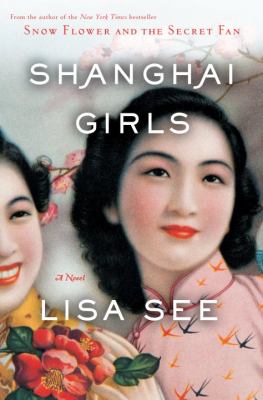
#27 - Shanghai Girls

Lisa See's Shanghai Girls (New York: Random House, 2009) was another pleasant surprise. I'd read Peony in Love, by the same author, and was pretty underwhelmed; maybe it's that I just can't get excited about a story where the main character is a ghost.

Summary: "In 1937, Shanghai is the Paris of Asia, full of great wealth and glamour, home to millionaires and beggars, gangsters and gamblers, patriots and revolutionaries, artists and warlords. Twenty-one-year-old Pearl Chin and her younger sister May are having the time of their lives, thanks to the financial security and material comforts provided by their father’s prosperous rickshaw business. Though both wave off authority and traditions, they couldn’t be more different. Pearl is a Dragon sign, strong and stubborn, while May is a true Sheep, adorable and placid. Both are beautiful, modern, and living the carefree life ... until the day their father tells them that he has gambled away their wealth, and that in order to repay his debts he must sell the girls as wives to suitors who have traveled from Los Angeles to find Chinese brides.

As Japanese bombs fall on their beloved city, Pearl and May set out on the journey of a lifetime, one that will take them through the villages of south China, in and out of the clutch of brutal soldiers, and across the Pacific to the foreign shores of America. In Los Angeles, they begin a fresh chapter, trying to find love with their stranger husbands, brushing against the seduction of Hollywood, and striving to embrace American life, even as they fight against discrimination, brave Communist witch hunts, and find themselves hemmed in by Chinatown’s old ways and rules.

At its heart, Shanghai Girls is a story of sisters: Pearl and May are inseparable best friends, who share hopes, dreams, and a deep connection. But like sisters everywhere, they also harbor petty jealousies and rivalries. They love each other but they also know exactly where to drive the knife to hurt the other sister the most. Along the way there are terrible sacrifices, impossible choices and one devastating, life-changing secret, but through it all the two heroines of this astounding new novel by Lisa See hold fast to who they are – Shanghai girls."

Opening line: "'Our daughter looks like a South China peasant with those red cheeks,' my father complains, pointedly ignoring the soup before him."

My take: Yes, Shanghai Girls is both a sweeping family story and an immigrant's tale ... but these descriptions alone don't do it justice. The characters are complex and believable; the plot compelling with just the right amount of surprise (neither predictable nor preposterous). As the above summary suggests, the story opens in 1937 Shanghai, where narrator Pearl and her less clever, more charming younger sister May are livin' la vida loca, garnering just the right amount of fame and fortune by modeling for the "beautiful girls" calendars that are ubiquitous to Shanghai advertising.

No sooner, however, have we gotten a taste of the girls' world than it starts to crumble, and ultimately shatters. Initially, Pearl and May defy their father's order to settle his debts by marrying the sons of a wealthy businessman, but then the full story emerges: Baba's creditor is a notoriously brutal gangster, and until he is paid, no one in the family is safe. The sisters have no other choice but to go through with the wedding, spending but a single night with their new husbands before the brothers depart for L.A. To their grave embarrassment, their new father-in-law publicly inspects their bedding in the morning, revealing that while Pearl and Sam have consummated their marriage, May and the childlike Vern have not.

As Sam, Vern, and their parents depart, Pearl and May promise to sail for America in 2 weeks to join them, but have no real plans to do so. That is, until the Japanese army invades Shanghai. Unable to find Baba, the girls and their mother try to trade in their tickets and flee to Hong Kong, but by now, they are but three among countless refugees. They end up hiring a wheelbarrow puller to carry their foot-bound mother as far as he can, stopping at the odd farmhouse along the way for food and rest, until ultimately, the soldiers catch up with them. Mama's attempt to protect her daughters, and later, Pearl's effort to save both Mama and May, have grave, life-altering consequences for all three of them.

All in all, an outstanding story, with a not-too-tidy ending (a plus, in my book). Highly recommended.

Thursday, October 29, 2009

113 - Hotel on the Corner ...

Odd. I just blogged about Home Safe, wanted to say, "Well, it's not a moving, stay-with-you kind of novel like ___" ... and couldn't find a novel I'd read recently to fill in the blank. Well, now I've found one.

Hotel on the Corner of Bitter and Sweet, by Jamie Ford (Ballantine, 2009) was excellent, memorable, and gently moving. Set in Seattle, it's actually two stories: one set in 1986, and one in during World War II. They're connected by the main character, Henry Lee, who's a pre-teen boy in the 1940s, and a widower in his 50s in the more recent chapters. Like Helen Ames in Home Safe, Henry has just lost his spouse of many years, but unlike Helen's, his loss was a long time coming.
"He missed his wife, Ethel. She'd been gone six months now. But he didn't miss her as much as you'd think, as bad as that might sound. It was more like quiet relief really. Her health had been bad -- no, worse than bad. The cancer in her bones had been downright crippling, to both of us, he thought.

"For the last seven years Henry had fed her, bathed her, helped her to the bathroom when she needed to go, and back again when she was all through. He took care of her night and day, 24/7 as they say these days. Marty, his son, thought his mother should have been put in a home, but Henry would have none of it. 'Not in my lifetime,' Henry said, resisting. ... He'd been raised to care for loved ones, personally, and to put someone in a home was unacceptable. What his son, Marty, never fully understood was that deep down there was an Ethel-shaped hold in Henry's life, and without her, all he felt was the draft of loneliness, cold and sharp, the years slipping away like blood from a wound that never heals."
In his bereaved first-chapter wanderings, he encounters a to-do at the Panama Hotel, a long-defunct local landmark. It seems a new owner has just purchased the hotel, and as she explains to news crews and onlookers, "in the basement she had discovered the belongings of thirty-seven Japanese families who she presumed had been persecuted and taken away. Their belongings had been hidden and never recovered -- a time capsule from the war years."

This discovery, and the bamboo parasol the new owner opens to illustrate her find, takes Henry back to his own childhood, when the Panama Hotel stood on the boundary between Chinatown and the Japanese neighborhood of Nihonmachi. His vehemently nationalist father, eager to distinguish his son from China's and the U.S.'s shared Japanese enemies, makes him wear a pin on his school shirt that proclaims "I Am Chinese," but the distinction is lost on his peers. The neighborhood kids call him baak gwai ("white devil") because he attends an all-white school, while his schoolmates call him Tojo, Jap, and yellow.

Henry is further set apart by having to work in the cafeteria at lunchtime -- a requirement for his scholarship. This isn't all bad, though, as it's how he meets his two closest friends: Sheldon, a black streetcorner sax player who happily accepts Henry's brown-bagged lunch (Mrs. Beatty, the lunch lady, lets him eat cafeteria leftovers), and Keiko, a sansei Japanese-American whose insistence that she's American first goes over about as well with the Rainier Elementary bullies as does Henry's "I Am Chinese" button. Henry and Keiko gradually become friends, although he's careful to keep this fact from his father. "His father wouldn't allow it. He was a Chinese nationalist and had been quite a firebrand in his day. ... Henry's father kept busy raising thousands of dollars to fight the Japanese back home."

Henry and Keiko also discover a shared love of jazz, and over a trip to the Black Elks Club to hear Sheldon play with local jazz legend Oscar Holden, they begin to fall in love, in that poignant, familiar way of early adolescence. The evening takes a frightening turn, however, when the club is raided by the FBI, and a handful of Japanese patrons handcuffed and taken away. "'Collaborators, kid. Secretary of the Navy says there were Jap scouts working in Hawaii -- all of them locals. That ain't happening around here. ... They can get the death penalty if they're found guilty of treason, but they'll probably just spend a few years in a nice safe jail cell.'" (Never mind that at least one of those captured is an innocent schoolteacher.)

In the coming months, the situation grows still more dire for the residents of Nihonmachi. Panicked neighbors burn wedding dresses, photos, and other family heirlooms, eager to destroy any evidence that might connect them to Japan. Henry stands up to not only his local schoolyard bully, but his own father in his determination to protect Keiko's family's things. It's not enough, though; ultimately, the Okabes are rounded up along with all the other Japanese-Americans, and sent off to interment at the ill-named Camp Harmony. Heartbroken but determined, Henry manages to visit (with some unexpected help from Mrs. Beatty), and even gets Mr. Okabe's permission to court Keiko.

Parallel to Henry and Keiko's story is the more subtle, but nonetheless touching, account of the middle-aged Henry's life: his efforts to find Keiko's things among the basement stash at the Panama Hotel, his tentative relationship with Marty, and how that relationship evolves when Marty comes clean about his own forbidden love: his Caucasian fiancee, Samantha.

I've read plenty of World War II novels, and some of my favorites are set mostly on the home front; Marge Piercy's Gone to Soldiers is a prime example. I haven't come across many that tackle the Japanese interment camps in the U.S., though -- and as I'm always a sucker for immigrant stories about what it means to be of two different cultures (and not belong fully to either), this made for a good backdrop. Hotel on the Corner just may make my faves of the year list.

Sunday, September 13, 2009

#87 - Fault Lines

I'm really on a roll here, both in terms of how many books I've cranked through these last few weeks and how good they've ended up being. (The two are not unrelated; the more interesting the story, the more likely I am to sit down and read and neglect everything else until I finish.) Last night's notch in the literary belt was Nancy Huston's Fault Lines (Black Cat, 2006).

Nazi Germany isn't exactly a novel setting for historical fiction, even when it's a multi-generational novel like this one. It's difficult for a book to offer a new spin on this theme, but Huston succeeds, with a tale narrated in the first person by four successive generations of one family. The book opens in California in 2004 with 6 year old Sol, who the jacket aptly describes as "a gifted, terrifying child whose mother believes he is destined for greatness."
"I'm awake.
Like flicking on a switch and flooding a room with light.
Snapping out of sleep, clicking into wakefulness, a perfectly functioning mind and body, six years old and a genius, first thought every morning when I wake up. ...
A sunny Sunday sun sun sun sun king Sol Solly Solomon
I'm like sunlight, all-powerful, instantaneous and invisible, flowing effortlessly into the darkest corners of the universe

capable at six of seeing illuminating understanding everything"
Make no mistake, though; little Sol is not one of those cute, bright little tykes. Nor is he just a spoiled, arrogant little prince of a boy (though he is that, too). This is a kid with a horrifying fascination with the Iraq war -- specifically, with the photos of mutilated corpses and Abu Ghraib prisoners he Googles compulsively, and finds precociously arousing. (Interesting that his stay-at-home mom Tessa, who prides herself on how well childproofed their home is -- "all the electrical outlets are covered ... There are soft plastic rounded covers added to every right-angle table and counter ... Also the burners to the stove have a special blocking mechanism ... Even the toilet is childproofed" -- has failed to notice this interest.) Father Randall occasionally makes a half-hearted effort to tone down Tessa's coddling, but has a two-hour commute to his job building warrior robots for the military-industrial complex, and seems disengaged even when he's technically present. Over his objections, Tessa schedules a surgery to remove the birthmark Randall, his grandmother, and Sol all share; in Sol's case, it's on his left temple.

Even Sol's omniscience, however, has its limits, which emerge when Randall's work takes him to Munich. By sheer force of will, his mother Sadie turns the trip into a four-generation odyssey -- Sol, Randall and Tessa, Sadie herself, and Sadie's mother G.G., nee Erra (or is she?) -- to visit G.G.'s sister Greta, who is reportedly dying.

His portion of the story ends on an ambiguous note in Munich, and we rewind to Randall's boyhood in New York City in the early 1980s. His home life is very different from Sol's; father Aron is a not-very-successful playwright and his primary caregiver, while it's Sadie who's the driven breadwinner, a teacher and historian specializing in the Aryanization of Europe during WWII. Her research takes the family from Manhattan to Haifa, where Randall becomes a whiz at Hebrew (at least, until an innocent language question prompts his tutor to quit in disgust), and gains a different perspective on Israel's history through a friendship of sorts with a Palestinian classmate.

From here, we go back still further to Toronto, circa 1962, where the lumpen young Sadie is fostered with her grandparents while single mother G.G./ Erra/ Kristina (as she is called here) leads the marginal, bohemian life of a not-yet-successful singer. The elder Kriswatys are cold and Spartan, and Sadie longs for the day when her mother will spirit her off to New York for good. The day eventually comes, but not without its share of surprises and questions.

Finally, we arrive in 1944 Munich, where 6 year old Kristina lives a mostly-unremarkable life with her parents and older siblings, Lothar and Greta, until, in a squabble over a favorite doll, Greta blurts out a shocking accusation. She apologizes and takes it back the next day, but still Kristina wonders -- especially when, a few months after Lothar is killed on the Russian front, their parents bring 10 year old Johann home, claiming that he's a war orphan in need of a new home. Johann, however, tells a different story.

All in all, this is a fascinating book. I loved the metaphor of the birthmark all four of the narrators share (though Sadie's is hidden and, she's always thought, hugely shameful). The ideas about how our families and our history shape who we are are excellent fodder for rumination (one of my favorite pastimes, in case that's not yet obvious). Huston also introduced an aspect of the war I wasn't previously familiar with, though this is an integral part of the story, and I don't want to spoil the surprise by mentioning it. Definitely one to read; if you can force yourself to keep going even when Sol's portion makes you squirm, it will be worth your while.