About Me

Ithaca, New York
MWF, now officially 42, loves long walks on the beach and laughing with friends ... oh, wait. By day, I'm a mid-level university administrator reluctant to be more specific on a public forum. Nights and weekends, though, I'm a homebody with strong nerdist leanings. I'm never happier than when I'm chatting around the fire, playing board games, cooking up some pasta, and/or road-tripping with my family and friends. I studied psychology and then labor economics in school, and I work in higher education. From time to time I get smug, obsessive, or just plain boring about some combination of these topics, especially when inequality, parenting, or consumer culture are involved. You have been warned.
Showing posts with label men. Show all posts

Wednesday, October 17, 2012

#89: I Thought You Were Dead

I Thought You Were Dead, by Peter Nelson 
(Chapel Hill, NC: Algonquin Books of Chapel Hill, 2010)
 Summary:
 "For Paul Gustavson, a hack writer for the wildly popular For Morons series, life is a succession of obstacles, a minefield of mistakes to stumble through. His wife has left him, his father has suffered a debilitating stroke, his girlfriend is dating another man, he has impotency issues, and his overachieving brother has invested his parents' money in stocks that tanked. Still, Paul has his friends at Bay State bar, a steady line of cocktails, a new pair of running shoes, and Stella. Beautiful Stella. With long, sleek legs, kind eyes, lustrous blond hair. Their relationship is the one true bright spot in his world. She offers him sage advice on virtually every topic. And she only wets herself every once in a while.

"Stella is Paul's dog, and she listens with compassion to all his complaints about the injustices of life and gives him better counsel than any human could. In fact, she seems to know Paul better than he knows himself. It's their relationship that is at the heart of I Thought You Were Dead, a poignantly funny and deeply moving story about a man trying to fix his past in order to save his future, and about a dog who understands just what it means to be a man's best friend."

Opening Line:
"In the winter of 1998, at the close of the twentieth century, in a small college town on the Connecticut River, on the sidewalk outside a house close enough to the railroad tracks that the pictures on the walls were in constant need of straightening, not that anybody ever straightened them, Paul Gustavson, having had a bit too much to drink, took the glove off his right hand, wedged it into his left armpit, and fumbled in his pants pocket for his house keys."

My Take:
Surprising. I wouldn't have expected to enjoy a novel that opens with a run-on sentence like this, or one where the protagonist's talking dog is an important character -- but this is a sweet, gentle story about a lonely man at a crossroads trying to come to terms and move forward with his imperfect life. (And the talking dog works, even for a diehard realist like me, if you read it as Paul simply talking to his dog while they're alone, and imagining what she might say if she could indeed respond. Don't all pet owners do this?) Paul's relationship with his struggling father, which evolves primarily over the internet, is especially poignant. His ill-defined relationship with Tamsen is an interesting plot line as well, though I wasn't as satisfied with the way Nelson resolved this one.

Tuesday, March 20, 2012

#20: Heft

Heft, by Liz Moore (New York: W.W. Norton, 2012)

Summary:
"Former academic Arthur Opp weighs 550 pounds and hasn't left his rambling Brooklyn home in a decade. Twenty miles away, in Yonkers, seventeen-year-old Kel Keller navigates life as the poor kid in a rich school and pins his hopes on what seems like a promising baseball career -- if he can untangle himself from his family drama. The link between this unlikely pair is Kel's mother, Charlene, a former student of Arthur's. After nearly two decades of silence, it is Charlene's unexpected phone call to Arthur -- a plea for help -- that jostles them into action. Through Arthur and Kel's own quirky and lovable voices, Heft tells the winning story of two improbable heroes whose sudden connection transforms both their lives. Like Elizabeth McCracken's The Giant's House, Heft is a novel about love and family found in the most unexpected places."

Opening Line:
"The first thing you must know about me is that I am colossally fat."

My Take:
A fairly quick read -- think I polished it off in a day, give or take -- but with a much bigger impact than I'd expected. Very engaging characters; one Washington Post review calls them "quirky" but that almost trivializes how perfectly, painfully human Arthur, Kel, and Charlene become. Don't miss this one. So far, up there with The Namesake among my favorites of the year.

Wednesday, February 29, 2012

#14: The Lost Saints of Tennessee

The Lost Saints of Tennessee, by Amy Franklin-Willis (New York: Atlantic Monthly, 2012)

Summary:
"With enormous heart and dazzling agility, debut novelist Amy Franklin-Willis expertly mines the fault lines in one Southern working-class family. Driven by the soulful and intrepid voices of forty-two-year-old Ezekiel Cooper and his mother, Lillian, The Lost Souls of Tennessee journeys from the 1940s to the 1980s as it follows Zeke's evolution from anointed son to honorable sibling to unhinged middle-aged man.

"After Zeke loses his twin brother in a mysterious drowning and his wife to divorce, only ghosts remain in his hometown of Clayton, Tennessee. Zeke makes the decision to leave Clayton in a final attempt to escape his pain, puts his two treasured possessions -- a childhood copy of The Adventures of Huckleberry Finn and Tucker, his dead brother's ancient dog -- into his truck, and heads east. He leaves behind two adolescent daughters and his estranged mother, who reveals her own conflicting view of the Cooper family story in a vulnerable but spirited voice stricken by guilt over old sins as she clings to the hope that her family isn't beyond repair.

"When Zeke finds refuge with his sympathetic cousins in Virginia horse country, divine acts in the form of severe weather, illness, and a new romance collide, leading Zeke to a crossroads where he must decide the fate of his family -- either by clinging to the way life was or moving toward what life might be."


Opening Line:
"The late August air lies still, its weight pressing down on me in a way it didn't when I was a boy."

My Take:
Not high literature for the ages, possibly not even book club material (I wish I knew, but never have stumbled on a book club that was looking for new members) -- but a lovely, gentle story about a man confronting that all-too-familiar midlife question, "Is this really all there is?" Long story short (really, for once), I enjoyed it.

Thursday, May 5, 2011

#32: City of Thieves

City of Thieves, by David Benioff (New York: Penguin Group, 2008)

Summary:
"Stumped by a magazine assignment to write about his own uneventful life, a man visits his retired grandparents in Florida to document their experience during the infamous siege of Leningrad. Reluctantly, his grandfather commences a story that will take him almost a week to tell: an odyssey of two young men determined to survive, against desperate odds, a mission in which cold, hunger, and the Russian authorities prove as dangerous as the invading Wehrmacht.

"Two young men meeting for the first time in a jail cell await summary execution for crimes of dubious legitimacy. At seventeen, Lev Beniov considers himself 'built for deprivation.' Small, smart, insecure about his virginity, he's terrified about the sentence that awaits him and his cellmate, the charismatic and grandiose Kolya, a handsome young soldier charged with desertion. However, instead of a bullet in the back of the head, the pair is given an outrageous assignment: In a besieged city cut off from all supplies, secure a dozen eggs for a powerful colonel to use in his daughter's wedding cake. Lev and Kolya embark on a hunt to find the impossible in five days' time, a quest that propels the from the lawless streets of Leningrad to the devastated countryside behind German lines. As they encounter murderous city dwellers, guerrilla partisans, and finally the German army itself, an unlikely bond forms between this earnest teenager and his unpredictable companion, a lothario whose maddening, and endearing, bravura will either advance their cause or get them killed.

"Hailed for his brilliantly drawn characters and incisive ability to capture the pulse of urban life, David Benioff rises to new heights in this portrait of two unforgettable young men and Soviet Russia under siege. By turns insightful and funny, thrilling and terrifying, City of Thieves takes us on a breathtaking journey into the twentieth century's darkest hour even as it celebrates the power of friendship to transform a life."


Opening Line:
"My grandfather, the knife fighter, killed two Germans before he was eighteen."

My Take:
Don't think there are many authors out there who can successfully combine a buddy movie and the seige of Leningrad between two covers, but somehow, Benioff manages. City of Thieves is an engrossing, entertaining book that manages to capture some of the humor and absurdity of war without trivializing it.

The main story opens in the Crosses, as Lev, an achingly young seventeen-year-old whose mom and sister fled the city long ago, awaits an unknown but dire fate in the dark, forebidding prison that's long been the stuff of every Leningrad child's nightmares. Enter Kolya, a handsome-and-knows-it Cossack deserter who claims he can write in the pitch dark and quotes from a great Russian novel that Lev (son of a famed poet) has never heard of. Kolya is arrogant but kind, Lev is impressed but annoyed, and whether or not they admit it, both are terrified. Not usually the stuff of lifelong friendships ... that is, until the next day, when the local colonel offers to redeem their lives if they can bring back a dozen eggs for his daughter's wedding cake within a week's time. Yes, in a city whose very name still defines the word siege.

Since both young men value their lives, they have no choice but to try. Their search begins in Leningrad proper, where they assume someone, somewhere must have eggs, and they need only the money, barter, and/or guile to get them. They crash with an old friend-with-benefits of Kolya's, narrowly escape a tribe of cannibals who do indeed have food to sell, and learn the truth behind the rumors of a crazy but armed old man who still keeps a flock of chickens on a rooftop somewhere ... but alas, no luck, and no eggs. They make a daring escape from the city, thinking the Germans must have left a farm or 2 intact somewhere, if only for their own provisions. Their instincts are correct, though it's not only the soldiers' culinary appetites the lovely young residents are satisfying -- a fact which incenses Kolya until his hosts describe, in harrowing detail, what the alternative would be and exactly how they know. Together, the young men and their hosts hatch a plan to catch the Germans with their pants down ... which is interrupted by the arrival of a band of pro-Allied guerrillas who have had some success plaguing both the German soldiers and the not-so-popular-around-here Soviet army. The guerrillas are led by Vika, a crack sniper barely Lev's age who seems to have a secret up his sleeve (among other places).

As you might expect, the young ex-cons join forces with the partisans, additional hair-raising adventures ensue, and not everyone survives till the last chapter ... though you know all along that Lev will, as he's still alive and now a grandfather in the frame story. A bit formulaic, I suppose, if I'm being honest -- but captivating and (har, har) novel enough that I didn't mind. Recommended if you enjoy World War II stories and/or tales of young men's adventures.

Monday, January 24, 2011

#10 - The Gendarme

The Gendarme, by Mark T. Mustian (New York: G.P. Putnam's Sons, 2010)

Summary: "What would you do if the love of your life, and all your memories, were lost -- only to reappear, but with such shocking revelations that you wish you had never remembered?

"Emmett Conn is an old man, near the end of his life. A World War I veteran, he's been affected by memory loss since being injured during the war. To those around him, he's simply confused, fading in and out of senility. But what they don't know is that Emmett has been beset by memories, of events he and others have denied or purposefully forgotten.

"In Emmett's dreams he's a gendarme, escorting Armenians from Turkey. A young woman among them, Araxie, captivates and enthralls him. But then the trek ends, the war separates them. He is injured. Seven decades later, as his grasp on the boundaries between past and present begins to break down, Emmett sets out on a final journey, to find Araxie and beg her forgiveness."

Opening Line: "I awake in a whispering ambulance."

My Take: A good story, but didn't quite live up to the potential it suggested at first. I'm reminded of one oft-offered criticism of the movie Julie & Julia: that Meryl Streep's performance as Julia Child was so compelling, the contemporary storyline featuring Amy Adams as the underemployed blogger seemed lacking by comparison. So it is here. By itself, the account of young Turkish Ahmet's service as a gendarme, overseeing the Armenian deportation to Syria, and then deserting the army to follow Araxie, the young Armenian woman who's somehow captivated him, is serviceable enough, albeit not completely convincing. As is almost always true of war stories involving genocide, the Turkish treatment of the Armenians was unimaginably brutal; we see this hear in Ahmet's descriptions of his comrades' behavior, and we simply don't learn enough about who he was before joining the army to know why he'd be any different. Why, then, does he become so enchanted with Araxie that he believes himself in love with her? Even more implausibly, why does Araxie seem to return his affections to some degree, when he's attempted to rape her and murdered her adoptive father in cold blood? And how, exactly, does Ahmet Khan find himself returned to the battlefield, wounded at Gallipoli, and eventually swept off by an American nurse to his new life as Emmett Conn?

Surprisingly, it's the story of 92-year-old Emmett, set in Georgia in 1990, that's far more captivating. Having lost his wife Carol (the aforementioned American nurse) to Parkinson's disease some years earlier, Emmett is alone, though daughter Violet visits often. At the novel's outset, he learns from the irrepressibly positive Dr. Wan that he's suffering from a brain tumor. Violet, Dr. Wan, and nearly everyone else in Emmett's orbit is quick to blame the tumor for the seizures and visions Emmett's been having, but in fact, Emmett is merely remembering, even reliving, his past. Violet and the doctors just assume these dreams need to stop, but Emmett needs them somehow -- desperate to remember who he was and what he did during the war, however shameful it may be, and to find out what became of Araxie. Ultimately, he is confined to a state psychiatric hospital for monitoring, but refuses medication after but one night when he realizes it suppresses his dreams.

Again, the elderly Emmett's story is well-written and gives the reader a lot to chew on, but I was left feeling like I myself was confused and drifting in and out of the story line. Perhaps this was deliberate on Mustian's part, but it seemed more like there were just plain pieces left out of the puzzle. It's the author's first novel, so I'm inclined to think maybe he just hasn't hit his stride yet. Be that as it may, I still think the book was a bit overrated. The horrors of war have been done many times before in literature; making the perpetrator an old man who now looks back with some horror on what he's done is an interesting spin, but doesn't by itself overcome the novel's shortcomings. In short, liked the book well enough, but wasn't overwhelmed.

Tuesday, October 26, 2010

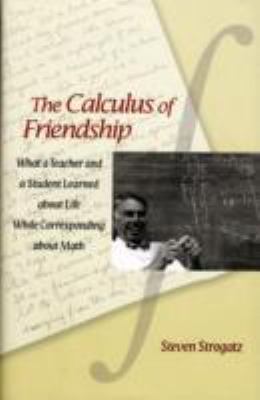
#76 - The Calculus of Friendship

The Calculus of Friendship: What a Teacher and a Student Learned about Life While Corresponding About Math, by Steven H. Strogatz (Princeton, NJ: Princeton University Press, 2009).

Summary: "The Calculus of Friendship is the story of an extraordinary connection between a teacher and a student, as chronicled through more than thirty years of letters between them. What makes their relationship unique is that it is based almost entirely on a shared love of calculus. For them, calculus is more than a branch of mathematics; it is a game they love playing together, a constant when all else is in flux. The teacher goes from the prime of his career to retirement, competes in whitewater kayaking at the international level, and loses a son. The student matures from high school math whiz to Ivy League professor, suffers the sudden death of a parent, and blunders into a marriage destined to fail. Yet through it all they take refuge in the haven of calculus -- until a day comes when calculus is no longer enough.

"Like calculus itself, The Calculus of Friendship is an exploration of change. It's about the transformation that takes place in a student's heart, as he and his teacher reverse roles, as they age, as they are buffeted by life itself. Written by a renowned teacher and communicator of mathematics, The Calculus of Friendship is warm, intimate, and deeply moving. The most inspiring ideas of calculus, differential equations, and chaos theory are explained through metaphors, images, and anecdotes in a way that all readers will find beautiful, and even poignant. Math enthusiasts, from high school students to professionals, will delight in the offbeat problems and lucid explanations in the letters. For anyone whose life has been changed by a mentor, The Calculus of Friendship will be an unforgettable journey."


Opening Lines: "Calculus thrives on continuity. At its core is the assumption that things change smoothly, that everything is only infintesimally different from what it was a moment before."

My Take: Coming to this as someone who never got calculus in high school but wishes I was in a position to tackle it anew today -- and someone who's always a sucker for a heartwarming, mentor-mentee story. Let's see ...

(Later, after finishing the book) Sigh. Guess this wasn't the book for me, or I wasn't the reader for it. If you either know calculus or are willing to spend a lot of time teaching yourself to follow the detailed, multi-page problems that form the bulk of Strogatz and Joffrey's correspondence, have at it. Sadly, I don't fall into either camp, and when you strip away the mathematical equations, there just wasn't much left. Oh well.

Wednesday, September 1, 2010

#65 - Summertime

Moving right along, #65 was Summertime, by J. M. Coetzee (New York: Viking, 2009).

Summary: "In the Nobel Laureate's latest novel, a young English writer is in pursuit of first-person testimony to write a biography of an esteemed novelist named J. M. Coetzee. The Englishman wants to focus on the years 1971-77, a period just before Coetzee's importance was recognized, a time the hopeful biographer finds oddly neglected by other biographers; he sees it as seminal because the novelist was finding his feet. From Coetzee's lover, his cousin, the mother of a pupil to whom Coetzee gave English lessons, a cohort who co-taught a college course with him, and another professional affiliate, the biographer elicits details about the man's relationships, amorous and otherwise. These personal accounts are the material from which readers draw a picture of Coetzee and upon which the writer will draw for his future composition. The Coetzee emerging here is an emotionally dessicated man never easy with intercourse of any shade, sexual or social. Assumptions on the reader's part of a parallel between the fictitious Coetzee and the actual one are best left alone, because the result can only be confusion and distraction. It is best, then, to simply see the character as just that and then to recognize the author of the admirable builder of character that he is." (-Brad Hooper, Booklist)

My take: Probably would have been more compelling if I were familiar either with Coetzee's other work or with the Afrikaans experience in South Africa, but this is nonetheless an interesting format for a story and, gradually, one through with a fascinating if less-than-likable portrait of a character emerges.

Monday, June 14, 2010

#46 - Homer & Langley

Homer and Langley, by E.L. Doctorow (New York: Random House, 2009).

Jacket summary: "Homer and Langley Collyer are brothers -- the one blind and deeply intuitive, the other damaged into madness, or perhaps greatness, by mustard gas in the Great War. They live as recluses in their once grand Fifth Avenue mansion, scavenging the city streets for things they think they can use, hoarding the daily newspapers as research for Langley's proposed dateless newspaper whose reportage will be as prophecy. Yet the epic events of the century play out in the lives of the two brothers -- wars, political movements, technological advances -- and even though they want nothing more than to shut out the world, history seems to pass through their cluttered house in the persons of immigrants, prostitutes, society women, government agents, gangsters, jazz musicians ... and their household lives are fraught with odyssean peril as they struggle to survive and create meaning for themselves."

Opening line: "I'm Homer, the blind brother."

My take: Didn't know quite what to expect here, but this was an interesting book. Loosely based on the famous if bizarre lives of the real Collyer brothers (no, I'd not heard of them either, but they died in the 1940s), it follows 2 Fifth Avenue recluses from their childhood and youth (long-haired pianist Homer goes blind; Langley goes off to fight the Great War and comes back ... different) in the 1910s, through their brushes with the Jazz Age (their long-time cook's grandson becomes a jazz horn player of some renown before moving South to wed and ultimately dying in WWII), Great Depression, and mid-20th century gangsters, and eventually providing a temporary crash pad for a tribe of hippies in the 1960s. Aside from the historical background, not much actually happens to the brothers -- largely, they become increasingly withdrawn and reclusive while the outside world transforms itself -- and normally, this bothers me in a story. Not here, though; the characters and their/ Doctorow's observations on 20th century history and progress make for compelling reading even without an action-packed plot. As was my experience with Ragtime, I find Doctorow a bit slow going in places, but I always feel richer for having read it. Homer and Langley is no exception.

Wednesday, March 10, 2010

#16 - All the Sad Young Literary Men

This one was better. Not perfect, but better. All the Sad Young Literary Men, by Keith Gessen (New York, 2008).

Summary: "A charming yet scathing portrait of young adulthood at the opening of the twenty-first century, All the Sad Young Literary Men charts the lives of Sam, Mark, and Keith as they overthink their college years, underthink their love lives, and struggle through the encouragement of the women who love and despise them to find a semblance of maturity, responsibility, and even literary fame. Heartbroken in his university town, Mark tries to focus his attention on his graduate work on the Russian Revolution, only to be lured again and again to the free pornography on the library computers. Sam binds himself to the task of crafting 'the first great Zionist epic' even though he speaks no Hebrew, has never visited Israel, and is not a practicing Jew. Keith, more earnest and easily upset than the other two, is haunted by catastrophes both public and private -- and his inability to tell the difference. At every turn, at each character's misstep, All the Sad Young Literary Men radiates with comedic warmth and biting honesty and signals the arrival of a brave and trenchant new writer."

My take (really, a pretty quick one this time): Annoying characters, but I still mostly liked it -- chiefly because I think Gessen knows they're annoying, and wants us to laugh and roll our eyes at them. (Actually, Keith, from what we see of him, is fairly sympathetic; Sam and Mark, not so much.) Beautiful downtown Syracuse, NY makes a less-than-flattering cameo, as Mark's temporary Elba for most of his graduate hears (he's in a doctoral program at SU), and while it's not my favorite city, either, I initially got my feathers riled about yet another Downstater thinking there's nothing north of Westchester save depressed downtowns and toothless rednecks ... but, um, Gessen was a student at Syracuse himself at one point, so I guess he's got cred.

Anyway, digression aside, it was sometimes hard to keep Mark's and Sam's plot lines (and occasionally, love interests) separate, but again ... I'm going to assume that was deliberate. I don't know that it's a great book, or that it'll be worth reading in 10 or 20 years, but if you're familiar with the "obscure humanities scholar" type or even academic/ intellectual pretensions in general, you'll probably get a few chuckles out of AtSYLM. Best to read it once you're well past, and not still in the thick of, your angst-ridden early 20s, though.

Saturday, August 29, 2009

#75 - Indignation

I'll have you know I broke a personal vow for this one. While I loved American Pastoral and, um, had tremendous respect and appreciation for Sabbath's Theater (translation: the main character was disgusting, but the book so compelling and alive that I couldn't help turning page after page and finding it brilliant), the last few of Philip Roth's books I've read -- The Human Stain, Exit Ghost, The Dying Animal -- have seemed so repetitious, and I'm not a fan of the hackneyed old older-man-rediscovers-passion-with-beautiful-young-thing story line to begin with, that I promised myself I was done with Roth for a while.

Well, then came Indignation (Houghton Mifflin, 2008). The narrator's in his early 20s, so I knew from that alone that Roth would have had to find a new subject to write about. He did, and while Indignation is no American Pastoral, I was favorably impressed. The protagonist, Marcus Messner, is the 19 year old son of a Kosher butcher in Newark in the early 1950s. After learning the business inside-out from his father, and graduating at the top of his high school class, he enrolls at the tiny local Robert Treat College, and is utterly in his element, among working-class strivers of all ethnic stripes, and studying under fiery, radical professors from across the river in NYC. Unfortunately, his father becomes increasingly obsessed with the possibility that some grevious harm will come to Marcus, and that a single false step or careless choice will be his downfall. Nathan's need to monitor and question Marcus' every move leads the latter to transfer to the conservative, ultra-traditional Winesburg College in Ohio ... where his determination to maintain straight As and avoid being drafted and sent to Korea buts up against roommates from hell, a maddening chapel requirement, an overly solicitous Jewish fraternity leader and BMOC, and a beautiful, insatiable young rich girl with a dark secret of her own.

The book's deceptively short, but a good read nonetheless, alternately funny and excruciating. The ending packs a wallop along the lines of Chris Bohjalian's The Double Bind; honestly, I gasped when I read it. A fascinating if sobering coming-of-age novel, which drives home the notion that simple, seemingly inconsequential decisions can have grave repercussions.

Monday, February 23, 2009

#20 - Tsotsi

Sorry, no clever title for this one, either -- Tsotsi, by Athol Fugard, is the kind of sock-you-in-the-gut book for which it's hard to find words. Set in apartheid-era Sophiatown, a black township on the outskirts of Johannesburg, it takes its name from the protagonist: a nihlistic gangster whose name means only "gangster" or "thug." Make no mistake, this is not a heartwarming, scrappy tough guy with a heart of gold kind of book. This is made abundantly clear in the second chapter, when Tsotsi and his gang murder a man on a crowded train with surgical precision in order to steal his pay packet. As another review aptly puts it, Tsotsi is completely primal; he has no given name, no memory of his past, and no aspirations beyond day-to-day survival:

"To know nothing about yourself is to be constantly in danger of nothingness, those voids of non-being over which a man walks the tightrope of his life. Tsotsi feared nothingness. He feared it because he believed in it. Even more than that, he knew with all the certainty of his being that behind the facade of life lurked nothing. Under men's prayers he heard the deep silence of it; behind man's beauty he had seen it faceless and waiting; inside man himself, beyond the lights of his loves and his hopes, there too was nothing, a darkness like an enormous unending night that closed in when the fires burned low and out, leavingonly ash as an epitaph to their passing warmth. The problem of his life was to maintain himself, to affirm his existence in the face of this nullity. He achieved this through pain and fear, and through death. He knew no other way."

This dark sameness begins to change when Tsotsi assaults a woman who, in her panic, thrusts a shoebox into his hands before running off into the night. In the box is a baby boy. With his fumbling efforts to care for the infant -- asking a terrified shopkeeper for "baby milk," forcing a young mother to feed the baby at knifepoint -- flickers of his own past come back to him, and he becomes desperate to remember more.

One critique suggests that it's clear Fugard is primarily a playwright and not a novelist. Both scenes and characters are described in broad strokes, leaving the reader to fill in the details for him- or herself with only a few key props to go on. While I found this satisfying in terms of the setting, I did wish for a little more depth to some of the characters: Boston, the clever but cowardly gang member who dares to break Tsotsi's rule about personal questions; the crippled beggar Tsotsi opts not to rob; Miriam, who in the wake of her husband's disappearance, finds renewed purpose in nursing baby David. Nowhere is this more true than for Tsotsi himself. Once he decides to buy milk and feed the baby, his transformation is gradual and believable. It's not an overwhelming surge of love for this helpless creature in his arms, but isolated smells and images that evoke something just outside his reach. What's not clear, though, is why he takes the baby home in the first place; certainly, it would be much more in character for the man we've seen up until that point to kill or abandon the child, shoebox and all, minutes after it's handed to him.

As I said initially, it's difficult to pick a theme or construct a summary to end on; I think this will be one to read through at least once more before it fully sinks in. The imagery is both bleak and beautiful, and it's certainly a book you appreciate rather than enjoy. 4 out of 5 bookmarks.

Saturday, January 24, 2009

2 at one blow!

Wow, it's been a while -- polished off 2 books today. Yep, finished one I'd been working on most of the week, and started and finished another. Who says I don't still have it?
  • 7. The English Major, by Jim Harrison. Gentle, lyrical novel about aging, change, and contemporary America -- at least that's what I think it's about. (Half the reason I waited so long to start a book blog is that I'm afraid I Just Won't Get what Good Books are supposed to be about ... I'll miss the point, reveal myself to be hopelessly lowbrow, and so on. Horrors.) Anyway, I really liked this one, although the subject matter would usually bore and annoy me. Interesting to read it right on the heels of Keillor's Liberty, as the two have a good deal in common. The English Major is the first-person story of Cliff, a 60-year-old Michigan farmer and former schoolteacher who, after his wife divorces him for an old high school flame and takes most of their assets, sets off on a mission to drive through all 50 U.S. states, renaming the state birds and discarding the pieces of an old U.S. jigsaw puzzle as he goes. Along the way, he crosses paths with an insatiable, free-spirited 40-something former student; an old friend who's become a snake farmer in AZ; and his movie-industry bigwig son. Yes, it's a road novel, and from this brief synopsis, it may sound like it should be a comedy, but it's not, really. The voice and protagonist feel very much like something out of Lake Wobegon, though less over-the-top and somewhat less meandering (which is not to say they don't meander at all) ... but while Liberty is about a man's search for freedom, passion, etc. in a world that's changed little over the years, The English Major is about a man's search for self and meaning in a world where nothing's stayed the same. Read it not for the plot, but for the language and characterization and musings on life and love. 4 out of 5 bookmarks.
  • 8. Blonde Roots, by Bernardine Evaristo. Fresh, compelling novel of slavery, with a twist. The twist -- I'm not giving anything away here, as it's written on the back-cover blurb and in the New York Times review that first brought the book to my attention -- is that black Africans are the masters, and Europeans their slaves. The novel is the story of Doris, daughter of an English serf who's kidnapped and sold into slavery. While the black masters-white slaves universe gives rise to a number of pointed but funny reversals -- for example, "Aphrika" is known as the sunny continent, while "Europa" is known as the grey continent, and slave women who want to make themselves attractive to the masters rub ochre into their skins so as to appear darker -- they're subtle, and scattered here and there, rather than in your face on every page. This isn't just another slavery novel with a gimmick; it would be provocative and compelling and sad even without the twist. Well worth reading. 4 out of 5 bookmarks.
Next up (probably; I just hit the public library today, so I've got quite a selection): The School on Heart's Content Road, by Carolyn Chute.